


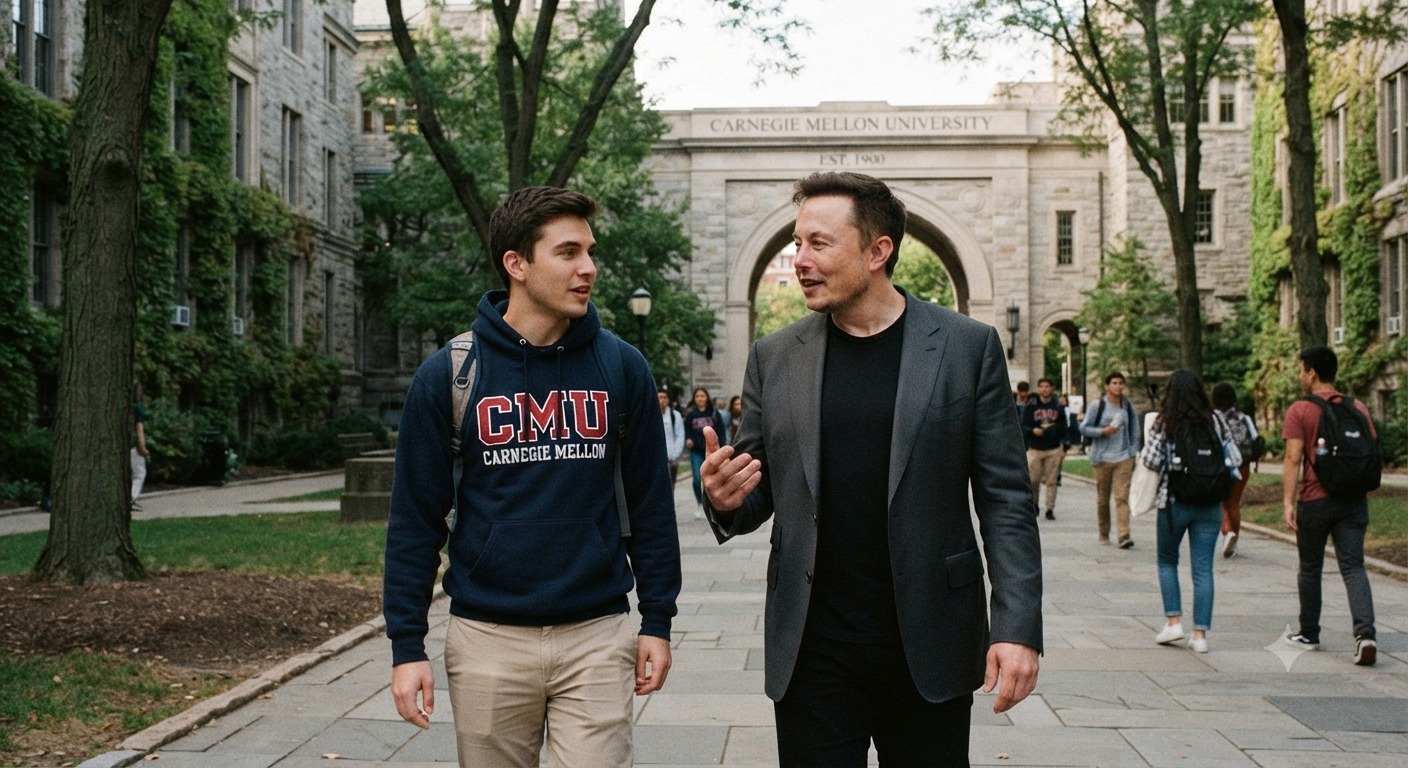
The search phrase Elon Musk son CMU surged after Elon Musk said at an October 2024 town hall in the Pittsburgh area that one of his sons would be attending college there the following fall. The remark sounded clear, but it left one important detail unanswered: Musk did not publicly name the son.
For readers using the Elon Musk son CMU query, the key is to distinguish a public remark from a verified student profile. A brief statement became a headline, headlines became speculation, and speculation was gradually repeated as fact.
The most accurate Elon Musk son CMU answer is narrower: Musk indicated that a son planned to attend college in Pittsburgh, while a questioner explicitly referred to Carnegie Mellon University. No reliable public source, however, identified the student or confirmed his academic program.
Elon Musk Son CMU: The Claim at a Glance
Here is the fact-checked version of the story:
- Confirmed: At the October 20, 2024 Pittsburgh-area event, a participant told Musk, “Your son is coming to Carnegie Mellon next year.” Musk responded that his son would be “attending college here next fall.”
- Strongly implied: The exchange connected the son with Carnegie Mellon University in Pittsburgh.
- Not confirmed: Musk did not say which son he meant.
- Not confirmed: No dependable public evidence establishes the student’s major, classes, admission route, academic record or campus activities.
- Still private: Carnegie Mellon has not issued a public announcement naming a Musk family member as the student.
That distinction matters. A responsible article about Elon Musk son CMU should separate Musk’s own words from assumptions added later by social media accounts and low-authority websites.
Where the Elon Musk Son CMU Story Began
Unlike many of his other stories, this one has an unusually clear genesis. At a town hall meeting at the Roxian Theatre in McKees Rocks, just outside Pittsburgh, journalist and activist Douglas Heuck invited Musk to come to the region to spend more time and money.
Heuck noted that Musk’s son was coming to Carnegie Mellon University. Musk responded that he expected to be in Pittsburgh often since his son would be attending college there in fall 2025.
Musk’s response did not include any clarification of the Carnegie Mellon misstatement. That is why so many news outlets jumped to the conclusion that it was CMU that his son would be attending.
It is vital to point out that Musk’s correction was far from perfect. He simply stated that his son would be attending “college here.” The phrase “Carnegie Mellon” was right there in the question that preceded Musk’s answer.
This exchange seems to be the basis for much of the discussion about the Elon Musk son CMU rumors. It appears that most of these stories stem from this exchange rather than any sort of official statement from the university or from Musk himself.
Why the Elon Musk Son CMU Wording Created Confusion
Public conversations are not formal press releases. Speakers often respond to the general point of a question without independently confirming every detail embedded within it.
In this case, Musk confirmed the broader statement that his son would study in Pittsburgh. Because he did not repeat the university’s name or identify the student, the exchange supports a strong CMU connection but does not answer every question readers now ask.
Which of Elon Musk’s Sons Is Linked to CMU?
No son has been credibly identified in public. That is the most important answer for anyone searching Elon Musk son CMU.
Online posts frequently name Kai Musk, largely because Kai and his brothers Damian and Saxon were born in 2006 and were around traditional college-entry age in 2024 and 2025. Griffin Musk, born in 2004, was also college-age.
Those ages and family relationships are publicly documented. Age alone, however, does not establish who applied, received admission or enrolled.
Claims that Kai entered electrical and computer engineering, artificial intelligence, robotics or another specific CMU program remain unverified unless supported by the student, the family or an authorized university source. Repetition is not confirmation.
Why Kai Musk Is Often Named
The Kai theory is driven by circumstantial clues rather than documentary proof:
- He belonged to the age group most likely to enter college in fall 2025.
- His name is more visible in search results than those of some siblings.
- Secondary websites repeated one another’s claims.
- Social posts gradually converted “possibly Kai” into “Kai is attending.”
The Elon Musk son CMU rumor illustrates how celebrity education claims harden online. A possibility becomes a probability and eventually appears as a “fact,” even when no new evidence has emerged.
Is Elon Musk’s Son Actually Enrolled at Carnegie Mellon?
Musk’s 2024 comment described a future plan. It did not provide a later enrollment confirmation.
Carnegie Mellon’s own privacy guidance helps explain why outside verification may be difficult. The university follows the Family Educational Rights and Privacy Act, commonly known as FERPA, and generally does not disclose personally identifiable information from educational records without a student’s written consent.
Students may also restrict the release of directory information. When that restriction is active, the university may decline to confirm even basic details connected to the student’s record.
A careful Elon Musk son CMU fact-check cannot turn privacy-driven silence into proof. The absence of an announcement does not prove the student enrolled, but it also does not prove that he did not.
For now, the most defensible wording is:
Elon Musk said one of his sons would attend college in Pittsburgh in fall 2025, during an exchange that specifically referenced Carnegie Mellon, but the son’s identity and enrollment details remain unconfirmed publicly.
Why Carnegie Mellon Would Make Sense
The popularity of Elon Musk son CMU is not driven solely by celebrity curiosity. Readers also recognize that Carnegie Mellon is closely aligned with industries associated with Musk’s companies.
CMU has prominent programs in artificial intelligence, computer science, robotics, software engineering, cybersecurity, human-computer interaction and engineering. In the university’s summary of the 2025 U.S. News undergraduate rankings, CMU reported No. 1 positions in artificial intelligence, cybersecurity, management information systems, mobile and web applications, and software engineering.
The university also has a deep robotics history. Carnegie Mellon established its Robotics Institute in 1979 and later introduced a Bachelor of Science in Robotics combining computer science, robot design, planning, control, perception, mathematics and hands-on system building.
CMU’s Connection to Musk’s Technology World
A student interested in fields associated with Musk’s businesses could find several natural academic pathways at CMU:
- Artificial intelligence: Machine learning, intelligent systems, language technologies and computer vision.
- Robotics: Autonomous machines, perception, control, manipulation and human-robot interaction.
- Computer science: Algorithms, programming systems, theory and software development.
- Electrical and computer engineering: Hardware, embedded systems, computer architecture and communications.
- Human-computer interaction: Product design, user behavior, interfaces and responsible technology.
- Entrepreneurship: Converting research and technical concepts into practical products or companies.
These overlaps explain the public interest, but they do not reveal the student’s major. A strong Elon Musk son CMU article can explain why the university is plausible without pretending to know what the student studies.
What the Story Says About Pittsburgh’s Technology Ecosystem
The exchange also drew attention to Pittsburgh itself. The city has evolved from an industrial powerhouse into an important center for robotics, autonomous systems, health technology, advanced manufacturing and artificial intelligence.
CMU’s presence is a central reason. Its researchers, graduates, laboratories and startup networks have helped attract technology companies, founders and investors to the region.
The original town hall question was not merely about college. It was part of an invitation for Musk to become more involved in Pittsburgh’s economic and technological future.
That context is often missing from short celebrity posts. The real information gain behind Elon Musk son CMU is that a family education remark became connected to a broader conversation about research, investment, talent and Pittsburgh’s ambition to expand its technology economy.
What Has Not Been Verified
Several Elon Musk son CMU claims should be treated cautiously until a first-party source confirms them.
A Specific Son’s Name
There is no solid public confirmation that the student is Kai, Damian, Saxon, Griffin or another son. Articles that present one name without qualification go beyond the available evidence.
The most accurate approach is to refer to one of Musk’s sons, just as Musk did.
A Specific Major
No reliable source has confirmed electrical and computer engineering, robotics, artificial intelligence, computer science, business or another degree program.
CMU’s academic strengths make these guesses sound believable. That is exactly why verification matters.
Preferential Admission
There is no credible evidence that the student received special treatment because of family wealth or prominence.
Carnegie Mellon says its first-year admission process evaluates candidates based on their ability to succeed and take advantage of the opportunities available within the university. Speculation about favoritism is not evidence of how an individual admissions decision was made.
Musk Donations or Formal Partnerships
The college remark led some people to predict future donations, laboratories, recruitment arrangements or partnerships between Musk’s companies and CMU. These remain possibilities rather than established outcomes.
The phrase Elon Musk son CMU should not be used to imply a financial relationship between Musk and the university unless a verifiable announcement is made.
Campus or Residential Details
There is no legitimate public need to identify a student’s residence hall, class schedule, daily routine or location on campus. Publishing speculative personal details could create privacy and security concerns.
Coverage should remain focused on confirmed public statements rather than attempting to track a private student.
How to Evaluate New Elon Musk Son CMU Claims
Readers can avoid misinformation by applying a simple evidence test.
First, check whether the claim comes from Elon Musk, the student, Carnegie Mellon or a named authorized spokesperson. A cropped screenshot without a traceable source is weak evidence.
Second, separate acceptance, planned attendance and actual enrollment. These are different stages of the college process.
A student can receive an offer and choose another institution. Someone can plan to attend and later defer, or enroll while keeping personal details private.
Third, inspect the attribution. Phrases such as “reports say,” “sources claim” or “it is believed” are not enough unless the publication identifies the original evidence.
Finally, consider whether the information is necessary. Being related to a famous entrepreneur does not make a young adult’s grades, housing, schedule or daily movements public property.
Why Privacy Is Part of the Story
Celebrity coverage often treats family members as extensions of a public figure. Universities operate under a different standard.
CMU states that student educational records are protected and that personally identifiable information is generally not released without consent. It also permits students to restrict directory information.
That policy applies regardless of whether a parent is famous, wealthy, politically active or connected to major technology companies.
This privacy framework explains why the Elon Musk son CMU question may never receive the level of detail some searchers expect. The absence of public class schedules, grades, residence details or university profiles is normal—not suspicious.
Why the Story Attracted So Much Search Interest
Several factors made the topic unusually clickable.
Elon Musk attracts intense interest because of his involvement in Tesla, SpaceX, xAI and other technology ventures. Carnegie Mellon attracts a different but overlapping audience interested in AI, robotics and computer science.
The story joined those subjects in a single headline. It offered celebrity intrigue, elite university admissions, emerging technology and questions about the next generation of the Musk family.
There was also an information vacuum. Because the son was not named, users began searching for answers that no credible source had yet provided.
That vacuum gave low-quality websites an opportunity to rank by offering certainty. The more responsible—and more useful—approach is to explain what remains unknown.
What Would Count as Genuine Confirmation?
Future updates should meet a much higher evidence standard than an anonymous post or recycled blog article.
Strong confirmation could include:
- A direct statement from the son.
- A direct statement from Elon Musk clearly naming him.
- An authorized family representative’s statement.
- A CMU announcement published with the student’s consent.
- A reputable news report citing named, knowledgeable sources.
- Public participation by the student in an official university event or project.
Even then, confirmation of enrollment would not automatically reveal the student’s major, academic performance or private activities.
Key Takeaways
- The Elon Musk son CMU story began with an October 2024 town hall exchange near Pittsburgh.
- A questioner explicitly said Musk’s son was coming to Carnegie Mellon.
- Musk replied that his son would attend college in Pittsburgh the following fall.
- Musk did not publicly identify the son or name a degree program.
- Kai Musk is frequently mentioned online, but that identification remains speculation.
- CMU is a logical possibility because of its strengths in AI, computer science, robotics, software and engineering.
- FERPA and CMU privacy rules restrict what the university may disclose.
- Claims involving admissions favoritism, donations, partnerships or a specific major remain unsupported without stronger evidence.
Frequently Asked Questions
Is Elon Musk’s son attending CMU?
Elon Musk said in October 2024 that one of his sons would be attending college in Pittsburgh the following fall. The question he answered explicitly identified Carnegie Mellon University, and Musk did not dispute that premise.
However, no public first-party announcement reviewed for this article names the student or provides a definitive post-enrollment confirmation.
Which Elon Musk son went to Carnegie Mellon?
The son has not been publicly confirmed. Kai Musk is the name most commonly circulated, but the claim is based primarily on his age and repeated online speculation rather than an authoritative statement.
Damian, Saxon and Griffin have also been within or near traditional college age during the relevant period. Available evidence does not justify choosing one of them as the definitive answer.
Is Kai Musk a student at Carnegie Mellon University?
There is no reliable public evidence definitively confirming Kai Musk as the student. He was college-age around the relevant period, but the same age-based reasoning could apply to other older Musk children.
Treat definitive “Kai Musk CMU” claims cautiously unless they are supported by Kai, Elon Musk, Carnegie Mellon or an authorized representative.
What is Elon Musk’s son studying at CMU?
No major has been verified. Online guesses frequently mention artificial intelligence, robotics, computer science, or electrical and computer engineering because these are prominent CMU fields.
A university’s academic reputation does not establish an individual student’s degree choice. Claims naming a major require separate evidence.
Why would Elon Musk’s son choose Carnegie Mellon?
CMU offers highly regarded education and research in AI, computing, robotics, engineering, software and human-computer interaction.
Its Robotics Institute dates to 1979, while its undergraduate robotics degree integrates computer science, perception, control, mathematics and practical robot building—areas closely connected to aerospace, autonomous vehicles and intelligent systems.
Final Verdict
The Elon Musk son CMU story contains a credible core wrapped in several layers of speculation. Musk publicly indicated that a son would attend college in Pittsburgh, and the exchange specifically pointed toward Carnegie Mellon University.
What the public does not reliably know is equally important: the son’s name, confirmed enrollment status, major, academic record and campus life.
Publishers updating an Elon Musk son CMU page should do so only when a first-party statement or reputable, attributable report adds meaningful evidence. Readers should ignore unsupported social claims and treat the student as a private individual rather than allowing internet guesswork to become biography.