


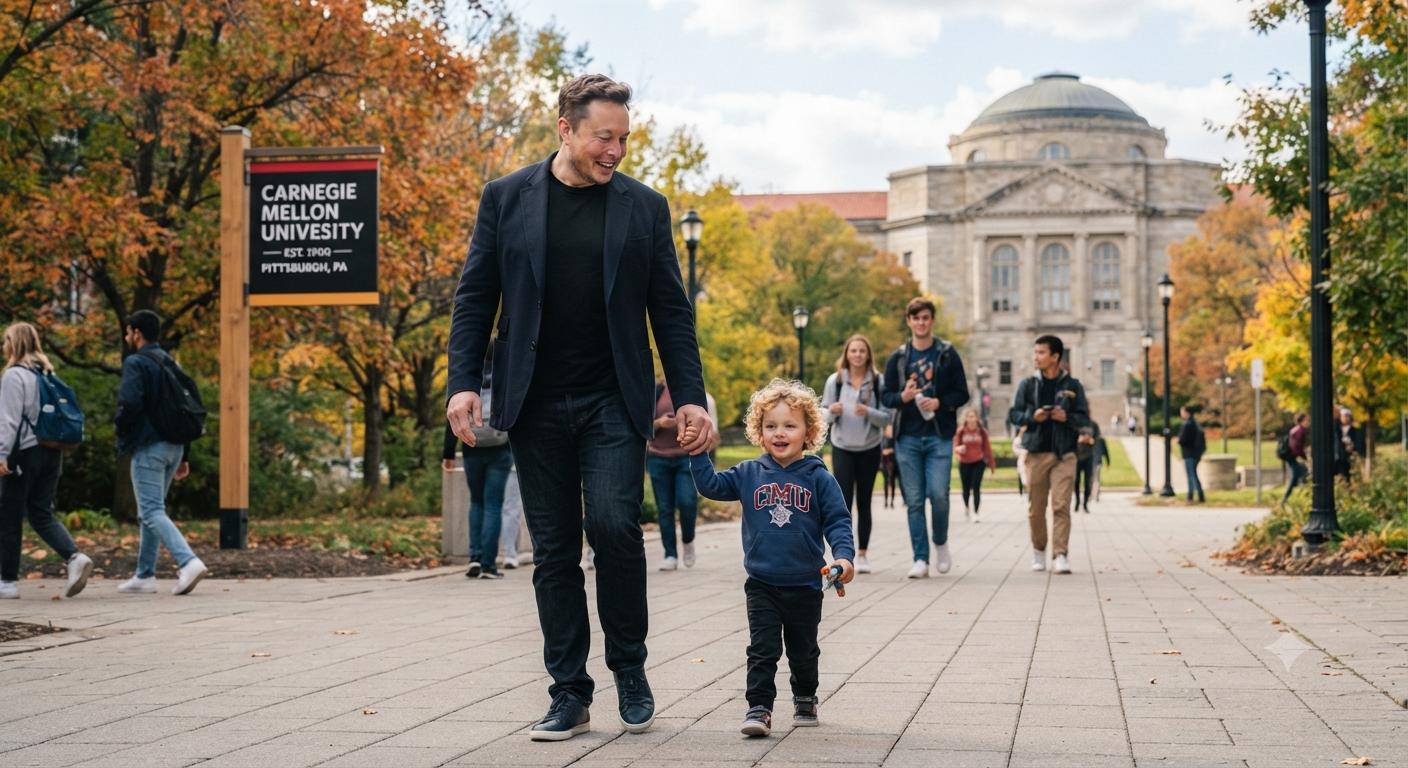
The search phrase Elon Musk son CMU has surged because it connects two attention magnets: the Musk family and Carnegie Mellon University, one of America’s best-known technology-focused institutions. Yet the online story has become messier than the underlying facts. Elon Musk did publicly discuss a son going to Carnegie Mellon, while later articles and social posts increasingly identified that son as Kai Musk and even attached a specific college or academic path to him.
That last step requires caution. The strongest public evidence supports a Musk-son-to-CMU connection, but publicly accessible, authoritative sources do not clearly establish every detail repeated online. A useful article therefore has to separate what is confirmed, what is reasonably supported, and what remains speculation.
Elon Musk Son CMU: The Short Answer
The core Elon Musk son CMU story traces to Musk’s appearances in Pennsylvania in October 2024. CBS Pittsburgh documented his October 20 town hall in the Pittsburgh area, and a later Pittsburgh Quarterly account described a question put directly to Musk that referenced the fact that “your son is coming to Carnegie Mellon next year.”
Multiple secondary reports subsequently said the son was Kai Musk, one of the triplets Elon Musk had with author Justine Musk. However, those reports are not the same thing as an official confirmation from Carnegie Mellon, Kai Musk, or a clear on-record statement from Elon Musk naming Kai in connection with the university.
A 2024 Sina Finance report, for example, attributed the identification to people familiar with the matter and online university-directory information, not to an official CMU announcement.
So the most accurate answer is simple: one of Elon Musk’s sons was publicly linked to attending Carnegie Mellon University, but the widely repeated identification of that son as Kai Musk should be treated as reported rather than definitively confirmed.
What Does “CMU” Mean in the Elon Musk Son CMU Search?
In this context, CMU means Carnegie Mellon University, the research university in Pittsburgh, Pennsylvania. It is particularly associated with computer science, artificial intelligence, robotics, engineering and interdisciplinary technology research.
That institutional profile explains why the Elon Musk son CMU query attracts so much attention. Carnegie Mellon’s School of Computer Science offers undergraduate pathways spanning computer science, artificial intelligence and robotics, while its College of Engineering emphasizes hands-on, interdisciplinary and project-based technical education.
The match may seem intuitive because Musk is closely associated with businesses operating across aerospace, electric vehicles, artificial intelligence and other technology sectors. But intuitive does not mean proven.
A parent’s career does not establish a child’s academic interests, college major or long-term career plans.
Who Is the Son Most Often Connected With CMU?
The name most commonly attached to the Elon Musk son CMU story is Kai Musk.
Kai is one of the triplets born to Elon Musk and his former wife, author Justine Musk; the other two are Saxon and Damian. Reputable profiles of Musk’s family have documented that the couple had twins and later triplets.
What is much less certain is Kai’s precise college status.
Some overseas education publications and reposted reports have stated that Kai was set to enter Carnegie Mellon and, in some versions, that he was connected with engineering rather than the School of Computer Science. Those claims have been copied widely enough that they can appear more established than the available primary evidence supports.
For E-E-A-T purposes, that distinction matters.
A claim repeated by 20 websites may still originate from one uncertain source.
Confirmed vs. Reported vs. Speculative
| Claim | Evidence Level | Best Interpretation |
|---|---|---|
| One of Elon Musk’s sons was headed to Carnegie Mellon | Strongly supported | Publicly referenced in connection with Musk’s 2024 Pittsburgh appearance |
| The son is Kai Musk | Reported, not conclusively confirmed | Repeated by secondary sources, but no clear official family or university confirmation located |
| Kai is in CMU’s College of Engineering | Unverified publicly | Treat as a report rather than an established fact |
| Kai chose engineering instead of computer science | Unverified publicly | Frequently repeated but should not be presented as certain |
| His future career will involve Tesla, SpaceX or xAI | Speculation | No reliable basis for claiming this |
This fact-checking framework is one of the most important parts of the Elon Musk son CMU topic because search results frequently blur the difference between reporting, inference and confirmation.
Why Carnegie Mellon Makes the Story So Interesting
Carnegie Mellon is not simply “a tech school.”
Its undergraduate ecosystem spans engineering, computing, robotics, artificial intelligence, science, business, arts and humanities, allowing students to approach complex technology problems from several directions.
The College of Engineering says its programs emphasize critical thinking, collaboration, creative problem-solving, research and a strong maker culture. Its undergraduate curriculum includes classroom, laboratory and hands-on learning, with project-based work forming an important part of the engineering experience.
Meanwhile, the School of Computer Science offers an artificial intelligence bachelor’s degree with coursework involving computer science, mathematics, statistics, computational modeling, machine learning and symbolic computation.
CMU also offers undergraduate robotics study focused on areas including motion, control, sensing, cognition and action.
That makes the Elon Musk son CMU connection compelling without needing to invent a specific major. A student interested in advanced technology could find multiple routes at CMU rather than one obvious “Musk-like” degree.
Is Kai Musk Studying Engineering at Carnegie Mellon?
This is where many online articles move too quickly.
The claim that Kai Musk entered CMU’s College of Engineering appears in several secondary sources, including Chinese-language education and finance coverage published after the 2024 Pittsburgh event. Some reports referenced apparent directory information and described him as an incoming student.
But an apparent directory listing is not the same thing as a university announcement.
More importantly, it should not become an excuse to reconstruct a private student’s academic life.
The U.S. Department of Education explains that educational institutions may designate some student details as “directory information.” Students can also have rights concerning the disclosure of that information, while education records are generally protected under the Family Educational Rights and Privacy Act, or FERPA.
For that reason, a responsible Elon Musk son CMU article should avoid using student-directory screenshots, schedules, contact details, residence information or similar personal data as entertainment.
The publicly relevant question is whether the reported CMU connection is credible, not how much private information can be uncovered about the student.
Engineering vs. Computer Science: Why the Distinction Matters
One recurring twist in the Elon Musk son CMU narrative is the claim that Kai chose engineering rather than computer science.
The implication is usually that this would be surprising because Carnegie Mellon is so strongly associated with computing.
Academically, however, the distinction is less dramatic than those headlines imply.
CMU’s engineering programs include areas such as electrical and computer engineering, while robotics can overlap heavily with both engineering and computer science. Carnegie Mellon also supports interdisciplinary technical study and offers robotics pathways that can complement students from different academic backgrounds.
Modern technology rarely respects traditional departmental boundaries.
Fields such as:
- Autonomous systems
- Robotics
- Embedded computing
- Control systems
- AI hardware
- Machine perception
- Aerospace engineering
- Advanced manufacturing
can require combinations of software, electronics, mechanics, mathematics and computer engineering.
So even if the engineering reports were eventually confirmed, they would not necessarily indicate a move away from computing, AI or emerging technologies.
That interpretation is far more useful than assuming that a Musk child “must” study artificial intelligence simply because of Elon Musk’s business interests.
The Ad Astra Connection and Musk’s Education Philosophy
Another reason the Elon Musk son CMU story gained traction is the Musk family’s unconventional educational history.
Elon Musk created an experimental school called Ad Astra in 2014 for his children and a small group of other students. Reporting on the development of technology-focused microschools has described the original program as emphasizing customized education, problem-solving and advanced STEM-related work rather than following a conventional school structure.
This background makes a project-heavy university such as Carnegie Mellon appear like a plausible next academic environment.
CMU’s College of Engineering emphasizes hands-on learning, collaborative problem-solving and customizable technical education. Its curriculum describes project-based coursework designed to give students experience working with practical engineering challenges.
There is an interesting philosophical overlap there.
But it should not be overstated.
The educational philosophy chosen by a parent during childhood should not be treated as a complete biography of an adult child. The strongest version of the Elon Musk son CMU story concerns a reported university connection, not a predetermined journey into the Musk business empire.
Why Search Results About Elon Musk’s Son Became Confusing
The Elon Musk son CMU search landscape provides a useful case study in how celebrity information becomes distorted online.
It usually happens in stages.
A public comment creates a legitimate news story. Secondary outlets then identify the unnamed person. Other websites copy that identity and begin adding details such as a college, major, career plans, age, net worth, interests, relationships or social-media profiles.
Eventually, search engines may display dozens of apparently independent pages repeating virtually identical details.
That creates the illusion of strong verification.
In reality, all of those pages can trace back to the same one or two uncertain claims.
Watch for These Three Warning Signs
- Circular sourcing: Articles cite other articles that ultimately lead back to the same original rumor.
- False precision: Exact majors, net worth figures, heights, relationships or future career plans appear without primary evidence.
- Inference presented as fact: A technology entrepreneur’s child is automatically assumed to be interested in AI, engineering or startups.
Readers investigating Elon Musk son CMU should therefore evaluate the quality and origin of evidence, not simply count how many websites repeat a statement.
Ten recycled articles do not equal ten independent confirmations.
What We Can Responsibly Say as of 2026
As of July 2026, the careful summary is narrower than many celebrity-profile pages suggest.
There is credible public evidence connecting a son of Elon Musk with Carnegie Mellon University following Musk’s 2024 appearances in Pittsburgh. Pittsburgh Quarterly later referenced the son’s upcoming CMU attendance directly in a question addressed to Musk, while several secondary reports subsequently identified Kai Musk as that son.
What remains harder to establish from authoritative public sources is every additional detail commonly attached to the story.
In particular, readers should distinguish between:
Reasonably supported:
- One of Elon Musk’s sons was expected to attend Carnegie Mellon.
- The story became public around Musk’s 2024 activity in Pittsburgh.
Widely reported but not fully confirmed:
- The son was Kai Musk.
- Kai entered Carnegie Mellon’s College of Engineering.
Not established:
- His precise major or specialization.
- His academic performance.
- His career intentions.
- Plans to join one of Elon Musk’s companies.
- Claims about personal wealth derived from his father.
- Private relationships or lifestyle information.
Carnegie Mellon’s official admissions and academic pages describe the university and its programs. They are not public biographies of individual students.
That nuance should remain at the center of trustworthy Elon Musk son CMU coverage.
Why CMU Could Appeal to a Student From a Tech-Focused Background
Without speculating about Kai personally, it is easy to understand why Carnegie Mellon might attract students interested in engineering and emerging technology.
CMU offers several particularly relevant strengths:
- Engineering breadth: Undergraduate opportunities include electrical and computer engineering, mechanical engineering, chemical engineering, civil and environmental engineering, and related interdisciplinary areas.
- Computer science depth: The School of Computer Science provides foundational computing education alongside specialized academic pathways.
- Dedicated AI education: Carnegie Mellon offers a Bachelor of Science in Artificial Intelligence, introduced in 2018.
- Undergraduate robotics: Students can study technical areas including sensing, motion, control and cognition.
- Project-based engineering: Students work with applied engineering problems and collaborative projects rather than relying only on theoretical classroom instruction.
These features explain the broader relevance of the Elon Musk son CMU story without relying on celebrity gossip.
CMU itself is interesting enough.
What the Story Does Not Tell Us
A university connection does not tell us whether a student eventually plans to join a family company, launch a startup, pursue graduate research or enter a completely different profession.
It also does not prove that admission resulted from family influence.
No credible evidence located for this article establishes a donation-for-admission arrangement, guaranteed admission, special academic treatment or a corporate pipeline between Musk’s companies and Carnegie Mellon.
Those are serious claims and would require serious evidence.
Likewise, claims that the Elon Musk son CMU story predicts a future position at Tesla, SpaceX, Neuralink or xAI are speculation.
Family background can provide exposure to particular industries. It cannot reliably predict an individual’s career.
Until the person involved publicly discusses his own plans, those predictions belong in the category of entertainment rather than verified biography.
FAQ About Elon Musk Son CMU
Which Elon Musk son goes to CMU?
Kai Musk is the son most frequently identified in secondary reporting, but that identification is not conclusively verified by a clear public statement from Carnegie Mellon, Kai Musk or Elon Musk naming him.
The safest wording is that one of Elon Musk’s sons was publicly linked to Carnegie Mellon University, while Kai is the widely reported identity.
Did Elon Musk say his son was going to Carnegie Mellon University?
Public reporting from the Pittsburgh period strongly supports the connection.
CBS Pittsburgh documented Musk’s October 2024 town hall in the Pittsburgh area. Pittsburgh Quarterly later published an account of a question addressed directly to Musk that explicitly referenced his son coming to Carnegie Mellon the following year.
This provides a stronger foundation for the general CMU connection than for later claims identifying the specific son and academic program.
Is Kai Musk studying computer science at CMU?
There is no authoritative public confirmation located establishing Kai Musk as a Carnegie Mellon computer science student.
Interestingly, many secondary reports claim the opposite: that he was associated with the College of Engineering rather than the School of Computer Science. That engineering claim is also insufficiently verified by authoritative public evidence, so neither version should be treated as settled fact.
Why is Carnegie Mellon important in technology and AI?
Carnegie Mellon has extensive undergraduate offerings in computer science, artificial intelligence, robotics and engineering.
Its official AI program describes coursework involving machine learning, mathematics, statistics and computational modeling, while the university’s robotics curriculum covers areas such as sensing, cognition, control and action.
Its combination of theoretical research and applied technical education has made CMU particularly relevant to students interested in emerging technology.
Why is there so much uncertainty around the Elon Musk son CMU story?
Because the central public connection was followed by secondary identification and online speculation.
Once one report identified Kai Musk, many later sites repeated the claim. Some then added further details concerning engineering, personal interests and future career possibilities without clearly demonstrating where those facts originated.
Universities also operate under student-privacy rules. FERPA protects education records while allowing institutions to designate limited categories of information as directory information under certain conditions.
The absence of a detailed public university biography of a student is therefore neither unusual nor evidence of secrecy.
Conclusion: Read the Elon Musk Son CMU Story With a Fact-Checking Mindset
The Elon Musk son CMU story has a real foundation: a son of Elon Musk was publicly connected with Carnegie Mellon University.
The uncertainty begins when the internet transforms that limited fact into an extensively detailed biography.
Kai Musk is the name most frequently reported, and some sources additionally place him in engineering. Those details should be described accurately for what they currently are: reported claims that lack complete authoritative public confirmation.
What is unquestionably clearer is why Carnegie Mellon attracts so much interest.
Its strength across engineering, computer science, artificial intelligence, robotics and project-based technical education makes CMU a natural focus whenever a high-profile technology family becomes connected with the university.
For readers, publishers and SEO writers, the next step is straightforward: prioritize original sources, distinguish confirmation from repetition, and never fill factual gaps with speculation.
That approach does more than produce a better Elon Musk son CMU article. It creates stronger E-E-A-T signals, greater information gain and a far more trustworthy resource than another recycled celebrity profile.