



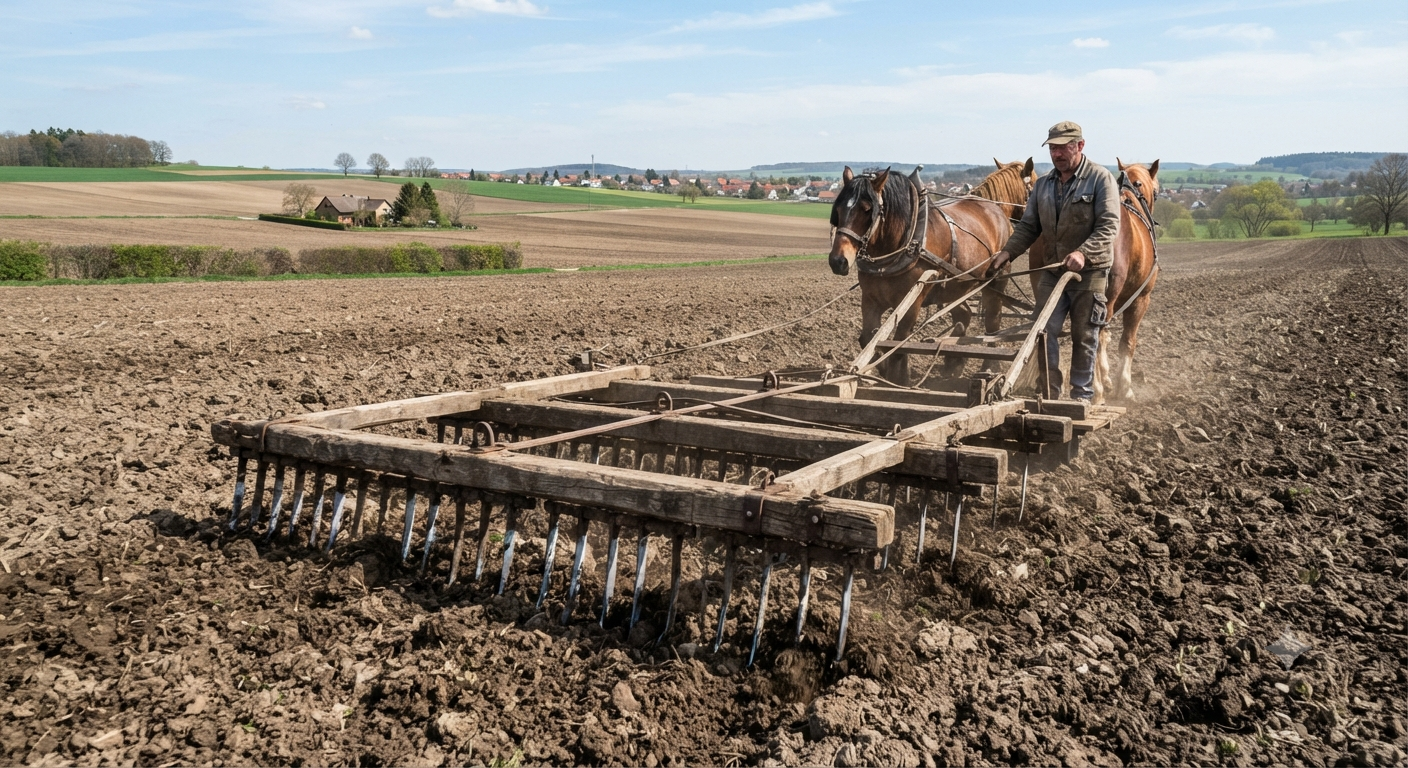
Messeregge is a German agricultural term for a knife-style harrow used in shallow soil preparation. It is designed to break clods, level the upper soil layer, and help create a more consistent seedbed, often as a front-mounted tool working with a roller or another implement.
The term has recently attracted confusing online definitions. Some pages describe it as a communication method, cultural concept, or even a regional dish, yet agricultural manufacturers, parts suppliers, and machinery listings consistently use it for a real soil-working implement. Manufacturer documentation is the most reliable basis for understanding the machine and its purpose.
What Does Messeregge Mean?
The word combines two German agricultural terms: Messer, meaning knife or blade, and Egge, meaning harrow. German-English dictionaries translate Messer as “knife” and Egge as “harrow,” making knife harrow the clearest English rendering.
That translation also explains the machine’s construction. Instead of relying only on flexible tines or rotating discs, the implement uses arranged knife-like working parts to engage the surface, crush larger clods, and even the field ahead of sowing or rolling.
A Messeregge should not be treated as one universally standardized machine. The precise blade pattern, spacing, frame, adjustment system, working width, and combination options vary by manufacturer and model, so specifications must always be checked in the relevant manual.
Why Search Results Often Misdefine Messeregge
The keyword is uncommon in English, which creates an information gap. Several recently published webpages assign unrelated meanings to it, including structured communication, branding, heritage, food, and blade-edge geometry.
The verifiable usage is agricultural. Kerner’s official operating manual abbreviates the implement as “ME,” explicitly defining that abbreviation as Messeregge, while the company’s parts catalogue lists a frame, support plate, and straight, left, and right knives for the assembly. Retail and replacement-parts pages use the same term for front-mounted clod-breaking equipment and compatible blades.
This distinction matters for searchers. Someone researching the term is usually trying to identify a machine, source parts, compare seedbed tools, understand setup, or evaluate whether a knife harrow suits particular soil conditions.
How a Messeregge Works
A Messeregge works primarily in the upper soil layer. Its blades contact raised clods and rough areas, applying cutting, crushing, and leveling forces rather than performing deep inversion like a mouldboard plough.
On a front-mounted system, the tractor pushes the tool ahead of itself. This lets the operator prepare and level the surface before the tractor’s rear-mounted equipment completes another job, such as reconsolidation or seedbed finishing.
A front packer can therefore combine several functions in one pass when conditions and machinery are properly matched. This may reduce the need for a separate finishing operation, although the result depends heavily on soil moisture, working depth, tractor balance, and the equipment attached behind.
Kerner describes its TORON front packer as combining crumbling, leveling, and reconsolidation. Its brochure lists the knife harrow among adjustable front-tool options, alongside other configurations, showing that the implement is part of a broader modular seedbed system rather than a stand-alone solution for every field.
The Three Main Actions
The machine’s field effect can be understood through three practical actions:
- Clod reduction: Blades strike or slice larger aggregates so the surface becomes more manageable.
- Surface leveling: High spots are reduced and loose soil is redistributed across shallow depressions.
- Seedbed refinement: The top layer becomes more uniform for following operations, while a roller may reconsolidate loosened material.
These actions can improve consistency, but “finer” is not automatically “better.” Excessive pulverization may leave some soils vulnerable to crusting or erosion, while unnecessary passes increase traffic and operating costs.
The objective is a crop-appropriate seedbed, not powder.
Where a Messeregge Fits in the Tillage System
A Messeregge is best classified as a shallow or secondary soil-working tool. Secondary tillage generally follows primary cultivation and focuses on breaking remaining clods, smoothing the surface, and preparing conditions for planting.
The University of Minnesota describes field cultivation as a secondary practice that pulverizes smaller clods after primary tillage, while shallow disc systems are commonly used to prepare a smoother seedbed. German agricultural guidance similarly describes seedbed preparation as the secondary operation that prepares the upper cultivated layer for sowing or planting.
That makes the implement most useful when the field already has acceptable deep structure but the surface still needs correction. It is not a substitute for subsoiling, drainage repair, or deep compaction removal.
A field can look smooth while still having serious restrictions beneath the surface. If roots cannot penetrate a compacted layer, merely refining the top few centimetres will not solve the underlying problem.
Typical Uses
A knife harrow may be used for:
- Breaking clods left by ploughing or previous cultivation
- Leveling a rough surface before drilling
- Refining the upper layer for smaller seeds
- Working ahead of a front or rear roller
- Reducing the number of separate finishing passes
- Preparing fields where shallow disturbance is preferable to deep mixing
- Improving the consistency of a following seed drill
- Flattening minor ridges and cultivation marks
The exact crop benefit depends on seed size, soil texture, moisture, residue load, and the performance of the following drill. Agricultural guidance notes that finer-seeded crops generally demand a finer, well-reconsolidated seedbed, making surface preparation especially important for those crops.
Large-seeded crops may tolerate a somewhat coarser structure. Small seeds, by contrast, can struggle when placed among large clods, air pockets, or uneven moisture zones.
Messeregge Specifications: What the Numbers Actually Mean
Specifications should be interpreted as model-specific, not universal. For example, Kerner’s current TORON documentation lists working widths of 2.5, 3.0, and 3.5 metres, a knife-harrow frame height of 250 mm, 24 working elements, 125 mm spacing, and an adjustable working depth of 0–10 cm.
Those figures reveal what buyers should examine:
- Working width affects field capacity and matching with the tractor and rear implement.
- Line spacing influences how continuously the surface is engaged.
- Working depth range determines how lightly or aggressively the upper layer can be treated.
- Frame clearance affects residue flow and blockage risk.
- Tool count and geometry influence load distribution and finish.
- Attachment category and weight determine tractor compatibility and ballast requirements.
- Adjustment method affects how quickly settings can be changed between fields.
- Transport dimensions influence road safety and storage requirements.
Do not buy solely by width. A wide implement with insufficient tractor front-lift capacity, poor steering balance, or unsuitable blade geometry can be less productive than a narrower, correctly matched machine.
The total weight of the front and rear combination also matters. Too much weight on one end of the tractor may affect steering, braking, traction, axle loading, and road behavior.
Messeregge vs. Other Seedbed Tools
Choosing between a Messeregge, spring-tine harrow, crossboard, disc harrow, power harrow, or packer depends on the problem being solved.
| Implement | Main Working Action | Best-Suited Task | Key Limitation |
|---|---|---|---|
| Knife harrow | Cuts, crushes, and levels near the surface | Clod reduction and front-mounted seedbed finishing | Not intended for deep loosening |
| Spring-tine harrow | Scratches and mixes with flexible tines | Light leveling, aeration, and residue movement | May struggle with very firm clods |
| Crossboard | Levels through angled paddles or bars | Flattening ridges and redistributing soil | Provides less cutting action |
| Disc harrow | Cuts and mixes with concave discs | Residue incorporation and more aggressive shallow tillage | Can move more soil and increase disturbance |
| Power harrow | Uses PTO-driven rotors for intensive crumbling | Fine seedbeds in demanding conditions | Higher energy demand and risk of overworking soil |
| Packer roller | Presses and reconsolidates | Firming the seedbed and improving contact | Does not replace clod cutting or leveling |
The machine is particularly attractive when a passive front tool can make the next operation more consistent without adding a separate powered pass. However, the best system is the one that achieves the required seedbed with the least unnecessary disturbance.
A power harrow may be justified in strong, difficult soil, but it can also consume more fuel and create an excessively fine surface when used aggressively. A crossboard may level well but provide less cutting action against solid clods.
The right comparison begins with the field problem—not the popularity of the machine.
Benefits of Using a Messeregge
A properly selected and adjusted Messeregge can offer several operational advantages.
Better Surface Uniformity
Irregular clods and ridges can cause variable drill depth and inconsistent press-wheel contact. By evening the surface before the drill or roller arrives, the implement may help the following machine work at a steadier depth.
Uniformity is especially valuable across the complete working width. When one side of a combination runs over ridges and the other runs through depressions, seed placement can vary even when the drill itself is correctly calibrated.
More Effective One-Pass Combinations
A front-mounted knife harrow can be paired with rear-mounted equipment, potentially combining surface preparation with another operation. Kerner positions its front packer as a system that integrates crumbling, leveling, and reconsolidation, which illustrates the one-pass logic.
Combining operations can reduce unnecessary field passes when the tractor and tools are correctly matched. That may save time and limit repeated traffic, but only when the combined machine maintains acceptable working quality.
Lower Disturbance Than Aggressive Tillage
When run shallow, a passive blade tool can target the upper layer without deeply inverting the profile. Research-based extension guidance notes that shallow tools can break surface clods while preserving more of the structure below, although the specific outcome always depends on setup and conditions.
This makes the implement relevant to farms trying to avoid unnecessary deep cultivation. It should still be used only when a clear agronomic purpose exists.
Improved Conditions for Seed Placement
Clods can create air gaps and reduce seed-to-soil contact. Extension guidance warns that tilling wet soil can form clods and compaction, both of which can interfere with uniform emergence and root development.
The benefit is therefore conditional: the tool can correct suitable dry clods, but it should not be expected to rescue badly smeared or compacted wet soil.
Improved Performance of Following Equipment
A level surface can help a roller, drill, or cultivator maintain more consistent engagement. It may also reduce bouncing and sudden depth changes as the rear implement travels over previously uneven ground.
This does not mean the front tool automatically improves every operation. Incorrect depth or excessive soil movement can make the rear implement’s job harder rather than easier.
Soil Conditions That Suit a Messeregge
A Messeregge performs best when the soil is dry enough to fracture rather than smear, yet not so hard that the blades merely bounce over the surface. The operator should assess the field rather than rely on a calendar date.
A simple hand test is useful. Take soil from the intended working depth and squeeze it; if it forms a sticky ribbon, coats the hand heavily, or deforms without crumbling, the field is probably too wet for effective finishing.
Wet-soil tillage can produce clods, smearing, and compaction. University of Minnesota guidance recommends keeping shallow operations genuinely shallow in wet conditions and notes that lifting wet soil creates clods that may require another pass later.
Residue must also be considered. A low-clearance arrangement may plug in heavy, damp straw, while excessive speed may cause uneven flow or soil throwing.
Check whether the chosen model is designed for the field’s residue volume and whether the blades are configured to pass material cleanly.
Light and Medium Soils
On lighter or medium-textured soils, the implement may create an even finish with relatively low disturbance. Operators should watch for over-pulverization, particularly when the soil is already friable.
Too many passes can destroy useful aggregates. That may leave the surface vulnerable to wind movement, rain impact, or crust formation.
Heavy Clay Soils
Clay soils can produce large, strong clods after primary cultivation. A knife harrow may help when those clods are sufficiently dry to fracture.
Timing is critical. Working heavy clay too early can smear it, while waiting until it becomes extremely hard may reduce effectiveness and increase wear.
Stony Ground
Stones increase impact loading and may damage blades, bolts, supports, or the frame. Buyers working stony land should ask specifically about blade protection, recommended speed, replacement costs, and warranty exclusions.
Inspect the machine more frequently in these conditions. A bent component can change the working pattern across the entire width.
How to Set Up a Messeregge Correctly
Correct adjustment matters more than chasing maximum aggression. The goal is the shallowest setting that achieves acceptable leveling and clod reduction.
1. Start With the Field Objective
Define the problem before changing the machine. Is the priority breaking large clods, flattening ridges, preparing for small seed, or creating a uniform surface for a rear roller?
A clear objective prevents unnecessary soil movement. It also gives the operator a measurable way to judge the test pass.
2. Match Width and Alignment
The front tool should cover the tractor’s effective track and align appropriately with the rear implement. Mismatched widths can leave untreated strips or cause repeated overlap.
Check the combination when lowered on level ground. The tool should sit evenly rather than cutting aggressively on one side.
3. Begin Shallow
Set the Messeregge near the shallow end of its range, make a short test pass, and inspect the full working width. Increase depth only when the blades are not engaging the target clods.
Deeper is not automatically more effective. It can increase draft, move moist soil upward, disturb additional residue, and create a softer layer than the crop requires.
4. Adjust Speed Gradually
Forward speed changes the energy applied to clods and soil movement. Too slow may underwork the surface; too fast can throw soil, increase vibration, worsen tracking, and accelerate wear.
Change one variable at a time. Altering speed, depth, and rear-implement pressure simultaneously makes it difficult to identify which adjustment improved or damaged the result.
5. Inspect Behind the Whole Combination
Do not judge the front implement in isolation. Dig behind the final roller or drill and check:
- Clod size
- Surface firmness
- Moisture distribution
- Seed-zone structure
- Residue placement
- Wheel-track effects
- Actual seed depth
- Soil contact around the seed
The final crop-establishment result matters more than the appearance immediately behind the blades.
Common Operating Mistakes
Even a well-designed Messeregge can perform poorly when used in the wrong conditions.
- Working wet soil: This risks smearing, compaction, and persistent clods.
- Running too deep: The tool may move unnecessary soil and increase draft.
- Chasing a cosmetic finish: A visually smooth field can still be over-pulverized or poorly reconsolidated.
- Ignoring residue: Damp straw can collect around frames and reduce uniformity.
- Using worn or mixed blades: Uneven blade length changes engagement across the width.
- Skipping test passes: Soil conditions can vary within the same field.
- Assuming one setup fits every crop: Fine seed, cereals, maize, and cover crops can require different seedbed structures.
- Ignoring tractor balance: A heavy front-and-rear combination can affect steering and axle loading.
- Failing to inspect after impacts: Stones or hidden objects can loosen or bend components.
The machine should be adjusted whenever soil texture, moisture, crop residue, slope, or the following implement changes.
Maintenance and Safety Checklist
Before using a Messeregge, read the manufacturer’s operating manual and follow the tractor’s front-linkage limits. Model-specific instructions take priority over generic advice.
Inspect the following points:
- Blade wear, cracks, bends, and missing fasteners
- Left, right, and straight blade placement
- Frame damage and loose joints
- Depth-adjustment mechanisms
- Hydraulic hoses and couplers, where fitted
- Three-point linkage pins and locking devices
- Lighting, visibility markers, and transport width
- Clearance between the tool, tractor, tyres, and rear combination
- Warning decals and protective components
- Wheel, roller, or bearing condition where applicable
Kerner’s parts documentation shows that the assembly may use straight, left, and right knives, which makes correct replacement orientation important.
Never enter the space beneath a raised implement unless it is mechanically secured according to the manufacturer’s procedure. Lower the machine, stop the engine, remove the key, release stored pressure, and prevent unintended movement before clearing blockages or replacing components.
Do not use hands or feet to remove material while the tractor is running. Stored hydraulic pressure and unexpected machine movement can cause severe injury.
Blade-Wear Monitoring
Measure or visually compare blades across the full width. One heavily worn section may work shallower than the rest, creating strips of different soil structure.
Replace parts using the correct specifications. Blade thickness, orientation, bolt grade, and mounting position can affect both performance and safety.
Fastener Checks
New or recently repaired components may settle after initial use. Recheck fastener torque according to the manual after the specified operating period.
Repeatedly loose bolts can indicate more than inadequate tightening. They may point to worn holes, incorrect hardware, vibration, misalignment, or impact damage.
How to Choose the Right Messeregge
Selecting a Messeregge starts with agronomy, not brand names. Ask what soil problem occurs repeatedly and whether a shallow knife tool solves it better than a crossboard, tine section, disc system, or powered cultivator.
Evaluate these buying criteria:
- Soil type and typical spring moisture
- Common clod size and field roughness
- Crop rotation and seed-size requirements
- Residue volume after harvest
- Tractor front-lift capacity and axle loading
- Rear implement width and weight
- Required road-transport dimensions
- Availability and cost of replacement blades
- Ease of depth adjustment
- Dealer support and parts lead times
- Expected annual working area
- Stone protection and frame strength
- Compatibility with future tractors or drills
Request a field demonstration in representative conditions. A machine that performs well on dry, worked loam may behave very differently in heavy clay, stones, or damp residue.
Whenever possible, inspect more than the surface after the demonstration. Dig into the worked layer, check reconsolidation, and examine whether the tool has created smearing or a loose, fluffy zone beneath the seedbed.
Questions to Ask the Dealer
Ask for the actual working-depth range, weight with options, blade spacing, replacement-part numbers, front-linkage requirement, maximum permitted speed, transport width, warranty coverage, and recommended combinations.
Also request the operator manual before purchase so compatibility and maintenance requirements can be reviewed properly.
Useful questions include:
- What tractor size and front-lift capacity are recommended?
- Which blade arrangement suits the farm’s soil?
- How quickly can working depth be adjusted?
- What are the most frequently replaced components?
- Are left, right, and straight blades stocked locally?
- How does the frame handle stones?
- Can the machine be demonstrated with the intended rear implement?
- What road-lighting equipment is included?
- Are additional weights necessary?
- What is the expected parts-delivery time during planting season?
A low purchase price is less attractive when replacement parts are difficult to obtain during a narrow sowing window.
Is a Messeregge a Conservation-Tillage Tool?
It can support lower-intensity cultivation, but the label depends on the complete system. Conservation tillage is generally defined around reducing passes, limiting aggregate disruption, and retaining protective residue rather than owning a particular implement.
A shallow knife-harrow pass may fit that strategy when it replaces a more aggressive operation or helps combine tasks. It does not automatically qualify as conservation tillage if it is added as another unnecessary pass, removes too much residue, or overworks the surface.
The practical principle is simple: disturb only the amount of soil required to establish the crop reliably.
Farmers should consider the full sequence from harvest to planting. One shallow operation within an otherwise pass-heavy system may not reduce overall disturbance, while a carefully planned combination could eliminate several separate journeys.
Can a Messeregge Reduce Fuel and Time?
Potential savings come from the operating system rather than the name of the implement. A passive front tool combined with a rear operation may reduce the need for a separate pass, which can lower time, labour, and fuel use.
However, savings should not be assumed. A poorly matched combination may increase wheel slip, require slower working speeds, create excessive draft, or force corrective cultivation later.
Calculate the real cost per hectare using:
- Tractor fuel consumption
- Working width
- Average field speed
- Turning and adjustment time
- Labour cost
- Blade and wearing-part cost
- Depreciation
- Number of eliminated passes
- Additional tractor ballast or tyre requirements
The most economical machine is not necessarily the one with the lowest purchase price. It is the one that consistently creates the required result with the fewest corrective operations.
Frequently Asked Questions
What is a Messeregge in English?
The closest English term is knife harrow or blade harrow. It is a shallow soil-working implement that uses knife-like parts to reduce clods, level the surface, and support seedbed preparation.
The agricultural meaning is supported by machinery manuals, parts catalogues, and equipment listings.
How deep does a Messeregge work?
Depth depends on the model and field objective. One current Kerner system lists an adjustable range of 0–10 cm, but operators should not treat that figure as a universal standard or assume maximum depth is desirable.
The ideal setting is normally the shallowest depth that breaks the target clods and levels the surface without bringing wet soil upward.
Can It Replace a Power Harrow?
Sometimes, but not in every soil or seedbed system. A passive knife tool may provide enough clod reduction and leveling in workable conditions, while a power harrow offers more intensive, PTO-driven crumbling.
The correct choice depends on soil strength, residue, required finish, tractor power, operating cost, and the risk of overworking the seedbed.
Can a Knife Harrow Be Used in Wet Soil?
Using it in wet soil is usually a poor choice because wet tillage can smear, compact, and lift soil into hard clods. If conditions are marginal, make a shallow test pass and stop if the soil deforms rather than fractures.
Waiting for better conditions may save an additional corrective pass and prevent longer-lasting structural damage.
Does a Messeregge Improve Yield?
No responsible operator should promise a direct yield increase from one implement. Its value is indirect: it may create a more uniform surface and improve the consistency of the following planting operation.
Crop results still depend on soil condition, weather, seed placement, variety, nutrition, pest control, drainage, compaction, and many other factors. The machine should be evaluated by measurable improvements in seedbed quality and field efficiency rather than unsupported yield claims.
Conclusion: Use the Tool to Solve a Specific Field Problem
A Messeregge is not a mysterious digital concept. It is a practical German knife-harrow implement built for shallow clod reduction, leveling, and seedbed refinement, often within a front-mounted packing or combination system.
Its greatest value comes from precision. Used in suitable soil at the correct depth, it can improve surface uniformity and help the following roller or drill work more consistently.
Used too deeply, too quickly, or in wet conditions, it can create additional problems.
Before buying or operating one, identify the exact surface problem, confirm tractor compatibility, review the manufacturer’s manual, and test the shallowest effective setting in real field conditions. Judge success by seed-zone structure and the performance of the complete planting system—not merely by how smooth the field looks from the cab.