



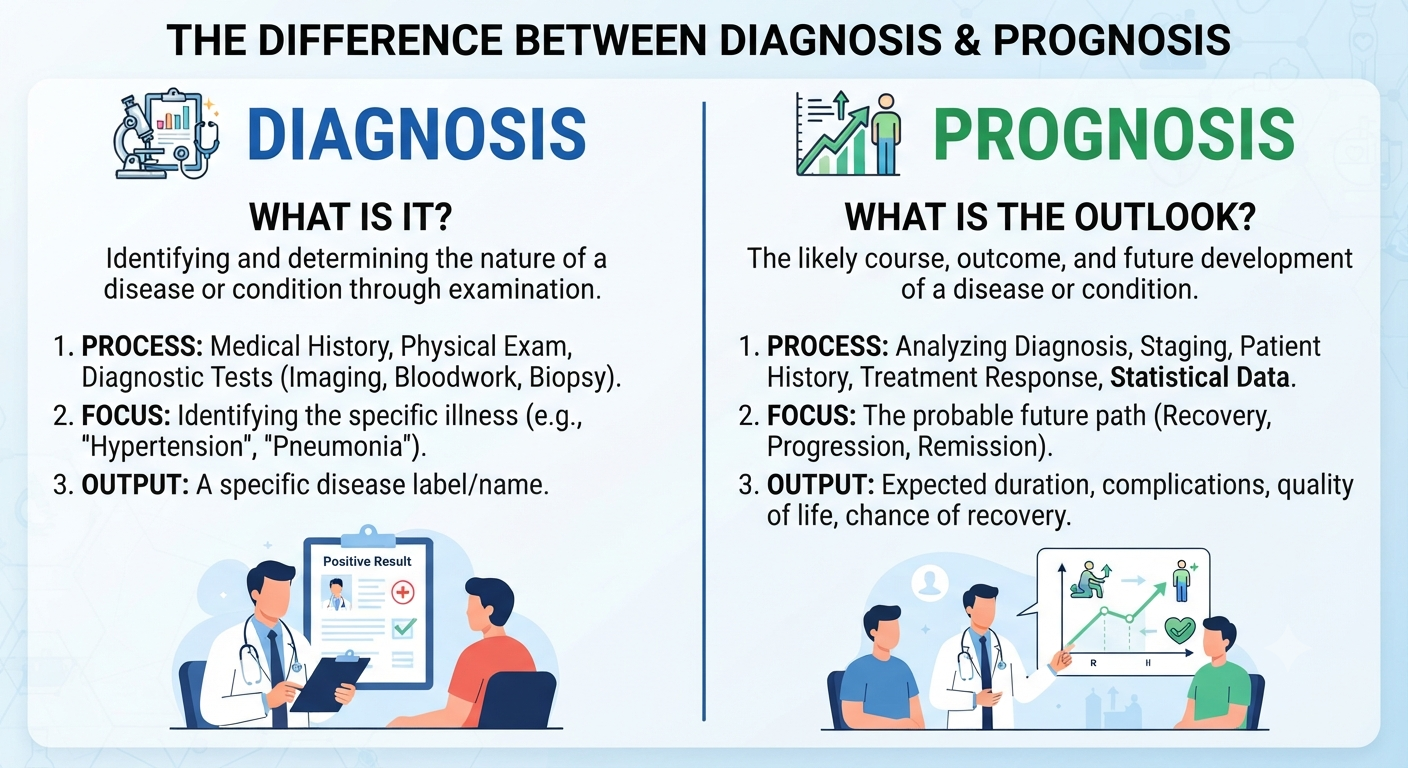
Understanding the diagnosis prognosis difference can make medical appointments far less confusing. A diagnosis identifies the disease, disorder, injury, or condition causing a person’s symptoms, while a prognosis estimates how that condition is likely to develop over time, including the chances of recovery, recurrence, complications, disability, or survival.
The two terms are connected, but they answer different questions. Diagnosis asks, “What is happening?” Prognosis asks, “What is likely to happen next?” A doctor generally needs enough diagnostic information before offering a meaningful prognosis, yet even a confirmed diagnosis does not make the future completely predictable.
Medical note: This guide explains general medical terminology. It cannot determine an individual diagnosis or prognosis, which must be discussed with a qualified healthcare professional who knows the patient’s history and test results.
Diagnosis Prognosis Difference at a Glance
The quickest way to understand the diagnosis prognosis difference is to compare purpose, evidence, and timing. Diagnosis focuses on identifying the present health problem; prognosis focuses on estimating the condition’s future course.
| Point of comparison | Diagnosis | Prognosis |
|---|---|---|
| Main question | What condition does the patient have? | What is the condition likely to do over time? |
| Main purpose | Identify or explain the health problem | Estimate outcome, progression, recovery, or recurrence |
| Common evidence | Symptoms, history, examination, laboratory tests, imaging, pathology | Diagnosis, severity, stage, biomarkers, treatment response, age, overall health |
| Degree of certainty | May be suspected, provisional, differential, or confirmed | Usually expressed as a probability or range |
| Can it change? | Yes, when new evidence appears | Yes, especially after treatment or changes in health |
| Example | “The diagnosis is bacterial pneumonia.” | “The prognosis is favorable with prompt treatment.” |
The National Cancer Institute defines diagnosis as identifying a disease, condition, or injury through signs, symptoms, health history, examination, and tests. It defines prognosis as the likely outcome or course of a disease, including the chance of recovery or recurrence.
What Is a Diagnosis in the Diagnosis Prognosis Difference?
A diagnosis is the medical explanation for a patient’s health problem. It may name a specific disease, such as influenza, rheumatoid arthritis, major depressive disorder, or type 2 diabetes, or it may identify a broader condition while further investigation continues.
Diagnosis is not always a single moment. The National Academies describes the diagnostic process as a complex, collaborative activity involving information gathering and clinical reasoning, and notes that it may become more certain as additional information emerges.
How Doctors Reach a Diagnosis
A clinician usually builds a diagnosis from several sources rather than relying on one isolated result. The process may include:
- Medical history: Symptoms, timing, previous illnesses, medicines, exposures, and family history
- Physical examination: Observable signs, vital signs, tenderness, weakness, swelling, or neurological findings
- Laboratory testing: Blood, urine, tissue, genetic, microbiological, or biochemical analysis
- Diagnostic imaging: X-ray, ultrasound, CT, MRI, mammography, or other imaging methods
- Special procedures: Endoscopy, biopsy, electrocardiography, lung-function testing, or nerve studies
- Clinical response: Whether symptoms improve, worsen, or remain unchanged after an intervention
Medical tests can help detect disease, support a diagnosis, guide treatment, measure treatment response, or monitor a condition. A single blood test often does not tell the whole story, so clinicians interpret results alongside symptoms, history, examination findings, and other tests.
Suspected, Differential, Provisional, and Definitive Diagnosis
The diagnosis prognosis difference becomes easier to understand when you know that a diagnosis can have different levels of certainty. A clinician may initially suspect a condition, list several possibilities, choose a working explanation, and later confirm or revise it.
A differential diagnosis is a structured list of conditions that could plausibly explain the same symptoms. MedlinePlus describes it as a process used to reach a final diagnosis when symptoms do not have one obvious cause.
A provisional or working diagnosis is the best current explanation based on available evidence. A definitive diagnosis is the final conclusion reached after appropriate testing, such as laboratory analysis, imaging, or biopsy.
Why a Diagnosis Can Change
A changed diagnosis does not automatically mean the first clinician acted carelessly. Some illnesses evolve, early symptoms overlap, tests can be inconclusive, and characteristic findings may appear only later.
Still, timely and accurate diagnosis matters because it guides treatment and other healthcare decisions. A diagnostic error may involve failing to establish an accurate, timely explanation or failing to communicate that explanation clearly to the patient.
What Is a Prognosis in the Diagnosis Prognosis Difference?
A prognosis is an evidence-based estimate of how a diagnosed condition is likely to progress. It may address symptom improvement, speed of progression, treatment response, risk of relapse, future ability to function, complications, quality of life, or survival.
This is the practical heart of the diagnosis prognosis difference: the diagnosis names the problem, but the prognosis describes the range of possible futures. Prognosis is not a promise, deadline, or guarantee.
Factors That Shape a Prognosis
Doctors estimate prognosis by combining research data with individual clinical details. Depending on the condition, relevant prognostic factors may include:
- Disease type, subtype, and biological behaviour
- Stage, grade, severity, or extent of organ involvement
- Age, frailty, and overall physical health
- Other medical conditions
- Genetic variants, biomarkers, or pathology findings
- How early the condition was detected
- Availability and effectiveness of treatment
- Response to treatment
- Risk of complications, recurrence, or treatment toxicity
- Functional status, nutrition, and ability to complete therapy
A prognostic factor is a patient characteristic, disease feature, or circumstance used to estimate the chance of recovery or recurrence. The importance of each factor differs by illness; a marker that strongly affects one disease may have little value in another.
Good, Fair, Poor, Guarded, and Uncertain Prognosis
Clinicians sometimes use broad descriptions rather than precise numbers. A good or favourable prognosis suggests a strong likelihood of recovery, control, or long-term stability, whereas a poor or unfavourable prognosis suggests a greater risk of progression, severe disability, complications, or death.
A guarded prognosis means the outcome is uncertain and the clinician is cautious because the condition could improve or worsen. “Fair” usually falls between favourable and poor, but these words are not standardised enough to replace a direct explanation of likely outcomes, timeframes, and uncertainty.
Prognosis Is Dynamic, Not Fixed
A prognosis may change after surgery, a new scan, laboratory results, a treatment response, a complication, or a decline or improvement in functional status. That is another key element of the diagnosis prognosis difference: a diagnosis may remain the same while the prognosis becomes better or worse.
For example, two patients can share the same diagnosis but have different disease stages, biological markers, treatment options, and general health. Their likely outcomes may therefore be very different.
Diagnosis Prognosis Difference: Five Clear Examples
Concrete examples make the diagnosis prognosis difference easier to remember.
Example 1: A Treatable Infection
A patient has fever, cough, chest pain, and an abnormal chest X-ray. The diagnosis is pneumonia; the prognosis may be favourable if the infection is identified early, the patient receives suitable treatment, and there are no serious underlying health problems.
Example 2: A Bone Fracture
An X-ray confirms a fractured wrist. That is the diagnosis, while the prognosis concerns healing time, expected return of movement, the likelihood of complications, and whether rehabilitation or surgery may be needed.
Example 3: Cancer
A biopsy may establish the diagnosis and type of cancer. Prognosis then depends on factors such as stage, grade, molecular characteristics, overall health, available therapies, and response to treatment.
Population survival statistics can inform cancer prognosis, but the National Cancer Institute warns that group statistics cannot predict exactly what will happen to one individual. Treatments and treatment responses differ, and older datasets may not fully represent newer therapies.
Example 4: A Chronic Autoimmune Condition
A patient may receive a diagnosis of an autoimmune disease after symptoms, examination, blood tests, imaging, and specialist review. The prognosis may include whether symptoms are likely to flare, which organs could be affected, how treatment may control disease activity, and how the condition could influence long-term function.
Example 5: Mental Health
A diagnosis such as major depressive disorder identifies a clinical pattern based on symptoms, duration, impairment, history, and assessment. Prognosis considers likely recovery, recurrence risk, safety, support, coexisting conditions, access to therapy, and response to treatment.
Diagnosis Prognosis Difference in Medical Reports
Medical records often place diagnosis and prognosis in separate sections because each serves a different clinical purpose. The diagnosis section may list the main condition, contributing conditions, and problems still under investigation; the prognosis section may describe expected recovery, risks, and follow-up needs.
Other related terms can create confusion:
- Etiology: The cause or causes of a disease
- Pathology: The structural or biological changes caused by disease, or the laboratory study of cells and tissues
- Stage: How extensive a disease is
- Grade: How abnormal tissue appears or how aggressively it may behave
- Course: The pattern a condition follows over time
- Outcome: What eventually happens, such as recovery, stability, recurrence, disability, or death
- Treatment plan: What clinicians recommend doing about the condition
Etiology is not the same as diagnosis. A diagnosis names the condition, while etiology explains why it developed; sometimes the diagnosis is known even when the exact cause remains uncertain.
Diagnosis Prognosis Difference: Prognosis vs Survival and Life Expectancy
The diagnosis prognosis difference is only part of the terminology patients encounter. Prognosis is broader than a survival percentage because it can include symptoms, function, complications, treatment response, recurrence, and quality of life.
A survival rate describes what happened to a defined group over a stated period. Median survival is the time point at which half of a study group remains alive; it does not mean every patient will live exactly that long.
Life expectancy is an estimate of how long a person may live based on relevant data and assumptions. It may be discussed as part of prognosis in a serious illness, but it is usually best expressed as a range and revisited as the clinical situation changes.
Why Prognostic Numbers Need Context
A statistic may be based on people with different ages, treatments, stages, follow-up periods, and health conditions. It may also describe relative survival, overall survival, disease-specific survival, or progression-free survival, which answer different research questions.
When a doctor quotes a number, ask what population it came from, which outcome it measures, and how closely that population resembles the patient. Without that context, an apparently precise percentage may be misleading.
Why the Diagnosis Prognosis Difference Includes Uncertainty
Medicine works with probabilities, not perfect foresight. Serious illness often involves uncertainty for patients, families, and clinicians, especially when disease trajectories are variable or evidence is limited.
The diagnosis prognosis difference also explains why a firm diagnosis may coexist with an uncertain future. Doctors may know exactly what the disease is while remaining unsure how quickly it will progress or how strongly a particular patient will respond to treatment.
Sources of prognostic uncertainty may include:
- Limited research on a rare condition
- Major variation between patients
- Incomplete staging or pending test results
- New treatments with limited long-term follow-up
- Several illnesses affecting one another
- Unpredictable complications
- Changing treatment preferences or eligibility
- Differences between study populations and the individual patient
Honest uncertainty is not the same as ignorance. Good prognostic communication explains what is known, what is not known, the most likely scenario, reasonable best- and worst-case possibilities, and which future findings could change the estimate.
Diagnosis Prognosis Difference and Treatment Decisions
Diagnosis guides the selection of treatments that target the actual condition. Prognosis helps clinicians and patients weigh potential benefits, burdens, risks, urgency, and goals.
The diagnosis prognosis difference is especially important when several valid treatments exist. A patient with a favourable outlook may choose an intensive treatment intended to cure disease, while another patient with limited expected benefit may prioritise symptom relief, independence, or time at home.
Prognosis should not be used to make decisions without the patient’s values. The same statistical outlook can lead different people to different choices because they may place different importance on longevity, comfort, cognition, mobility, fertility, caregiving responsibilities, or treatment side effects.
Questions About the Diagnosis Prognosis Difference
Patients do not need to master medical statistics before asking useful questions. To clarify the diagnosis prognosis difference in a personal situation, take notes and ask the clinician to separate what is confirmed from what is estimated.
Useful questions include:
- What is my exact diagnosis, and how certain is it?
- Which findings or tests support this diagnosis?
- Are other conditions still being considered?
- What is the most likely course of this condition?
- What are the best-case and worst-case reasonable outcomes?
- Which factors improve or worsen my prognosis?
- How might treatment change the prognosis?
- What signs would suggest improvement, progression, or a complication?
- When should the diagnosis or prognosis be reviewed again?
- Are the numbers you are quoting based on people similar to me?
Ask the clinician to explain unfamiliar terms in plain language and write down the next decision point. Bringing a trusted person, requesting an interpreter, or asking for a written summary can make a complex discussion easier to absorb.
Common Diagnosis Prognosis Difference Misunderstandings
“A Poor Prognosis Means There Is No Hope”
Not necessarily. A poor prognosis may mean cure is unlikely or the risk of serious decline is high, yet treatment may still slow disease, relieve symptoms, preserve function, or provide meaningful time.
“A Good Prognosis Guarantees Recovery”
No. A favourable estimate means the odds are better, not certain. Complications, unexpected treatment reactions, or new findings can alter the outcome.
“The Diagnosis Automatically Determines the Prognosis”
This is one of the biggest misconceptions about the diagnosis prognosis difference. The disease name matters, but stage, severity, biology, treatment response, age, other illnesses, and patient goals can substantially alter what happens next.
“An Abnormal Test Result Is a Diagnosis”
Often it is only one clue. MedlinePlus notes that test results must commonly be interpreted with symptoms, history, and additional evidence, and some abnormal panels cannot identify a specific disease on their own.
“A Five-Year Survival Rate Means Five Years to Live”
It does not. It describes the proportion of a study population alive at a specified point, not an expiration date for an individual.
When to Seek Clarification or a Second Opinion
Consider asking for clarification when the diagnosis is vague, the prognosis is presented as absolute certainty, the explanation conflicts with the written report, or you do not understand how the recommended treatment follows from the findings. A second opinion may be valuable for a rare disease, major surgery, cancer treatment, uncertain pathology, conflicting test results, or a life-changing decision.
The goal is not to distrust clinicians. It is to make sure the diagnosis, evidence, uncertainty, expected course, alternatives, and next steps are clearly understood.
Frequently Asked Questions
What is the main diagnosis prognosis difference?
The main diagnosis prognosis difference is that diagnosis identifies the current medical condition, while prognosis estimates its likely future course and outcome. Diagnosis is primarily explanatory; prognosis is predictive and usually probabilistic.
Can a Person Have a Diagnosis Without a Prognosis?
Yes. A clinician may identify the condition but lack enough evidence to estimate its course accurately, particularly with a rare disease, early presentation, incomplete staging, or pending test results.
In such cases, the prognosis may be described as uncertain and updated later. The doctor may wait for further scans, laboratory findings, pathology reports, genetic testing, or evidence of treatment response.
Can the Prognosis Change Even When the Diagnosis Stays the Same?
Yes. Treatment response, complications, new biomarkers, disease progression, surgery results, and changes in general health can all shift prognosis without changing the underlying diagnosis.
This is a central feature of the diagnosis prognosis difference. The name of the disease may remain unchanged even when the patient’s expected outcome improves or worsens.
Is Prognosis the Same as Life Expectancy?
No. Life expectancy may be one part of prognosis, especially in serious illness, but prognosis can also cover recovery, recurrence, symptom burden, disability, treatment response, complications, and quality of life.
Some conditions have little effect on lifespan but significantly influence mobility, independence, pain, cognition, or the ability to work. A complete prognosis should address the outcomes that matter most to the patient.
Which Comes First, Diagnosis or Prognosis?
Diagnosis usually comes first because clinicians need to identify the condition before estimating its likely course. However, an early or provisional prognosis may be discussed while testing continues.
Both diagnosis and prognosis can be revised as new evidence appears. A working diagnosis may become definitive, while an initial prognosis may improve or worsen after treatment begins.
The Practical Takeaway
The diagnosis prognosis difference can be remembered in one line: diagnosis explains what condition is present; prognosis estimates where that condition may lead. Both depend on evidence, both can change, and neither should be reduced to a single unexplained label or statistic.
At your next appointment, ask the clinician to state the diagnosis, level of certainty, likely course, important prognostic factors, treatment options, and signs that would change the outlook.That conversation turns medical terminology into information you can actually use.