



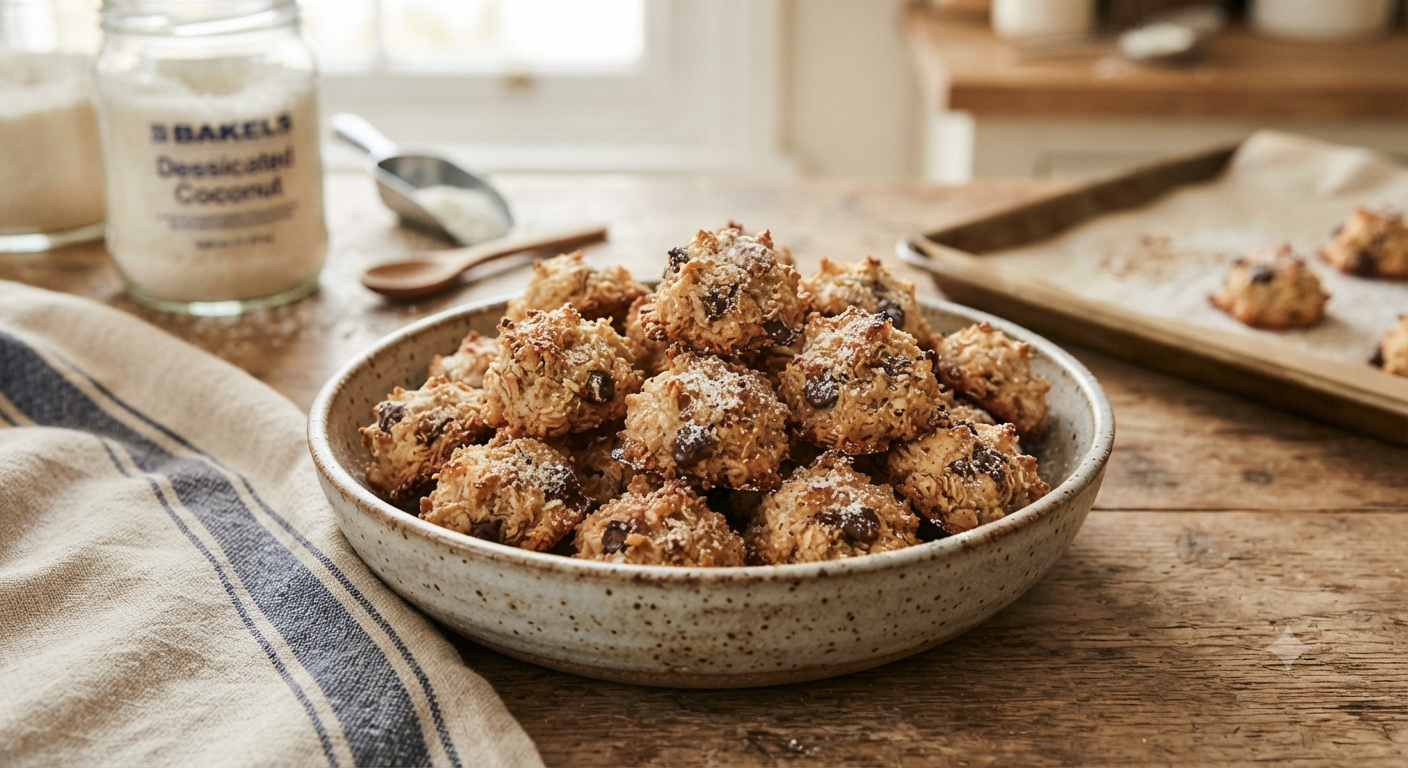
Bakels coconut drops 30g 12.5k is a product term searched by bakery owners, caterers, wholesalers and commercial kitchens looking for a convenient bulk coconut treat. There is, however, one important detail that many online descriptions overlook: the published Australian Bakels specification lists a 12.5 kg carton containing 25 g frozen, ready-to-bake coconut drops, rather than 30 g portions.
That difference is more significant than it initially appears. Portion weight affects carton yield, ingredient cost per cookie, baking consistency, inventory forecasting and the final selling price, so buyers should verify the product code and carton label instead of relying solely on an abbreviated online listing.
This guide explains what the product actually is, how it should be stored, what it contains and how professional bakeries can calculate its real commercial value.
What Is Bakels Coconut Drops 30g 12.5k?
The phrase Bakels coconut drops 30g 12.5k generally appears to describe a commercial carton of pre-portioned coconut dough pieces or “drops.” According to Australian Bakels, Coconut Drops are light-yellow, frozen portions developed as ready-to-bake cookies or biscuits with a sweet coconut flavour and a chewy texture after baking.
The verified Australian product code is 631052. Bakels places the product in its frozen products and sweet baked goods categories, with biscuits and cookies identified as the intended finished products.
That makes this product different from:
- Loose desiccated coconut
- Toasted coconut flakes
- Coconut chips
- Dry macaroon mix
- Coconut cake filling
- Chocolate-style coconut inclusions
- Fresh or frozen grated coconut
It is a formulated, pre-portioned bakery product. The pieces are intended to move from frozen storage to a controlled baking process with minimal preparation.
The important 30 g versus 25 g discrepancy
Several unofficial web pages refer to Bakels coconut drops 30g 12.5k and interpret “30g” as the weight of each portion. The manufacturer’s published specification dated 20 September 2023 instead states that the product is packed in a 12.5 kg carton with 25 g drops.
There are several possible reasons for the discrepancy. It may be an older description, a regional product variation, a reseller catalogue error or a search term that has been repeated across multiple websites without checking the original technical sheet.
Before purchasing, ask the distributor to confirm:
- The exact weight of each frozen drop
- The full Bakels product code
- The approximate number of portions per carton
- The manufacturing and best-before dates
- The current product specification
- Frozen transport conditions
- Ingredient and allergen declarations
- Whether the product differs by market
A professional buyer should not calculate food cost using a 30 g portion until that weight has been confirmed on the physical carton.
Verified Bakels Coconut Drops 30g 12.5k Product Snapshot
Anyone researching Bakels coconut drops 30g 12.5k should start with the manufacturer-supported facts rather than reseller summaries. The published Australian product information provides the following details.
- Product name: Coconut Drops
- Product code: 631052
- Format: Frozen, ready-to-bake coconut drops
- Published portion weight: 25 g
- Pack size: 12.5 kg carton
- Appearance: Light-yellow coconut drops
- Coconut content: 32%
- Storage range: -18°C to -25°C
- Shelf life: 12 months from manufacture
- Country of origin: Australia
- Ingredient sourcing: Local and imported ingredients
- Certification claim: Kosher certified
- Finished product category: Cookies and biscuits
These characteristics make the product especially relevant to businesses that require repeatable portions and faster preparation. They also show why proper frozen handling is essential: this is not an ambient-stable packet of coconut pieces that can be kept on a dry-store shelf.
Bakels Coconut Drops 30g 12.5k Ingredients and Production Role
The official ingredient list for Bakels coconut drops 30g 12.5k includes coconut, sugar, wheat flour, water, butter, milk solids, maize starch, raising agents, natural flavour and natural colour. The coconut accounts for 32% of the formulation and contains sulphite preservative 223.
Each ingredient has a practical role in the finished product:
- Coconut provides flavour, aroma, fibre and characteristic texture.
- Sugar contributes sweetness, colour development and tenderness.
- Wheat flour creates structure and helps the drop retain its form.
- Butter and milk solids add richness and influence mouthfeel.
- Maize starch supports texture and moisture management.
- Raising agents affect expansion, spread and bite.
- Natural flavour reinforces the intended flavour profile.
- Natural colour helps create a consistent appearance.
This is a complete formulated dough product, not simply sweetened coconut shaped into small pieces. The balance of flour, fat, starch, sugar and raising agents is designed to produce a consistent baked item.
It should not automatically be treated as a baking inclusion
Some online descriptions present Bakels coconut drops 30g 12.5k as an ingredient that can be scattered into muffin batter, bread dough, pastries or cake fillings. That interpretation is not supported by the Australian Bakels product page, which categorises the drops as frozen portions for cookies and biscuits.
A bakery may be able to develop alternative applications through testing, but it should not assume the drops will behave like chocolate chips or dry coconut pieces. Their butter, sugar, flour, water and raising-agent content could affect moisture, spreading and structure in another recipe.
Unless a technical representative recommends an alternative method, the most reliable use is to bake the portions as individual coconut cookies or biscuits.
Flavour, Texture and Expected Customer Experience
The manufacturer describes the baked product as sweet and coconut-flavoured, with a chewy texture. The light-yellow colour and 32% coconut content suggest a straightforward coconut biscuit designed for broad customer appeal rather than an intensely toasted or heavily flavoured specialty cookie.
The final result will still depend on the bakery’s process. Baking time, oven airflow, tray material, portion temperature and cooling conditions can influence colour, spread, crispness and centre texture.
For menu development, the product may pair naturally with:
- Dark or milk chocolate drizzle
- Caramel sauce
- Citrus glaze
- Raspberry or passionfruit flavours
- Vanilla ice cream
- Coffee and hot chocolate
- Dessert platters
- Afternoon tea selections
Any topping or coating should be tested for shelf stability and margin impact. A product that looks profitable as a plain cookie can become expensive once chocolate, packaging and finishing labour are added.
Allergen Information and Dietary Suitability
Bakels coconut drops 30g 12.5k contains wheat, gluten, milk and sulphites. Australian Bakels also states that tree nuts, egg and soy may be present because the product is manufactured using shared equipment.
The product should therefore not be promoted as:
- Gluten-free
- Wheat-free
- Dairy-free
- Sulphite-free
- Vegan
- Tree-nut-free
- Egg-free
- Soy-free
The “may be present” statement is particularly important for cafés and bakeries serving customers with allergies. An ingredient may not be deliberately added to the recipe but can still present a cross-contact risk through shared manufacturing equipment.
Is the product vegan or vegetarian?
The formulation contains butter and milk solids, so it is not vegan. It may be suitable for many vegetarian customers, but businesses should confirm their own certification standards before printing a vegetarian claim on menus or packaging.
Sulphites also require careful communication. Staff should have access to the latest carton label and allergen document rather than answering customer questions from memory.
Bakels Coconut Drops 30g 12.5k Nutrition Per 100 g and Per Drop
Australian Bakels publishes the nutritional information per 100 g. The listed values are 1,790 kJ of energy, 4.4 g protein, 23.5 g total fat, 20 g saturated fat, 47.3 g carbohydrate, 33 g sugars, 5.6 g dietary fibre and 130 mg sodium.
Based on the manufacturer-listed 25 g portion, one unbaked drop would contain approximately:
- 448 kJ of energy
- 1.1 g protein
- 5.9 g total fat
- 5 g saturated fat
- 11.8 g carbohydrate
- 8.3 g sugars
- 1.4 g dietary fibre
- 33 mg sodium
These figures are mathematical estimates derived from the published per-100 g values. They should not automatically be used as final retail nutrition declarations because baking can change moisture content and the weight of the finished product.
A food business should calculate final nutritional information using its legally approved method. Toppings, coatings, fillings and serving accompaniments must also be included.
Carton Yield and Food-Cost Planning
If the carton contains 12.5 kg of 25 g portions, its theoretical yield is 500 coconut drops. The calculation is straightforward: 12,500 g divided by 25 g equals 500 pieces.
A genuine 30 g version sold under the Bakels coconut drops 30g 12.5k description would produce approximately 416 full portions, with a small remaining weight balance. That is around 84 fewer complete pieces than a carton containing 25 g portions.
This difference can materially affect:
- Cost per cookie
- Daily production capacity
- Menu pricing
- Packaging purchases
- Sales forecasts
- Gross profit
- Freezer-space planning
- Reorder frequency
Calculate the true cost per saleable item
Do not compare suppliers using carton price alone. A lower carton price can become less attractive after frozen freight, damaged stock and lower usable yield are included.
Use this formula:
Total landed carton cost ÷ number of saleable baked pieces = cost per finished piece
The landed cost should include:
- Product price
- Frozen freight
- Fuel or delivery surcharges
- Import charges where applicable
- Taxes
- Distributor fees
- Cold-storage handling
- Payment or currency costs
The usable yield should be based on sellable finished pieces, not simply the theoretical number of frozen portions.
For example, a carton may theoretically provide 500 cookies, but only 485 may be suitable for sale after breakage, overbaking, handling damage and quality-control rejection. Dividing the landed cost by 485 gives a more realistic figure than dividing it by 500.
Why Commercial Bakeries Consider This Product
Commercial interest in Bakels coconut drops 30g 12.5k is mainly driven by convenience and repeatability. Pre-portioned frozen dough can remove several labour-intensive steps from daily production.
Potential operational advantages include:
- Consistent portion control
- Faster tray preparation
- Less weighing and mixing
- Reduced recipe-scaling errors
- Easier staff training
- More predictable daily output
- Reduced handling of loose coconut
- Simpler production forecasting
- Consistent customer portions
- Lower dependence on advanced mixing skills
Speed matters during busy mornings, seasonal demand and staff shortages. A team can concentrate on tray loading, baking, cooling and merchandising rather than preparing a complete coconut dough from scratch.
Convenience should still be measured against cost and product positioning. A premium artisan bakery may prefer a proprietary scratch recipe, while a high-volume café chain may place greater value on consistency and labour control.
Bakels Coconut Drops 30g 12.5k Storage and Cold-Chain Control
Correct frozen storage is essential for Bakels coconut drops 30g 12.5k. The manufacturer specifies a storage range of -18°C to -25°C and a best-before period of 12 months from the date of manufacture.
This means the carton should only be purchased from a distributor capable of maintaining frozen temperatures during storage and transport. A damaged, soft or partially thawed carton may create food-safety, quality and portion-handling problems.
Frozen-delivery receiving checklist
When a delivery arrives, staff should:
- Confirm that the carton is frozen.
- Inspect it for tears, crushing or moisture damage.
- Match product code 631052 with the purchase order.
- Check the batch and best-before information.
- Verify whether the label states 25 g or 30 g.
- Record the delivery temperature where required.
- Move the carton into frozen storage promptly.
- Rotate stock using first-expired, first-out procedures.
Do not automatically refreeze thawed portions. Isolate affected stock and follow the company’s food-safety plan or written supplier instructions.
A 12-month shelf life does not mean every delivered carton will have 12 months remaining. Ask the supplier to confirm the minimum remaining shelf life at dispatch, particularly when buying several cartons at once.
Baking and Handling for Consistent Results
The public product page confirms that the portions are ready to bake, but it does not publish one universal oven temperature or baking duration. Operators should follow the instructions printed on the carton or obtain a local technical sheet from their Bakels distributor.
Avoid copying baking instructions from an unrelated commercial oven. A rack oven, deck oven, convection oven and small café oven can produce noticeably different results at the same displayed temperature.
Before committing to a full batch, conduct a controlled one-tray trial and record:
- Condition of portions at loading
- Actual calibrated oven temperature
- Oven type
- Tray type
- Baking paper or release product
- Distance between portions
- Baking duration
- Colour at removal
- Cooling time
- Final diameter
- Final piece weight
- Centre and edge texture
Once the preferred result has been established, create a short standard operating procedure. Include photographs of the correct baked colour so different employees can judge the endpoint consistently.
Product Quality Checks After Baking
A buying decision should be based on repeatability, not simply whether one warm cookie tastes good. Test pieces from different trays and different positions inside the oven.
Evaluate:
- Colour: Is browning even across the tray?
- Shape: Are the pieces similar in diameter and thickness?
- Aroma: Is the coconut scent pleasant and clean?
- Texture: Is the centre chewy without feeling underbaked?
- Edges: Are they firm without becoming excessively hard?
- Release: Do the cookies lift cleanly from the tray?
- Breakage: Do they survive cooling, packing and display?
- Holding quality: Does the texture remain acceptable during the planned sales period?
Record the results against the batch number. This creates useful evidence if quality varies between deliveries or if the bakery needs technical support from the supplier.
Comparing Frozen Coconut Drops With Scratch-Made Cookies
Scratch-made coconut cookies give a bakery greater control over sweetness, coconut content, flavouring, size and ingredient sourcing. They can also support a handmade or signature-recipe marketing position.
Bakels coconut drops 30g 12.5k offers a different commercial advantage: simplified labour and standardised portions. The better option depends on volume, staffing, equipment, freezer capacity, brand identity and target margin.
The frozen format may be more suitable when:
- Labour availability is limited.
- Output varies between production shifts.
- Fast preparation is a priority.
- The business has reliable frozen storage.
- Consistency matters more than customisation.
- A standard coconut cookie fits the menu.
- Multiple locations need similar results.
Scratch production may be more suitable when:
- A proprietary recipe is central to the brand.
- Ingredient customisation is essential.
- The business needs a different allergen profile.
- Frozen delivery is unavailable.
- Freezer space is limited.
- The bakery promotes handmade production.
- A premium recipe supports a higher selling price.
Some businesses can successfully use both approaches. Frozen portions may support everyday volume, while a scratch-made signature cookie can serve as the premium option.
How to Buy Bakels Coconut Drops 30g 12.5k Confidently
Pricing and availability may vary by distributor and region. A quotation should identify the exact product code, pack weight, unit weight and frozen-delivery conditions rather than using only a shortened product name.
Ask the supplier to provide:
- The latest product specification
- A photograph of the current carton label
- Confirmation of 25 g or 30 g portion weight
- Product code and country of manufacture
- Approximate number of drops per carton
- Minimum order quantity
- Frozen delivery charges
- Remaining shelf life at dispatch
- Allergen documentation
- Kosher certification details where required
- Temperature-damage return policy
- Sample or trial-carton availability
- Technical baking guidance
These questions help prevent the business from ordering a similarly named dry mix, a different regional SKU or a carton that does not match its projected yield.
Compare value, not just price
When comparing quotations for Bakels coconut drops 30g 12.5k, calculate the cost per saleable baked piece. A supplier with a slightly higher carton price may offer better value through reliable frozen delivery, longer remaining shelf life and lower damage rates.
Also consider payment terms, minimum quantities and reorder speed. Cheap stock is not useful if the bakery must buy more than it can safely store or sell before the best-before date.
Common Purchasing and Production Mistakes
The most common mistake is treating Bakels coconut drops 30g 12.5k as a globally standardised 30 g product description. The Australian manufacturer information currently available identifies 25 g portions, making physical-label verification essential.
Other mistakes include:
- Keeping the carton in a chiller instead of a freezer
- Ignoring sulphites and cross-contact warnings
- Calculating yield from an unverified 30 g weight
- Failing to include frozen freight in food cost
- Ordering several cartons before a baking trial
- Assuming every delivery has 12 months of shelf life remaining
- Publishing vegan or gluten-free claims
- Using unofficial baking instructions
- Measuring gross margin from theoretical rather than usable yield
- Allowing cartons to remain at room temperature during production
- Failing to record batch numbers and delivery temperatures
A short purchasing checklist can prevent expensive pricing, labelling and production problems.
Frequently Asked Questions
1. What does Bakels coconut drops 30g 12.5k mean?
The description normally suggests coconut drops weighing 30 g each in a 12.5 kg commercial carton. However, the Australian Bakels specification for product code 631052 shows a 12.5 kg carton containing 25 g frozen drops, so the local carton label should always be verified.
2. How many coconut drops are in a 12.5 kg carton?
A carton containing 25 g portions has a theoretical yield of 500 drops. A carton containing genuine 30 g portions would provide approximately 416 complete drops, which is why portion-weight confirmation is necessary before calculating food cost.
3. Are Bakels Coconut Drops ready to bake?
Yes. Australian Bakels describes them as frozen, ready-to-bake coconut drops intended to produce cookies or biscuits. Operators should use the carton instructions or local technical guidance for the correct temperature, tray spacing and baking time.
4. How should Bakels Coconut Drops be stored?
They should remain frozen between -18°C and -25°C. The published best-before period is 12 months from manufacture, but the actual date and remaining shelf life should be checked on every carton.
5. Do Bakels Coconut Drops contain allergens?
Yes. They contain wheat, gluten, milk and sulphites, while tree nuts, egg and soy may be present because of shared manufacturing equipment. They should not be promoted as gluten-free, dairy-free, vegan or allergen-free.
Final Takeaway
Bakels coconut drops 30g 12.5k may appear to be a simple bulk bakery listing, but the portion-weight discrepancy changes the complete buying calculation. The most reliable Australian manufacturer specification identifies product code 631052 as a 12.5 kg frozen carton of 25 g ready-to-bake coconut drops, made with 32% coconut and requiring storage between -18°C and -25°C.
Before placing an order, request the latest technical specification and a photograph of the carton label. Confirm the portion weight, calculate cost using saleable yield, inspect the frozen-delivery arrangements and conduct a controlled baking trial.
Those few checks can protect your bakery from inaccurate pricing, incorrect allergen claims and unexpected production losses. More importantly, they help turn a convenient frozen product into a consistent, properly costed and profitable menu item.