



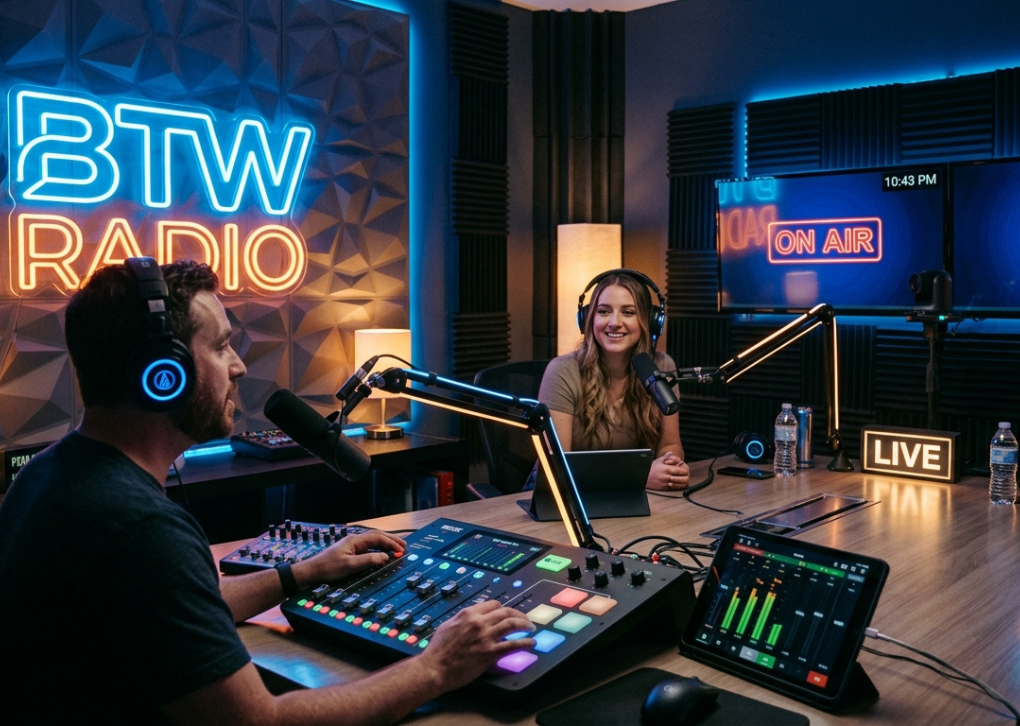
Btwradiovent is usually described online as a BetterThisWorld-linked digital radio or hosted audio event built around live discussions, storytelling, personal development, community issues, and interactive participation. That simple description, however, hides a major problem: the available web record is inconsistent, and many pages repeat broad promotional claims without supplying the basic details a real event normally makes easy to verify—such as a named organizing team, confirmed broadcast schedule, registration page, speaker roster, streaming destination, or accessible episode archive.
That makes this topic unusually important to approach with evidence rather than repetition. The most useful answer is not to declare every claim true or false; it is to separate what public pages actually say from what can be independently confirmed as of September 2026.
What Is Btwradiovent?
The most common description presents Btwradiovent as an online radio event associated with BetterThisWorld. Pages on BTWRadioVent.org describe it as a hosted digital broadcast featuring live discussions, curated programming, speakers, and conversations around global awareness, community impact, innovation, personal growth, wellness, and positive action.
BetterThisWorld.com uses a somewhat different framing. Its June 2026 coverage describes a multi-format event for storytellers, journalists, podcasters, producers, technologists, and media students, with live radio, field recordings, workshops, mixed-media panels, and audience experimentation.
Those descriptions overlap around digital broadcasting, audio storytelling, community engagement, and live participation, but they are not identical. One version sounds like a personal-development radio gathering; another resembles a professional media festival or radio lab.
That difference matters because an authoritative event profile should normally have a stable identity, purpose, format, and participation process. When those details shift between sources, readers need more than repeated claims before treating the event profile as settled fact.
The Most Important Fact: Public Information Is Inconsistent
Searchers often encounter confident statements about the project, yet the web evidence does not line up cleanly. One site even describes the term as a medical ventilation device used for breathing support while simultaneously discussing radio broadcasts and 2021 event dates—an internal contradiction that strongly suggests unreliable or conflated content.
A September 2026 fact-check by Tape Magzine reached a similar credibility concern from another direction. It reported finding multiple articles about the claimed event but no confirmed organizers, specific schedule, working registration page, or independently verifiable access route in the materials it reviewed.
This does not establish that every reference to the event is fabricated. It establishes something more useful for readers: claims should be treated as claims until the operational details can be verified.
That distinction is central to trustworthy coverage. An article can accurately report that a website describes an event in a particular way without pretending that every detail of that description has been independently proven.
Btwradiovent and BetterThisWorld: What the Connection Appears to Be
Several websites explicitly connect the event with BetterThisWorld. BTWRadioVent.org calls itself the official platform and says the broadcast initiative is organized by BetterThisWorld, while BetterThisWorld.com has published multiple articles describing it as its own event or media program.
The difficulty is that “BetterThisWorld” is not represented by one obviously unified web identity in search results. Multiple similarly branded domains publish lifestyle, motivation, business, technology, personal-growth, and event-related content, which makes source attribution harder for a reader who lands on a page from Google without prior brand knowledge.
For SEO researchers, journalists, potential attendees, and sponsors, this is a key entity-resolution problem. Before relying on a claim, identify which BetterThisWorld domain published it, who authored it, whether that domain provides verifiable organizational details, and whether another credible source corroborates the same information.
That extra step matters because similarly named sites are not automatically the same organization. Brand resemblance alone is weaker evidence than consistent ownership information, named personnel, cross-linked official profiles, and a traceable publishing history.
How the Claimed Online Radio Format Is Supposed to Work
Based on the most consistent descriptions, Btwradiovent is presented as a hosted online radio event rather than a conventional terrestrial radio station. The supposed format includes live or scheduled digital audio, interviews, discussions, interactive sessions, community participation, and, in some descriptions, workshops or mixed-media programming.
Conceptually, that format is plausible. Modern internet radio and virtual events can combine livestream audio, moderated chat, listener questions, guest interviews, prerecorded segments, on-demand replays, newsletters, and social distribution without requiring a local FM or AM frequency.
The distinction is important. A podcast is typically episode-based and primarily consumed on demand; terrestrial radio is tied to a station and broadcast infrastructure; a live online audio event is usually time-bound, internet-delivered, and participation-oriented.
If the project operates as described, it would fit closest to the third category. It may borrow mechanics from podcasts, webinars, digital conferences, livestreams, and community radio without belonging perfectly to any single traditional media format.
Btwradiovent Broadcast Dates: What Can Actually Be Verified?
This is the area where readers should be most cautious. BTWRadioVent.org says broadcast dates are announced and instructs visitors to stay updated for upcoming sessions, but the event guide reviewed does not provide a concrete next date in the relevant schedule section.
More importantly, the site’s own terms state that it does not guarantee the accuracy, completeness, or reliability of broadcast schedules, including historical references to 2021 dates.
That disclaimer materially weakens any unsupported schedule claim copied by third-party sites. A page saying that broadcasts are “regularly announced” is not equivalent to publishing an authoritative calendar with confirmed dates and access details.
BetterThisWorld.com’s June 17, 2026 article describes the event as returning in 2026 and discusses programming, workshops, attendees, and outcomes, but the page text reviewed does not show a registration instruction, a specific event date, or named speakers. That gap makes the article useful as a description of the concept, but not sufficient as a practical event notice.
So the safest current answer is straightforward: no specific upcoming Btwradiovent broadcast date should be treated as confirmed unless it appears on a verifiable first-party schedule with a working access or registration path. A publish date on an article is not the same thing as an event date.
What About “Btwradiovent Broadcast Dates 2021”?
The 2021 query deserves separate treatment because it appears in search-oriented content. BTWRadioVent.org references archived information related to 2021 broadcasts on its About page, yet the detailed event guide reviewed does not provide an actual 2021 date list.
There is also a timeline problem for one frequently surfaced domain. A public WHOIS-style record reports that btwradiovent.com was created on July 26, 2025.
That does not prove an event could not have existed under another name or platform in 2021. It does mean the present .com domain is not contemporaneous documentation from 2021, so historical claims on it require corroboration from older archives, dated social posts, event listings, audio files, press coverage, or other independent records.
This distinction is easy to miss. A website created years after an alleged event can report historical information, but the website’s existence cannot itself serve as proof that the earlier event occurred.
Why So Many Pages Sound Certain Even When Details Are Missing
This pattern is common in low-information search topics. Once a phrase begins appearing in indexed content, later publishers may infer details from earlier pages, paraphrase one another, or expand thin claims into complete-sounding narratives.
The result is a form of citation drift. “An online radio event” can gradually become “an annual event,” then acquire workshops, fundraising, expert speakers, global participation, archives, or a detailed mission even though the chain of evidence remains unclear.
Repetition creates familiarity, but familiarity is not verification. Ten websites repeating the same unsupported detail do not necessarily provide ten independent confirmations if they ultimately derive the claim from one another.
Search engines increasingly reward content that demonstrates experience, expertise, authority, and trust. For this topic, the strongest E-E-A-T approach is therefore not exaggerated certainty; it is source transparency, date checking, entity verification, explicit uncertainty, and a clear distinction between reported features and confirmed facts.
How to Verify Btwradiovent Before Registering, Paying, or Sharing Data
Before treating any event page as authoritative, run a basic verification workflow. This protects you from misinformation, outdated schedules, fake registrations, and pages that exist mainly to capture search traffic.
- Check for a specific date, start time, time zone, and streaming platform, not vague language about “upcoming broadcasts.”
- Look for named hosts, speakers, organizers, or production staff whose identities can be independently verified.
- Confirm that any registration or livestream link works and belongs to the same organization or a recognized event platform.
- Search for a past broadcast archive, episode recording, transcript, event recap, attendee discussion, or dated social post.
- Compare claims across first-party pages. If the mission, audience, format, or event history changes significantly from site to site, treat that as a credibility warning.
- Never submit sensitive personal or payment information solely because a page ranks highly for a branded keyword. Verify ownership, privacy terms, contact details, and the purpose of data collection first.
This process is especially important when a site makes strong claims but gives few operational details. A genuine online broadcast normally leaves a trail: announcements, URLs, guest identities, timestamps, recordings, comments, newsletters, social posts, or partner references.
Absence of one signal proves little. Absence of nearly all of them, however, should change how confidently you describe the event.
Is Btwradiovent a Radio Show, Event, Podcast, or Conference?
The available descriptions point most strongly toward a virtual audio event or digital broadcasting series, not a conventional radio station. Some sources also describe conference-like elements such as workshops, networking, media labs, and professional collaboration.
Calling it a podcast is less precise because the public descriptions emphasize live participation and scheduled broadcasts. Calling it a conference may also overstate what is confirmed, especially because venue, ticketing, full agenda, and participant documentation are not consistently available.
The best neutral label is therefore “a claimed BetterThisWorld-linked hosted online radio or audio event.” That wording reflects the dominant public description without presenting disputed operational details as established fact.
It also avoids collapsing several conflicting descriptions into a certainty the evidence does not support. Precision here is more valuable than using the most impressive-sounding label.
Who Might Be Interested in the Concept?
If the project operates according to its published descriptions, its themes could appeal to listeners interested in personal development, mental wellness, social impact, entrepreneurship, media innovation, podcasting, journalism, digital storytelling, and community-led broadcasting. Different pages emphasize different audiences, which is another reason to verify the specific session before assuming it matches your interests.
For creators, the underlying format is attractive because live audio can create immediacy without the production burden of a full video conference. For listeners, it can make expert interviews and community conversations easier to consume while commuting, working, or multitasking.
Still, potential value and verified existence are separate questions. A compelling format description should never replace a real schedule, identifiable participants, or a functioning way to attend.
That principle applies beyond this particular event. Whenever an online program promises networking, education, expert access, or community participation, the practical evidence should match the marketing language.
What Would Make the Project More Trustworthy?
The project would be much easier to evaluate if its first-party presence published a permanent event information hub containing the next confirmed date, timezone, streaming provider, registration status, named organizing team, speaker bios, editorial policy, past recordings, and an archive of previous schedules. Those are not decorative trust signals; they are the operational details users need to decide whether an event is current, legitimate, and relevant.
A consistent brand identity would help too. The current search landscape includes different BetterThisWorld-branded domains and conflicting descriptions, which creates ambiguity for users and weakens topical authority.
From an SEO standpoint, the solution is not more pages repeating the same keyword. It is better evidence architecture: one canonical event page, structured Event schema, author and organizer entities, last-updated timestamps, archived programs, embedded recordings, cited claims, and clear links between the parent organization and the broadcast property.
That structure would also improve semantic relevance. Google could connect the organizer, speakers, dates, media files, topics, and individual event editions as real entities instead of interpreting dozens of loosely related pages.
Frequently Asked Questions
Is Btwradiovent a real online radio event?
Several websites describe it as a BetterThisWorld-related online radio or digital audio event, and BetterThisWorld.com has published articles presenting it as an active media initiative. However, public verification remains incomplete because concrete operational details such as a consistently identifiable organizer, next broadcast date, working registration route, named lineup, and accessible archive are not uniformly available.
The most accurate approach is therefore conditional rather than absolute. The event has a visible web footprint, but readers should distinguish that footprint from independent confirmation of every claim made about its activities.
When is the next Btwradiovent broadcast date?
No specific upcoming date should be presented as confirmed based on the pages reviewed for this article. BTWRadioVent.org discusses schedules and says dates are announced, but its own terms disclaim guarantees regarding broadcast schedule accuracy, so readers should verify any date directly against a current first-party event page before making plans.
A trustworthy announcement should include the date, start time, timezone, participation method, and working stream or registration destination. Without those details, a date mentioned on an unrelated article should not be treated as an official schedule.
Were there Btwradiovent broadcast dates in 2021?
Some current pages reference 2021 broadcasts, but the sources reviewed do not provide a verifiable date-by-date 2021 archive. The fact that btwradiovent.com was reportedly registered in July 2025 also means that domain cannot, on its own, prove events occurred four years earlier.
Stronger historical proof would include archived event announcements, dated recordings, independent press references, social posts from 2021, participant accounts, or older web snapshots. Until such material is located, exact 2021 schedule claims should be labeled unverified.
How can I join a Btwradiovent live stream?
Do not rely on generic instructions such as “visit the official platform” unless a current page provides a functioning stream or registration link. Verify the event date, timezone, host identity, platform, privacy policy, and access URL first.
If those details are missing, wait for a clearer first-party announcement rather than submitting personal information to an unverified form. Legitimate online events should make the pathway from discovery to attendance straightforward.
Is Btwradiovent a medical ventilator?
There is no reliable basis in the reviewed evidence to treat the term as an established medical device name. One website makes that claim while also mixing in radio-event terminology and broadcast dates, creating a serious internal inconsistency.
For health or clinical information, rely on recognized medical-device manufacturers, regulators, hospitals, and peer-reviewed or professional sources instead. A search-optimized webpage should never be used as evidence that an unfamiliar medical device exists or is suitable for patient care.
Final Verdict: Treat the Concept as Plausible, but Verify the Event
Btwradiovent is best understood as a web-described, BetterThisWorld-linked digital audio or online radio event centered on conversation, storytelling, learning, and community engagement. The concept itself is coherent, and multiple pages describe overlapping features, but the public record still contains enough contradictions and missing operational details to justify caution.
If you want to attend, cite, promote, sponsor, or write about the project, make your next step evidence-based. Locate a current first-party page that shows the exact date, time zone, organizer, speakers, streaming or registration link, and preferably a past-event archive.
Until those elements are visible and consistent, avoid repeating unsupported dates or presenting promotional claims as verified facts. Readers searching for practical information benefit far more from careful verification than from another confident summary built on recycled claims.
That approach is also the stronger long-term SEO strategy. Answer the search intent fully, expose the uncertainty competitors gloss over, establish clear entity relationships, and give users a practical method for distinguishing a documented broadcast from recycled search content.