



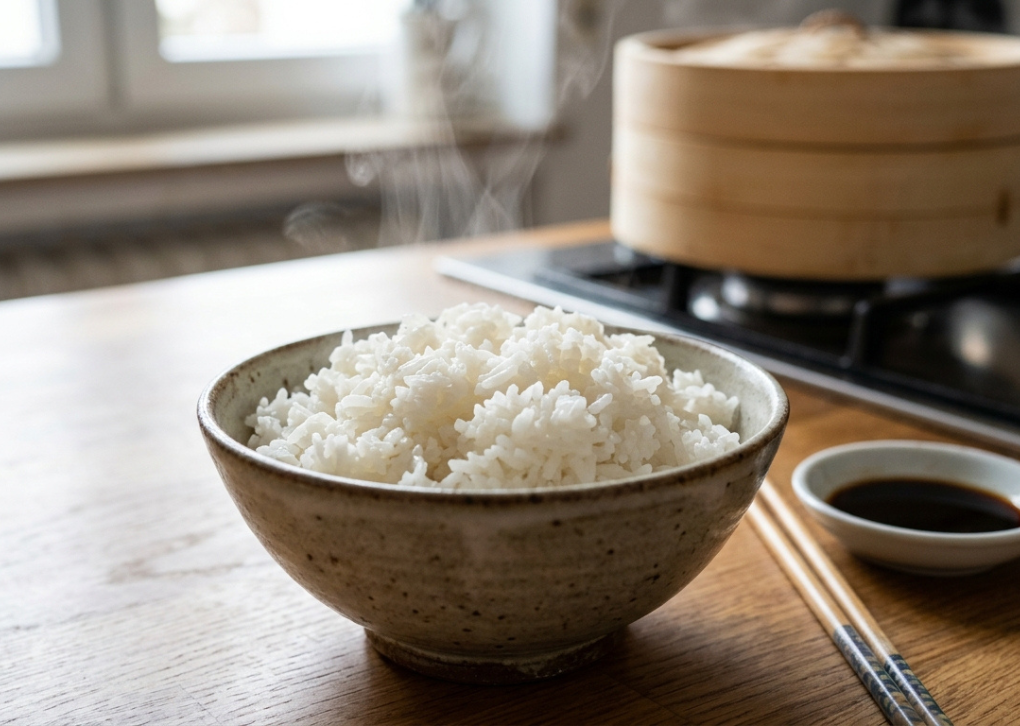
Dampfreis looks like a simple food term, but it carries more nuance than many online explanations admit. In German culinary usage, Dampfreis generally means steamed rice: rice cooked with steam or finished in a tightly covered vessel so the grains become tender without being churned in excess boiling water. In commercial rice markets, however, the same wording may also appear on packs of steam-treated Basmati, which is a processing category rather than a home-cooking technique.
That distinction matters. If you are trying to reproduce restaurant-style fluffy rice, buy rice for biryani, understand a German menu, or compare steam Basmati with Sella rice, you need to know whether the term describes what happens in the kitchen or what happened at the mill.
What Does Dampfreis Actually Mean?
The word combines the German Dampf, meaning “steam,” and Reis, meaning “rice.” In ordinary food-service and kitchen contexts, Dampfreis is best understood as steamed rice, and the usage is visible on German-language restaurant menus as well as equipment designed specifically for cooking rice with steam.
There is no single protected recipe attached to the name. Depending on the kitchen, it may refer to rice cooked in a steamer, rice cooked by absorption and allowed to finish in its own steam, or rice that is briefly boiled and then steamed until fully tender.
This is where many low-quality explanations go wrong. Dampfreis is not a unique rice species, a newly discovered grain, or a special German cultivar. The term primarily describes preparation, while some commercial suppliers also use “Dampfreis” or “steam rice” for rice that has received steam treatment before sale.
The Two Meanings You Should Not Confuse
1. Dampfreis as a Cooked Dish
At home or in a restaurant, the phrase usually points to cooked rice served as a side dish. The aim is typically clean grain definition, an even texture, and enough moisture for tenderness without turning the rice into a wet or porridge-like mass.
A steamer can achieve that directly. A covered saucepan or rice cooker can achieve a similar final effect through absorption: the water is absorbed, the heat is lowered or switched off, and trapped steam completes the cooking.
2. Dampfreis as Steam-Processed Rice
In Basmati trading, especially in South Asian export markets, “steam rice” can describe rice treated with steam during industrial processing. That product may remain pale or off-white and is often marketed separately from raw white Basmati and Sella, the latter being a more fully parboiled product.
Commercial terminology is not perfectly standardized across every supplier, so the processing specification matters more than the label alone. When buying packaged rice, check whether the producer means simply “suitable for steaming,” “steam-treated,” or “parboiled.”
Dampfreis vs. Boiled, Parboiled, Sella, and Rice-Cooker Rice
The easiest way to understand the category is to separate cooking method from grain processing.
Boiled rice may be cooked in excess water and drained, much like pasta, or simmered in a measured amount of water until the liquid is absorbed. Steamed rice relies more heavily on steam as the heat-and-moisture transfer mechanism, either from below or inside a covered vessel.
Parboiled rice is different again. Before milling, paddy rice is typically soaked, steamed or otherwise heat-treated, and dried. That hydrothermal process changes the starch structure and can move some micronutrients from the outer layers toward the endosperm, helping retain them after milling. FAO describes soaking, steaming and drying as the core parboiling process.
Sella Basmati is a common South Asian term for parboiled Basmati. It tends to cook firmer and more separately than raw white Basmati, while steam Basmati is often positioned as a lighter-treated, paler product with a more delicate bite. Exact processing conditions can differ among mills, which is why specification sheets are more reliable than marketing terminology alone.
A rice cooker does not define a rice type at all. It is simply a controlled cooking appliance, and it can produce excellent steamed rice when the rice-to-water ratio, variety, soaking time, and resting period are matched correctly.
Why the Texture Is Different
Good steamed rice depends on starch management. Rice kernels contain starch, including amylose and amylopectin, and their relative proportions influence whether cooked grains feel firm, fluffy, soft, or sticky.
Rinsing removes loose surface starch and dust, which can reduce gumminess in varieties intended to stay separate. Soaking can help moisture penetrate the grain more evenly, particularly with aged Basmati, although the ideal soak depends on the rice and the cooking method.
Heat then gelatinizes starch inside the kernel. If there is too much free water, too much agitation, or too long a cooking time, the outer structure can break down and release more starch, creating clumps or mush.
Gentle steam and a proper rest reduce that mechanical disturbance. The result is not necessarily “drier” rice; it is rice in which moisture is distributed more evenly through the grain.
Best Rice Varieties for Dampfreis
You can use many rice varieties, but the result changes dramatically with grain genetics and processing. Long-grain Basmati is a strong choice when you want fragrance, elongation, and visibly separate grains, while jasmine rice produces a softer, more cohesive texture with a floral aroma.
Medium- and short-grain rice can also be steamed, but they naturally have characteristics that encourage more cling. That is useful for some East Asian meals but less suitable if your target is the dry, elongated grain structure associated with biryani or pilaf.
For a practical buying decision, focus on the outcome you want:
- Aged Basmati: best for long, aromatic, separate grains and dishes such as biryani or pulao.
- Steam Basmati: useful when you want a pale grain with extra cooking resilience compared with very delicate raw white rice.
- Sella or parboiled Basmati: ideal for large batches, catering, and dishes where firmness and grain separation matter.
- Jasmine rice: best when a tender, slightly cohesive texture and pronounced aroma are desirable.
- Ordinary long-grain white rice: economical and versatile for everyday side dishes.
- Brown rice: retains the bran layer and provides more fiber, but it requires more water and considerably more cooking time.
How to Make Dampfreis at Home
There are several valid techniques, but consistency improves when you treat the water ratio as a variable rather than a universal rule. Different varieties, ages, soaking times, pot shapes, and heat levels change how much water is needed.
For a basic absorption method, rinse long-grain rice until the runoff is noticeably less cloudy, drain it well, and place it in a heavy pot with the manufacturer’s recommended amount of water. Bring it just to a boil, cover tightly, reduce the heat to its lowest stable setting, and cook without repeatedly lifting the lid.
Once the water has been absorbed and the grains are tender, remove the pot from the heat and leave it covered for about 10 minutes. That resting phase is not dead time: trapped vapor redistributes moisture, while the grain surface becomes less wet and fragile.
Fluff with a fork or rice paddle rather than stirring aggressively. If you are using Basmati, work gently from the edges inward so you do not snap the elongated grains.
Traditional Direct-Steaming Method
For true steam-only cooking, rice is usually soaked first because dry raw kernels hydrate slowly when they are not sitting directly in water. The drained rice is placed in a steamer basket or perforated insert over simmering water and covered until tender.
This method requires equipment with fine enough perforations to hold the grains and enough steam flow to cook evenly. Tefal, for example, markets dedicated rice bowls specifically for cooking rice and grains in a steam cooker, illustrating that direct steam preparation is an established kitchen method rather than merely an SEO definition.
The Persian-Style Boil-and-Steam Method
Another important technique is to boil soaked rice briefly in plenty of water, drain it while the center still has some firmness, and then return it to a covered pot for a steam finish. This is the foundation of Persian chelo-style rice and can create exceptionally distinct grains.
The technique also makes it possible to develop tahdig, the crisp layer formed at the bottom of the pot. In this context, the final texture is steam-finished even though the grains initially spend time in boiling water.
Common Mistakes That Ruin Dampfreis
The first mistake is assuming every bag of rice needs the same amount of water. Freshly harvested rice, aged Basmati, parboiled rice, brown rice, and jasmine rice hydrate differently, so a fixed “one ratio fits all” rule is unreliable.
Another problem is excessive stirring. Rice is not risotto unless you are intentionally cooking it that way; repeated agitation damages softened grains and releases surface starch.
Opening the lid repeatedly also dumps steam and disrupts the temperature balance. Every peek changes the cooking environment.
Skipping the rest is equally costly. Freshly cooked rice can look slightly wet and feel fragile, but a covered rest lets moisture equalize and makes the grains easier to separate without breaking.
Finally, do not confuse “more steam” with “more water.” Too much water still creates overly soft rice, even when the pot is covered. Texture is controlled by total hydration, starch type, temperature, time, and rest—not by steam alone.
Is Dampfreis Healthier Than Regular Rice?
Not automatically. The nutritional profile depends more on the rice variety, degree of milling, fortification, serving size, and pre-processing method than on whether the final cooking stage uses steam.
Brown rice keeps its bran and germ, so it generally contains more fiber and naturally occurring micronutrients than highly polished white rice. Milling removes significant amounts of nutrients from rice, while parboiling can improve retention of certain vitamins and minerals by moving some nutrients toward the endosperm before milling.
A more precise claim is that cooking rice with only the water it needs may avoid the losses that can occur when rice is cooked in excess water and that water is discarded. That does not make steamed rice a “superfood”; it simply means the cooking method can influence what remains in the final serving.
For blood-glucose management, avoid relying on the word “steamed” as a health signal. Glycemic response can vary with rice variety, amylose content, parboiling, portion size, meal composition, cooking degree, and individual physiology. Research reviews specifically note that parboiling and processing conditions can affect glycemic characteristics, but the effects are not identical for every rice product.
Food Safety: The Part Most Rice Guides Miss
Cooked rice deserves careful handling because uncooked rice can carry spores of Bacillus cereus. Some spores can survive normal cooking, and if cooked rice spends too long at room temperature, bacteria may multiply and toxins can form.
Food-safety authorities therefore emphasize rapid cooling and cold storage for leftovers. If you cook rice in bulk, transfer leftovers into shallow containers and refrigerate promptly rather than leaving a large pot sitting at room temperature.
Guidelines vary by jurisdiction. The UK Food Standards Agency advises cooling rice as quickly as possible, ideally within one hour, refrigerating it, consuming refrigerated rice within 24 hours, and reheating it no more than once.
The key point is counterintuitive: reheating does not “reset” badly stored rice. Safe handling begins immediately after cooking.
How to Choose Packaged Dampfreis
Packaging language can be ambiguous, so read beyond the front label. If a product is sold as Basmati Dampfreis, look for the variety name, country of origin, whether it is raw, steam-treated, or parboiled, and any cooking instructions that reveal the intended use.
German retailers, for example, sell products explicitly labelled Basmati Dampfreis and describe steam treatment as part of the processing story. At the same time, rice exporters may distinguish white, steam, and Sella Basmati as separate commercial categories.
For premium Basmati, grain length and age can affect cooking performance, but neither tells the whole story. Broken-grain percentage, moisture, processing intensity, storage, and supplier grading can all change the final plate.
If you are buying for a restaurant or in bulk, run a controlled cooking test. Use the same dry-rice weight, soak, water, pot, heat, and holding time for each sample, then compare aroma, elongation, breakage, stickiness, firmness, and cooked yield.
That simple test tells you far more than a bag covered in adjectives such as “premium,” “extra-long,” or “superior.”
What to Serve With Dampfreis
Because the flavor is deliberately neutral and clean, steamed rice works best as a structural side rather than a competing centerpiece. It absorbs sauces, balances spice, and provides a soft-textured base for meat, fish, tofu, legumes, curries, stir-fries, and vegetable dishes.
For South Asian food, aromatic Basmati works naturally with dal, korma, grilled kebabs, chicken curry, and biryani-style preparations. In East and Southeast Asian meals, jasmine or other regionally appropriate varieties may fit better with stir-fries, teriyaki, coconut curries, or steamed fish.
German-language restaurant menus also commonly pair Dampfreis with Asian-style chicken, beef, duck, vegetables, curries, and sweet-and-sour dishes, reinforcing its role as a versatile neutral accompaniment.
The useful rule is simple: choose the rice variety to match the cuisine, then choose the steaming method to achieve the texture you want.
FAQ About Dampfreis
Is Dampfreis the same as steamed rice?
Usually, yes. In a German menu or household cooking context, Dampfreis generally refers to rice prepared with steam or finished by steaming in a covered vessel.
On packaged Basmati, however, the term may describe industrial steam treatment. That is why the processing description on the package matters.
Is Dampfreis the same as parboiled rice?
No. Parboiled rice is a processing category, not simply rice that has been steamed for dinner.
Traditional and industrial parboiling generally involves hydrating paddy rice, thermally treating it—often with steam—and drying it before milling. A bowl of rice can be steamed at home without the grain ever having been commercially parboiled.
Do I Need a Steamer to Make Dampfreis?
No. A steamer is one method, but a covered saucepan or rice cooker can produce the same fluffy, steam-finished style through absorption cooking.
The critical variables are rice variety, water amount, heat control, cooking time, and resting time. Equipment helps, but technique matters more.
Should I Rinse Rice Before Steaming It?
For Basmati and many long-grain varieties, rinsing is useful because it removes loose surface starch and can improve grain separation. Rinse gently rather than crushing or rubbing the kernels aggressively.
Some enriched rice products advise against extensive rinsing because added nutrients may wash away. When the manufacturer gives specific preparation instructions, those should take priority.
How Do I Keep Dampfreis From Becoming Sticky?
Start with a variety designed for separate grains, rinse when appropriate, avoid excess water, keep agitation low, and rest the rice covered after cooking. Letting it stand for several minutes is one of the simplest ways to improve grain definition.
If you need maximum resilience for catering, biryani, buffet service, or large-batch cooking, steam-treated or parboiled Basmati may be more forgiving than delicate raw white rice.
Conclusion: Treat the Label as a Clue, Not the Whole Answer
Dampfreis is best understood as a technique-centered rice term, not a mysterious grain variety. In most culinary settings it means steamed or steam-finished rice, but in Basmati commerce it may also point to a steam-treated product with specific processing characteristics.
For the best result, decide what you actually need before you cook or buy: delicate aromatic rice, firm separate grains, a restaurant-style side dish, or a resilient bulk-cooking product. Then match the variety, processing method, water ratio, and steaming technique to that goal.
If you are cooking tonight, start with the instructions on your rice package, rinse if appropriate, measure water carefully, keep the lid closed, and give the finished rice a proper rest. That combination improves consistency more reliably than any one “secret” ratio.