



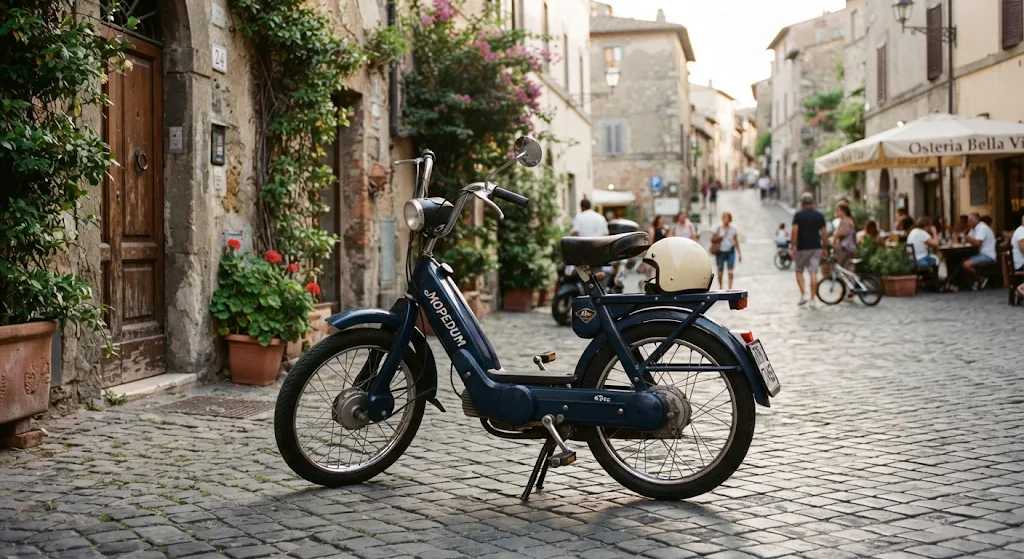
Mopedum is a name associated with Sweden’s vintage moped history, nostalgic culture, and everyday life during the 1950s, 1960s, and 1970s. Located in Nynäshamn, south of Stockholm, the original Mopedum museum brought together classic mopeds and historical objects to recreate the atmosphere of an earlier period in Swedish society.
Unlike a conventional vehicle museum, Mopedum offered visitors more than motorcycles and mechanical displays. Its recreated environments included household objects, toys, clothing, furniture, and other reminders of everyday Swedish life. The result was a nostalgic experience that connected transportation history with social and cultural heritage.
However, there is an important distinction for anyone researching Mopedum today: the original physical museum permanently closed in December 2022. Its former location should not be confused with the Mopedum name and online content that continue to appear in search results.
Trendify Magazine+2
This guide explores what Mopedum was, why vintage mopeds became important in Sweden, what visitors could discover, what happened after the museum closed, and where enthusiasts can explore similar historical exhibits.
What Is Mopedum?
Mopedum was a Swedish nostalgia museum dedicated primarily to the history of mopeds and their connection with everyday life. Its full identity was associated with Mopedum Svenska Nostalgimuseet, and its historical setting was in Nynäshamn, a coastal town south of Stockholm.
The museum focused particularly on the period between 1952 and 1979, an era associated with the growing popularity of mopeds as affordable personal transportation.
What made Mopedum distinctive was its presentation. Instead of displaying vehicles in isolation, it placed them alongside objects and recreated settings that helped visitors understand the society in which these machines were used.
What Made Mopedum Different From Other Vehicle Museums?
Many traditional transport museums concentrate on technical specifications, manufacturers, engines, and vehicle development. Mopedum approached the subject from a broader cultural perspective.
Its displays connected several aspects of Swedish heritage:
-
Vintage transportation: Classic mopeds and their historical development.
-
Everyday lifestyle: Furniture, household equipment, and familiar domestic objects.
-
Fashion and clothing: Period-related styles that reflected changing decades.
-
Childhood memories: Toys, games, and other nostalgic items.
-
Commercial history: Recreated environments inspired by shops and everyday businesses.
This combination allowed visitors to understand not only how people travelled but also how they lived, dressed, socialized, and spent their free time.
The History of Mopedum and Sweden’s Vintage Moped Culture
To understand Mopedum, it helps to understand why mopeds became such an important part of Swedish transportation and popular culture.
During the middle of the twentieth century, personal mobility was changing across Europe. Affordable two-wheeled vehicles offered an accessible way for people to travel without purchasing a full-sized car. Mopeds became particularly attractive to young people, commuters, and families looking for practical transportation.
Sweden developed a strong relationship with these vehicles. Domestic manufacturers produced mopeds that reflected changing engineering standards, consumer expectations, and design preferences.
Why Were Mopeds So Popular in Sweden?
Mopeds offered several advantages that made them appealing to ordinary households:
-
Affordable transportation: They provided a less expensive alternative to cars and larger motorcycles.
-
Everyday convenience: Riders could use them for commuting, shopping, and short-distance journeys.
-
Personal independence: Younger riders gained greater freedom to travel independently.
-
Practical engineering: Their relatively compact construction made them suitable for everyday transportation.
-
Distinctive design: Different manufacturers introduced recognizable frames, body shapes, colors, and mechanical arrangements.
The popularity of mopeds was not simply about transportation. They became associated with independence, youth culture, leisure, and technological progress.
Mopedum’s Historical Period: 1952–1979
One of the most interesting aspects of Mopedum was its focus on the period from 1952 to 1979.
This timeline covered several decades of changing European lifestyles.
| Period | Historical significance |
|---|---|
| 1950s | Growing interest in affordable personal transportation |
| 1960s | Changing consumer culture, design and youth lifestyles |
| 1970s | Evolving vehicle styles, technology and everyday mobility |
The museum used this historical framework to create a broader picture of Swedish life rather than treating vintage mopeds as isolated mechanical objects.
Its recreated rooms also reflected the changing appearance of homes, shops, and leisure environments during these decades.
Vällingby Centrum+2
What Could Visitors See Inside Mopedum?
A major attraction of Mopedum was its combination of vintage transportation and everyday historical objects.
Visitors could explore different environments designed to represent earlier Swedish lifestyles. These displays made the museum interesting even for people who were not particularly knowledgeable about motorcycles.
1. Vintage Moped Collection
The vintage moped displays were at the center of the museum’s identity.
Different vehicles represented the development of two-wheeled transportation during the twentieth century. Their construction, styling, and mechanical characteristics offered visitors an opportunity to compare historical models.
Some of the manufacturers represented in the surviving Stockholm exhibition include:
-
Crescent: A recognizable Swedish name associated with bicycles and mopeds.
-
Husqvarna: A historic Swedish manufacturer with a long association with motorcycles and other mechanical products.
-
Monark: A Swedish brand known for bicycles and motorized two-wheelers.
-
Fram: Another name represented in the historical moped display.
-
Victoria: A European manufacturer associated with older motorcycles and mopeds.
These manufacturers provide an interesting starting point for anyone researching Swedish moped history. Comparing their surviving machines can reveal differences in frame construction, styling, equipment, and design philosophy.
Vällingby Centrum+1
2. Recreated 1950s Swedish Kitchen
The recreated 1950s kitchen was another memorable part of the nostalgic experience.
It represented a period when household design and modern domestic conveniences were becoming important aspects of everyday life. The room featured characteristic period details, including angled upper kitchen cabinets.
Rather than explaining history through written information alone, this type of exhibit allowed visitors to observe how domestic environments were arranged.
It also demonstrated why household objects deserve a place in cultural museums. A kitchen can tell visitors about changing lifestyles, consumer products, family routines, and design preferences.
3. Traditional Swedish Shop
The traditional shop display recreated an earlier style of retail shopping.
Before modern self-service supermarkets became dominant, many customers purchased products through counter-based shopping. Shopkeepers would retrieve items, measure products, and assist customers directly.
This environment helped illustrate how commercial relationships and shopping habits have changed over time.
For younger visitors, it offered a glimpse into a retail experience very different from modern supermarkets and convenience stores.
4. 1960s Hair Salon and Fashion Culture
Personal appearance and fashion also formed part of the museum’s wider historical theme.
The recreated hair salon represented the changing styles and consumer culture of the 1960s. Hairdressing equipment, salon furniture, and period-inspired surroundings helped establish the atmosphere of that decade.
This exhibit added another dimension to the experience by showing that nostalgia extends beyond transportation and household technology.
5. 1970s Children’s Room and Toys
The children’s room provided a particularly interesting look at family life during the 1970s.
Its decorative elements included Dunderklumpen-themed wallpaper, reflecting the popular children’s culture of the period.
Toys, decorations, and familiar domestic objects can preserve memories in ways that technical displays sometimes cannot. Visitors who grew up during the era could recognize objects from their childhood, while younger generations could compare the room with contemporary children’s bedrooms.
The recreated kitchen, traditional shop, hair salon, and children’s room are documented in the official Vällingby Centrum exhibition information.
Vällingby Centrum+2
Where Was Mopedum Located?
The original Mopedum museum was located in Nynäshamn, Sweden.
Its former address was:
Vikingavägen 39, 149 40 Nynäshamn, Sweden.
Nynäshamn is a coastal town south of Stockholm, known for its harbor and connection to the Stockholm archipelago.
The location made Mopedum an interesting destination for people exploring the region. Visitors could combine an interest in Swedish transport history with a wider trip around the coastal area.
However, the address is now historical rather than a current museum destination. The former attraction closed permanently in December 2022.
Explore Archipelago+1
When Did Mopedum Open and Close?
The original museum operated for approximately ten years.
Its opening is generally associated with 2012, while its permanent closure took place in December 2022.
| Historical detail | Information |
|---|---|
| Museum name | Mopedum Svenska Nostalgimuseet |
| Country | Sweden |
| Original location | Nynäshamn |
| Opening year | 2012 |
| Closure | December 2022 |
| Main historical period | 1952–1979 |
| Main attraction | Vintage Swedish and European mopeds |
| Wider theme | Swedish everyday life and nostalgia |
The closure was connected with the founders’ decision to retire. The important development was that Vällingby Centrum acquired the museum’s contents and some of its mopeds rather than allowing the entire collection to disappear from public view.
The center subsequently developed its own Nostalgimuseum exhibition in Stockholm.
Vällingby Centrum+2
Why Did Mopedum Close?
The closure was primarily associated with the retirement of its creators, Nisse and Lotta Skogmyr.
Running a specialized museum requires considerable personal commitment. Collecting historical vehicles, maintaining exhibits, preserving objects, and welcoming visitors all involve time and resources.
After approximately a decade of operation, the founders decided to retire. This brought the original museum experience in Nynäshamn to an end.
One important detail is that the closure did not mean every historical object was immediately lost or discarded. Vällingby Centrum stepped in to acquire the museum’s contents and a number of its mopeds, providing a new home for parts of the collection.
This decision helped preserve the historical environments and make them accessible to another audience.
Vällingby Centrum+1
What Happened to the Mopedum Collection After Closure?
One of the most frequently asked questions about Mopedum concerns the destination of its historical exhibits.
Fortunately, part of the collection found a new home at Vällingby Centrum in Stockholm.
The shopping center acquired the museum’s contents and a number of its mopeds when the original owners retired. It then recreated several historical environments within the center’s public passages.
The Move to Vällingby Centrum
The new exhibition opened to visitors on March 17, 2023.
Rather than creating another conventional museum building, Vällingby Centrum integrated the displays into its existing shopping-center environment.
This arrangement created an unusual opportunity to experience historical interiors while moving through a modern commercial space.
The recreated environments include:
-
A traditional shop inspired by earlier retail practices.
-
A Swedish 1950s kitchen.
-
A 1960s hair salon.
-
A 1970s children’s room.
-
A collection of vintage Swedish and European mopeds.
The center identifies five display areas, with the moped collection presented in a dedicated showcase.
Importantly, this is a preserved selection of the former museum’s collection, not a reopening of the original Nynäshamn attraction.
Vällingby Centrum+2
Which Vintage Moped Brands Can You See Today?
The current Vällingby Centrum moped display identifies several historical manufacturers.
| Manufacturer | Historical relevance |
|---|---|
| Crescent | Swedish bicycle and moped heritage |
| Husqvarna | Swedish motorcycle and mechanical engineering heritage |
| Monark | Swedish two-wheeler manufacturing |
| Fram | Historical European moped representation |
| Victoria | European motorcycle and moped heritage |
These names make the exhibition particularly interesting for people researching classic Swedish mopeds and European transportation history.
The selection also demonstrates how different manufacturers contributed to the development of affordable two-wheeled mobility.
Is the Entire Original Collection Still Available?
No complete public inventory establishes that every item from the former museum remains together in Stockholm.
The reliable distinction is that Vällingby Centrum acquired the contents of the museum and a number of its mopeds, and its current exhibition presents selected surviving objects and recreated environments.
It is therefore more accurate to describe the Stockholm display as a continuation of part of the collection rather than claim that every original vehicle and object is available there.
Vällingby Centrum+1
Is Mopedum Still Open in 2026?
No. The original Mopedum museum in Nynäshamn is permanently closed.
Its closure took place in December 2022, and there is no verified announcement that the original museum has reopened.
There are several reasons why people may still encounter information suggesting otherwise:
-
Older travel websites retain historical opening hours.
-
Previous visitor reviews remain accessible.
-
Historical photographs and museum descriptions continue circulating online.
-
The Mopedum name still appears in vintage-moped-related search results.
-
The surviving collection is displayed at a different location in Stockholm.
These details can create confusion, particularly for international visitors searching for a Swedish vintage museum.
Can You Still Visit the Mopedum Exhibition?
Although the original museum no longer welcomes visitors, parts of its former collection can still be explored at Nostalgimuseum in Vällingby Centrum.
The official shopping-center website provides information about the exhibition, including its historical interiors and moped display.
You can check current visitor information here:
The first link is particularly useful when planning a visit because it describes the surviving exhibition and its location.
Vällingby Centrum+1
Why Is Mopedum Important for Swedish Cultural Heritage?
The historical importance of Mopedum extends beyond its collection of vintage vehicles.
It demonstrated how everyday objects can help explain social changes. A moped, for example, can represent much more than a particular engine or manufacturer. It can reflect economic conditions, transportation needs, youth independence, and technological developments.
Preserving Everyday History
Historical preservation often concentrates on major political events, famous personalities, architectural landmarks, and important inventions.
However, ordinary objects also deserve attention.
Consider the following examples:
-
A vintage moped illustrates historical transportation and personal mobility.
-
A traditional kitchen reveals changes in domestic technology.
-
A recreated shop demonstrates earlier shopping practices.
-
Vintage toys preserve memories of childhood entertainment.
-
A historical hair salon reflects changing fashion and consumer culture.
By bringing these elements together, Mopedum created a more complete picture of everyday Swedish life.
Connecting Different Generations
Nostalgia museums can also create meaningful connections between generations.
Older visitors may recognize objects they used during childhood or remember seeing in their family homes. Younger visitors can discover how people travelled, communicated, shopped, and entertained themselves before modern digital technology became widespread.
This intergenerational experience is an important part of cultural preservation.
The surviving Stockholm exhibition continues this approach by placing historical interiors and vehicles in an accessible public setting.
Mopedum and the Evolution of Vintage Mopeds
For motorcycle enthusiasts, one of the most interesting aspects of Mopedum is its connection with classic moped engineering.
Vintage mopeds represent an important stage in the development of personal transportation. Their designs reflected the engineering capabilities, manufacturing methods, and consumer preferences of their respective periods.
What Makes a Vintage Moped Different From a Modern Scooter?
Although vintage mopeds and modern scooters share the same general purpose, they often differ significantly in construction and design.
| Feature | Vintage mopeds | Modern scooters |
|---|---|---|
| Design | Traditional mechanical styling | Contemporary styling |
| Engine technology | Often simple combustion engines | Combustion or electric systems |
| Instrumentation | Basic mechanical controls | Often digital displays |
| Maintenance | Frequently requires mechanical knowledge | Varies by model and technology |
| Parts | Can be difficult to source | Availability depends on manufacturer |
| Historical value | May have collector interest | Primarily practical or technological value |
These are broad comparisons rather than specifications applicable to every model.
Why Do Collectors Value Classic Mopeds?
Vintage mopeds can attract collectors for several reasons.
Historical significance: Certain models represent important stages in the development of personal transportation.
Manufacturer heritage: Older brands often have recognizable design identities and manufacturing histories.
Original condition: An unrestored vehicle with documented provenance can be especially interesting to collectors.
Mechanical simplicity: Some enthusiasts appreciate the relatively straightforward construction of older machines.
Nostalgic appeal: A particular model may remind someone of their childhood, family members, or an earlier period.
For serious collectors, originality and documentation are especially important. A restored vehicle may look impressive, but original components, manufacturer markings, historical photographs, and ownership records can provide additional evidence of authenticity.
What Should You Know Before Buying a Vintage Moped?
The historical interest surrounding Mopedum also makes vintage moped ownership an interesting subject for enthusiasts.
However, purchasing an old moped requires more than choosing an attractive model. Mechanical condition, availability of replacement components, legal requirements, and documentation all deserve attention.
Here are some practical checks before buying a classic moped.
1. Inspect the Engine
Check for visible oil leaks, unusual noises, corrosion, damaged components, and signs of previous repairs.
If possible, have a qualified mechanic inspect the engine and assess whether it runs correctly.
2. Examine the Frame and Body
Look carefully for rust, cracks, previous welding, and structural damage.
Cosmetic deterioration can sometimes be repaired relatively easily, but structural damage may create significant restoration costs.
3. Verify the Manufacturer and Model
Check the manufacturer’s identification plates, frame numbers, engine numbers, and historical documentation.
This is particularly important when dealing with older Swedish and European models.
4. Check Replacement Parts
Before purchasing an uncommon vehicle, investigate whether essential components are available.
Brake components, electrical parts, cables, engine components, and original bodywork may be difficult or expensive to obtain.
5. Confirm Legal Requirements
Vehicle registration, insurance, roadworthiness, and licensing requirements differ between countries.
A historically interesting moped is not automatically legal to ride on public roads. Check the relevant national regulations before using it.
These practical considerations help collectors protect their investment while preserving the historical character of their vehicles.
How to Explore Swedish Vintage Moped History Today
Even though the original Mopedum museum is closed, people interested in Swedish transportation heritage still have several ways to explore the subject.
Visit the Nostalgimuseum in Vällingby
This is the most directly relevant option for people interested in seeing surviving parts of the former collection.
The exhibition includes classic mopeds and recreated historical environments from 1952 to 1979.
Its public setting also makes it different from a traditional ticketed museum.
Explore Swedish Transport Museums
Spårvägsmuseet
A museum focused on the history of public transportation in Stockholm. It offers a broader perspective on how urban transport developed.
Tekniska Museet
A technology museum where visitors can explore engineering, inventions, industrial development, and technological change.
Nordiska museet
A cultural-history museum with collections and exhibitions exploring Nordic lifestyles, traditions, and everyday culture.
These museums are not replacements for the original Mopedum experience, but they offer related opportunities to understand Swedish history, design, transportation, and society.
Frequently Asked Questions About Mopedum
1. What was Mopedum in Sweden?
Mopedum was a Swedish nostalgia museum in Nynäshamn dedicated to vintage mopeds and everyday life from the 1950s, 1960s, and 1970s. Its displays included classic Swedish and European mopeds, household objects, furniture, toys, clothing, and recreated historical interiors. Its main historical period covered 1952–1979.
2. Is Mopedum still open or permanently closed?
The original museum permanently closed in December 2022. It is no longer operating as a visitor attraction at its former address in Nynäshamn. However, parts of its collection and historical environments were acquired by Vällingby Centrum and incorporated into its Nostalgimuseum exhibition in Stockholm.
3. Where was the original Mopedum museum located?
The original museum was located at Vikingavägen 39, 149 40 Nynäshamn, Sweden. Nynäshamn is a coastal town south of Stockholm. The address identifies the historical museum location and should not be interpreted as a currently operating museum.
4. What happened to the Mopedum collection after it closed?
Vällingby Centrum acquired the contents of the former museum and a number of its mopeds when its creators retired. Several recreated historical environments were subsequently installed in the shopping center’s public passages. The surviving exhibition includes a selection of Swedish and European mopeds from 1952–1979, although there is no verified public inventory establishing that every original item remains together.
5. Where can I see vintage mopeds from Mopedum today?
You can explore surviving parts of the former collection at the Nostalgimuseum in Vällingby Centrum, Stockholm. Its moped display includes examples from Crescent, Husqvarna, Monark, Fram, and Victoria. Check the center’s official website for current opening arrangements before visiting.
Conclusion: Why Mopedum Remains Worth Remembering
Mopedum represents an interesting chapter in Sweden’s transportation and cultural history. Its combination of vintage mopeds, recreated domestic environments, traditional shops, toys, and historical objects made it more than a conventional vehicle exhibition.
Although the original museum in Nynäshamn permanently closed in December 2022, its historical collection did not disappear entirely. Vällingby Centrum preserved parts of the collection and created a new public exhibition where visitors can continue exploring Swedish life between 1952 and 1979.
For vintage motorcycle enthusiasts, the surviving mopeds offer an opportunity to appreciate traditional engineering and classic European design. For history enthusiasts, the recreated rooms provide a more personal understanding of how Swedish society evolved.
What should you do next? If you want to experience this heritage firsthand, explore the Nostalgimuseum at Vällingby Centrum and check its official visitor information before planning your trip. If your interest is collecting, start researching individual vintage moped manufacturers, model histories, and restoration requirements.
The original museum may be closed, but the historical stories behind its collection remain worth discovering.
Research Sources and Further Reading
The following sources provide useful historical and institutional information for readers who want to verify the details discussed in this article.
-
Vällingby Centrum – Nostalgimuseum: Official information about the surviving collection, historical rooms, and moped manufacturers.
-
Vällingby Centrum – Nostalgimuseum Opening Announcement: Announcement of the exhibition’s March 2023 opening.
-
Vällingby Centrum – Collection Preservation: Background on acquiring and preserving the former museum’s collection.
-
Explore Archipelago – Mopedum: Historical museum description, former address, and December 2022 closure information.
These sources are particularly useful because they distinguish the original museum from the surviving Stockholm exhibition.