


If you are searching for Lyrics for oh when the saints go marching in, you are probably looking for more than a few repeated lines. This traditional spiritual has traveled from church worship and community singing into New Orleans jazz, brass-band parades, classrooms, sporting events, and popular culture. Its words are simple enough to learn quickly, yet the ideas behind them—hope, belonging, resurrection, celebration, and the desire to join the faithful—carry much more weight.
The song does not have one single “official” modern lyric sheet. Like many traditional spirituals, it circulated through oral performance, hymnals, recordings, and local traditions, so verses can change from one singer to another. That flexibility is part of the reason the tune remains alive.
Lyrics for Oh When the Saints Go Marching In: Common Traditional Version
A widely published traditional version uses these verses:
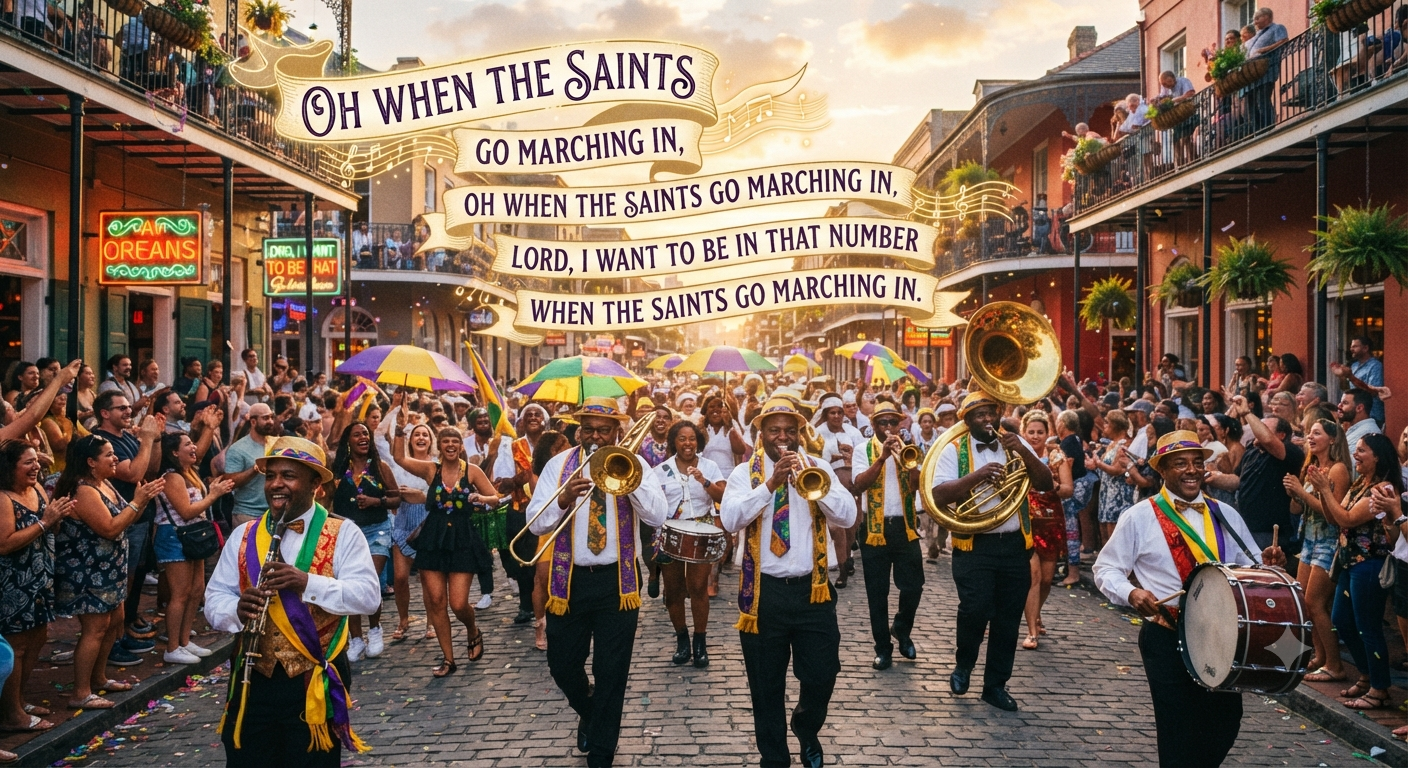
O, when the saints go marching in,
O, when the saints go marching in.
Lord, I want to be in that number
when the saints go marching in.
O when the sun refused to shine,
O when the sun refused to shine,
Lord, I want to be in that number
when the sun refused to shine.
O when they gather ’round the throne,
O when they gather ’round the throne,
Lord, I want to be in that number
when they gather ’round the throne.
O when they crown Him Lord of all,
O when they crown Him Lord of all,
Lord, I want to be in that number
when they crown Him Lord of all.
And on that hallelujah day,
And on that hallelujah day,
Lord, I want to be in that number
on that hallelujah day.
Hymnary identifies this text as an African American spiritual and marks it as public domain. It also connects the hymn with biblical passages concerning everlasting life, the gathering of the faithful, and a renewed world.
When people search for Lyrics for oh when the saints go marching in, they may see different verses elsewhere. That is not necessarily a mistake. Traditional songs often grow through performance, and “The Saints” is especially well known for interchangeable lines built around the same musical pattern.
What Do the Lyrics for Oh When the Saints Go Marching In Mean?
At the heart of the song is one clear wish: “Lord, I want to be in that number.” The singer imagines a future gathering of the saints and asks to belong among them. In Christian interpretation, the saints are the faithful gathered in God’s presence.
The marching image matters. It turns a theological idea into something physical and communal. Instead of picturing salvation as a quiet private event, the song imagines a group moving together with purpose. That image helps explain why the tune works so naturally with processions, brass bands, and call-and-response performance.
“I Want to Be in That Number”
This is the emotional center of Lyrics for oh when the saints go marching in. The line is personal, but it is not isolated. The singer wants to join a larger company.
That combination—individual hope inside collective celebration—gives the song unusual power. A soloist can sing it sincerely. A packed room can shout it together. A marching band can play the melody without words, and the same feeling of communal movement still comes through.
Images of Light, Judgment, and Celebration
Traditional verses mention the sun refusing to shine, gathering around the throne, crowning the Lord, or a “hallelujah day.” These images echo biblical language associated with judgment, resurrection, worship, and eternal life. Hymnary links the song with passages in Jude and Revelation, among others.
The mood, however, is rarely gloomy in performance. Even when the imagery points beyond earthly life, the musical character often sounds bright and forward-moving. That tension between solemn meaning and joyful sound is one of the song’s defining qualities.
Where Did “When the Saints Go Marching In” Come From?
The exact authorship is uncertain. The song is generally treated as a traditional African American spiritual that developed from gospel material in the late nineteenth and early twentieth centuries rather than as the work of one clearly identified songwriter.
The Library of Congress preserves an archival catalog record for an incomplete version associated with traditional music collections and dates that item between 1933 and 1950. Its presence in a folklore collection shows how deeply the song had entered American traditional music by the first half of the twentieth century.
Because spirituals often changed in churches, communities, and live performances before being fixed in print or commercial recordings, tracing one clean point of origin is difficult. That is also why Lyrics for oh when the saints go marching in can appear in several legitimate forms.
Louis Armstrong and the Jazz Life of “The Saints”
The song existed before Louis Armstrong recorded it, but his influence on its worldwide identity was enormous. The Smithsonian’s National Museum of American History catalogs a Louis Armstrong and His Orchestra release and notes that “When the Saints Go Marching In” was originally recorded in 1938.
Armstrong’s treatment helped connect the spiritual with the sound of New Orleans jazz: trumpet-led melody, rhythmic swing, vocal personality, ensemble interaction, and improvisation. Once a tune works as both a singalong and a jazz vehicle, musicians can reshape it endlessly without losing the audience.
That is why Lyrics for oh when the saints go marching in are only one part of the song’s legacy. Instrumentalists know the melody even when nobody sings. Brass bands can stretch it. Jazz players can trade solos over it. Crowds can enter on the refrain after only a few notes.
Why These Lyrics Are So Easy to Remember
Many famous songs are memorable because of elaborate hooks. “When the Saints Go Marching In” succeeds through clarity.
Its core pattern is simple:
- A short opening phrase is repeated.
- The melody moves in an easy, singable shape.
- The third line creates anticipation.
- The final line returns to the verse idea.
- New verses can use the same melodic frame.
This repeated design makes Lyrics for oh when the saints go marching in easy to learn for children, choirs, congregations, and casual singers. It also supports call and response. A leader can introduce a new line, and the group can join almost immediately because the musical structure stays familiar.
That simplicity is not a weakness. In communal music, predictability lowers the barrier between performer and audience.
Why There Are Different Lyrics for Oh When the Saints Go Marching In
People sometimes assume alternate lines are “wrong.” With a traditional song, that is too rigid.
A spiritual carried through oral culture can collect new verses, lose older ones, or change wording to fit a church, funeral, parade, school, or recording session. Some performers sing about trumpets sounding. Others use verses about stars, heavenly gates, a new world, or gathering around the throne.
Hymnary shows the song appearing in multiple hymnals and identifies it as traditional, a spiritual, or an African American spiritual depending on the publication. That history supports a key point: variation is part of the song’s life.
If your goal is to learn Lyrics for oh when the saints go marching in for a formal performance, choose one coherent version and use it consistently. For an informal singalong, familiar traditional verses can be added more freely.
How to Sing Lyrics for Oh When the Saints Go Marching In
The tune sounds effortless when experienced musicians perform it, but a few choices improve clarity and energy.
Start at a Comfortable Tempo
Do not rush the opening. A moderate pulse gives singers time to shape the repeated phrase and makes the words clearer.
Once everyone is secure, increase the energy if the arrangement calls for it. New Orleans-style performances can feel lively, but liveliness comes from rhythmic confidence—not speed alone.
Give the Refrain a Clear Lift
The phrase “Oh, when the saints” should feel like an invitation. Keep the opening supported and avoid swallowing the word “when.”
For a group learning Lyrics for oh when the saints go marching in, speak the words in rhythm once before singing. This tiny rehearsal step often improves entrances and keeps repeated lines together.
Use Call and Response
A leader can sing the opening line and let the group echo it. That approach fits the song’s communal character and works especially well with children, choirs, church groups, and informal gatherings.
Instrumentalists can answer the voice too. A trumpet, clarinet, trombone, or saxophone can fill the spaces between phrases without covering the singers.
A Simple Arrangement That Builds Excitement
The tune is commonly supported by straightforward harmony, making it friendly for beginner musicians while still giving experienced players room to improvise.
Try this performance shape:
- Open with one voice or lead instrument.
- Add piano, guitar, banjo, or another chordal instrument.
- Bring in bass or a stronger pulse on the next verse.
- Add a harmony voice or horn response.
- Save the fullest ensemble sound for the final refrain.
This works because Lyrics for oh when the saints go marching in describe a gathering. An arrangement that gradually adds voices and instruments quietly reinforces the meaning of the text.
For a jazzier result, leave space. Short instrumental replies between vocal phrases often create more excitement than having every player perform constantly.
The Song’s Connection to New Orleans
Few melodies are as closely associated in the public imagination with New Orleans brass and traditional jazz. The connection makes musical sense: the tune is repetitive, portable, easy to improvise over, and suited to procession.
It also bridges sacred and social settings. The imagery of saints and heavenly gathering comes from religious tradition, while the performance can feel exuberant and public. That dual identity has allowed the song to appear in ceremonies, parades, concerts, festivals, and sporting culture without losing its recognizable core.
When a listener hears the opening notes, the reaction is often immediate. That instant recognition gives Lyrics for oh when the saints go marching in unusual cultural reach compared with many other traditional hymns.
Are the Lyrics for Oh When the Saints Go Marching In Public Domain?
The traditional text and tune are widely treated as public domain. Hymnary explicitly labels the representative text and the tune as public domain.
There is an important distinction: a traditional song can be public domain while a particular modern arrangement or recording still has separate rights. A musician may write an original arrangement, and a specific sound recording can have its own legal protection.
So if you want to print traditional Lyrics for oh when the saints go marching in, arrange the old melody yourself, or record your own performance, the public-domain status of the underlying traditional material is relevant. If you want to copy a specific artist’s arrangement or reuse a commercial recording, check the rights attached to that exact version.
Why the Song Still Works Generations Later
The secret is not nostalgia alone. The song combines simple language, a strong communal message, a memorable melody, and a structure that welcomes repetition without becoming musically closed.
It can be reverent or jubilant. Slow or fast. Sung by beginners or opened up into a long jazz performance. The refrain stays recognizable while verses, instrumentation, tempo, dynamics, and solos can change.
For readers who arrived only to find Lyrics for oh when the saints go marching in, this broader story explains why the song survives. People do not simply remember the words. They keep finding new settings in which the words still work.
Key Facts to Remember
- Song type: Traditional African American spiritual and gospel standard.
- Authorship: No single universally accepted author.
- Core theme: A desire to join the faithful in a future heavenly gathering.
- Jazz legacy: Strongly associated with New Orleans-style performance.
- Famous recording: Louis Armstrong and His Orchestra recorded a celebrated version in 1938.
- Copyright: Hymnary lists the traditional text and tune as public domain.
FAQ About Lyrics for Oh When the Saints Go Marching In
What are the main Lyrics for oh when the saints go marching in?
The best-known refrain begins with “O, when the saints go marching in” and repeats that idea before the singer says that he or she wants to “be in that number.” Traditional hymn versions add verses about the sun, the heavenly throne, Christ’s kingship, and a hallelujah day.
Different communities may use different verses because the song developed through tradition rather than one fixed modern lyric sheet.
Who wrote “When the Saints Go Marching In”?
There is no single confirmed songwriter for the traditional song as it is commonly sung. It developed within African American spiritual and gospel tradition and circulated through communal performance.
That makes its history different from a modern pop song with one clearly credited writing team.
What is the meaning behind Lyrics for oh when the saints go marching in?
The words express hope of belonging among the faithful when the saints gather in the presence of God. The marching image makes that hope communal and active.
Instead of describing faith only as private belief, the song imagines people moving together toward a promised celebration.
Why is “When the Saints Go Marching In” associated with jazz?
Its memorable melody, repeating form, and flexible structure make it ideal for ensemble playing and improvisation. New Orleans musicians embraced it, and Louis Armstrong’s 1938 recording became an important part of its jazz identity.
The tune can support vocals, horn responses, solos, and a full-band finish without losing its recognizable shape.
Can I use Lyrics for oh when the saints go marching in in my own project?
The traditional words and tune are listed as public domain by Hymnary. However, a modern arrangement or commercial recording may have separate rights.
The safer approach is to work from the traditional public-domain material, create your own arrangement, and verify permissions if you plan to copy a specific recorded or published version.
Final Thoughts
Lyrics for oh when the saints go marching in are easy to learn, but the song becomes richer once you understand the history behind the refrain. It grew from African American spiritual tradition, carries imagery of faith and eternal gathering, and became one of the most recognizable vehicles for New Orleans-style jazz.
Start with the four-line refrain. Add two or three traditional verses. Sing them at a comfortable tempo, then build energy with harmony, rhythm, and instrumental responses.
Whether you are preparing a church performance, classroom activity, brass-band arrangement, or simple family singalong, Lyrics for oh when the saints go marching in work best when the group sounds like a group—many voices moving toward the same musical destination.