


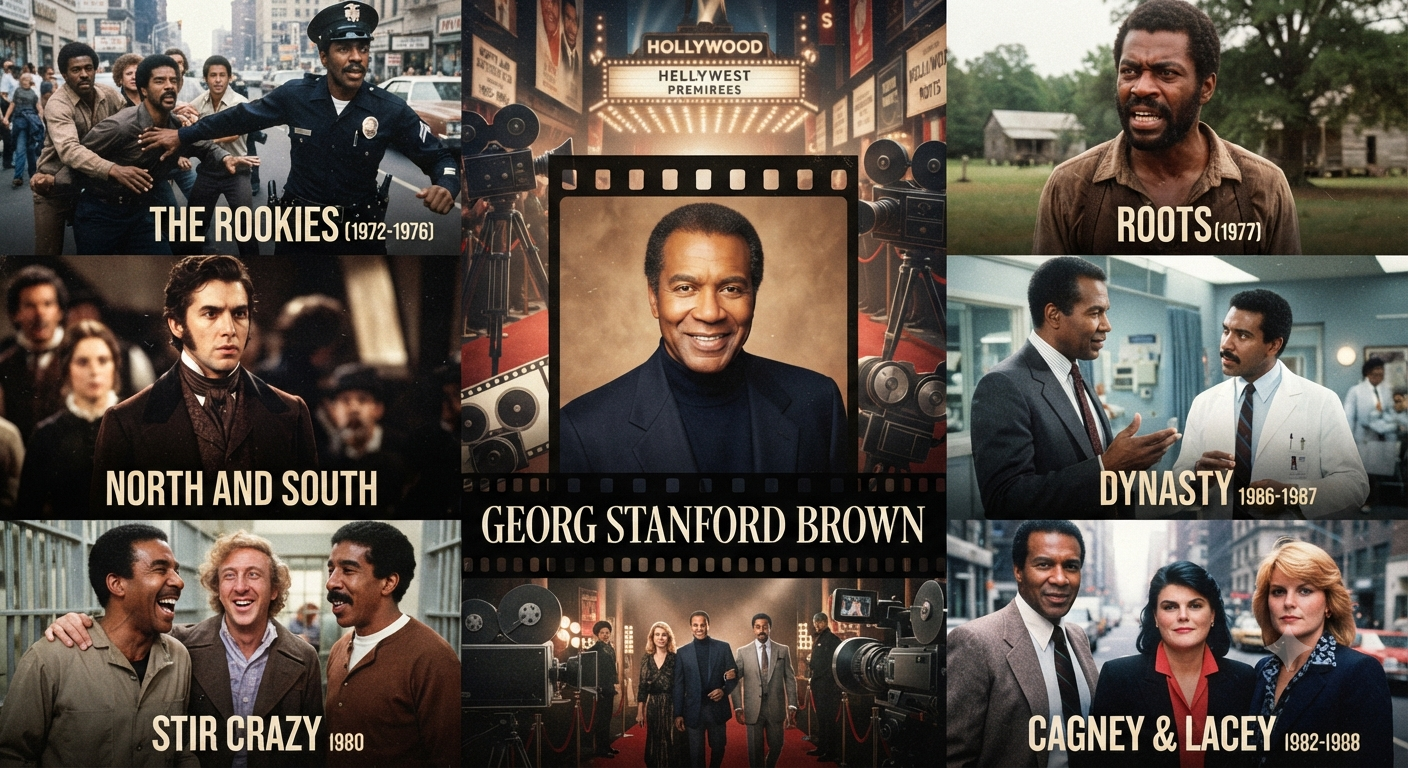
Georg Stanford Brown movies and TV shows span nearly five decades and reveal a career that is far more varied than many casual viewers realize. Brown became widely recognized as Officer Terry Webster on The Rookies, played Tom Harvey in the landmark Roots television saga, appeared in films including Bullitt and Stir Crazy, and later built an equally important career behind the camera as a television director. es his filmography especially interesting is the transition. Brown did not simply move from one acting role to another. He used his experience in front of the camera to become a prolific episodic television director, eventually winning a Primetime Emmy for directing Cagney & Lacey. His screen career is therefore worth exploring as both an acting history and a directing legacy. s Georg Stanford Brown?
Born in Havana, Cuba, on June 24, 1943, Georg Stanford Brown moved with his family to Harlem when he was a child. He later studied theater at Los Angeles City College and the American Musical and Dramatic Academy before beginning his professional acting career in the 1960s. early path was unusually broad. Stage work was followed by feature films, guest appearances on network dramas, a long-running police series, prestige miniseries, comedy, voice acting, producing, and eventually directing.
IMDb lists dozens of acting and directing credits across his career, illustrating just how much larger his professional résumé is than the handful of roles most viewers immediately recognize. est way to understand Brown’s career is to separate his major acting periods from the substantial directing career that followed.
Best-Known Georg Stanford Brown Movies and TV Shows
Several productions define Brown’s legacy more clearly than others. Collectively, they demonstrate how comfortably he moved between police procedurals, historical drama, comedy, political stories, and character-driven television.
The Rookies (1972–1976)
Brown’s breakthrough television role was Officer Terry Webster in ABC’s The Rookies. He remained a series regular throughout the show’s four-season run, making Webster one of the defining roles of his acting career. es followed inexperienced police officers learning the realities of law enforcement, giving Brown a sustained dramatic role instead of the guest appearances that had characterized much of his earlier television work.
More importantly, The Rookies became the bridge between his acting and directing careers.
Producer Aaron Spelling encouraged Brown to experiment with directing, and Brown eventually directed four episodes of the program. After the show ended, his work behind the camera continued to expand. es The Rookies central to any Brown filmography: it established both halves of his professional identity.
Roots (1977)
Brown became part of one of the most culturally significant television productions of the 1970s when he joined Roots.
He portrayed Tom Harvey, a descendant of Kunta Kinte and an important figure within the multigenerational family narrative based on Alex Haley’s work. acter gave Brown an opportunity to demonstrate a very different dramatic presence from Officer Webster. His performance was measured, grounded, and ideally suited to a historical story driven by family, survival, identity, and generational change.
Brown returned to the story in Roots: The Next Generations in 1979.
Interestingly, his involvement went beyond acting. Brown also directed an installment of the sequel miniseries, demonstrating how rapidly his behind-the-camera career was developing. Crazy (1980)
Among Brown’s feature credits, Stir Crazy remains one of his most recognizable theatrical films.
Directed by Sidney Poitier and starring Gene Wilder and Richard Pryor, the enormously popular prison comedy featured Brown as Rory Schultebrand. e is important within Brown’s career because it placed him inside a major theatrical comedy after audiences had become accustomed to seeing him in serious dramatic television.
It also demonstrates his versatility. Brown could function effectively within an ensemble dominated by the energetic comic chemistry of Wilder and Pryor without feeling out of place.
Bullitt (1968)
Years before The Rookies, Brown appeared in the celebrated Steve McQueen crime thriller Bullitt as Dr. Willard.
It was not one of his largest roles, but the movie’s long-term reputation makes the appearance a notable early credit in Brown’s film career. omatoes lists Bullitt among the highest-rated movies associated with Brown’s filmography. That distinction reflects the movie’s overall critical reputation rather than the size of Brown’s individual role, but it still demonstrates the caliber of productions he entered early in his career. Comedians (1967)
One of Brown’s earliest credited feature appearances came in The Comedians, starring Richard Burton and Elizabeth Taylor.
Brown portrayed Henri Philipot.
The movie arrived soon after his formal dramatic training, making it an important marker of how rapidly he progressed from studying performance to working professionally on substantial productions. ers tracing Brown’s filmography chronologically, The Comedians provides a useful starting point.
Georg Stanford Brown Movies: Notable Film Roles
Brown’s feature-film career was smaller than his television career, but the range is surprisingly broad.
Notable movie appearances include:
- How to Steal a Million (1966) – Waiter, uncredited
- The Comedians (1967) – Henri Philipot
- Dayton’s Devils (1968) – Theon Gibson
- Bullitt (1968) – Dr. Willard
- Colossus: The Forbin Project (1970) – Dr. John F. Fisher
- Wild in the Sky (1972) – Lynch
- The Man (1972) – Robert Wheeler
- Stir Crazy (1980) – Rory Schultebrand
- House Party 2 (1991) – Professor Sinclair
- Ava’s Magical Adventure (1994) – Clayton “Clay”
- Cuban Blood (2003) – supporting role
- Shackles (2005) – Warden
- Madea’s Tough Love (2015) – voice role -discussed movies deserve particular attention.
Colossus: The Forbin Project
Released in 1970, Colossus: The Forbin Project became a respected piece of science-fiction cinema built around artificial intelligence, computerized defense systems, and technological control.
Brown appeared as Dr. John F. Fisher. adds science fiction to a résumé more commonly associated with police dramas and historical television.
The Man
In 1972’s The Man, Brown portrayed Robert Wheeler alongside a cast led by James Earl Jones.
The political drama imagined extraordinary circumstances leading to the elevation of America’s first Black president. Brown’s presence within such a production is another reminder that his early career often intersected with projects engaging directly with race, authority, institutions, and American society. exclusively on Stir Crazy therefore misses a substantial portion of his movie work.
Georg Stanford Brown TV Shows Beyond The Rookies and Roots
Television is where Brown’s acting résumé becomes particularly extensive.
Before landing a permanent role on The Rookies, he worked through numerous established network programs.
His early television credits included:
- Dragnet 1967
- Judd, for the Defense
- It Takes a Thief
- The F.B.I.
- Julia
- The Bold Ones: The Lawyers
- Mannix
- Medical Center
- Room 222
- Mission: Impossible pearances are more meaningful than they initially seem.
Brown was building experience across crime dramas, medical shows, legal series, action television, and socially focused programming before receiving a regular starring opportunity. His rise was gradual rather than dependent upon a single lucky casting break.
His later television career added several memorable performances.
North and South (1985)
Brown portrayed Garrison Grady in North and South, Book I, the large-scale historical miniseries set around the American Civil War.
The role continued Brown’s association with ambitious historical television after his appearances in Roots. reinforced his value as an ensemble performer. Brown could enter stories containing numerous prominent characters and still establish a distinctive presence.
Matlock (1987–1989)
Brown appeared in multiple episodes of Matlock, portraying different characters including Judge Stuart Franklin and Major Jeffrey Hamilton. ppearances as different characters were common for dependable television actors, particularly performers capable of bringing credibility to authority figures.
That quality became a recurring feature of Brown’s screen persona.
Linc’s (1998–2000)
One of Brown’s most substantial later acting commitments came with Showtime’s Linc’s.
He played Johnnie B. Goode as part of the show’s recurring ensemble. Both IMDb and major filmography databases identify the series as one of his important late-career television roles, although databases differ on the precise episode count. crepancy is worth noting because entertainment databases sometimes count appearances differently, particularly for recurring or partially credited roles.
Nip/Tuck (2004)
Brown reached another generation of television viewers when he appeared as James Sutherland in four episodes of Nip/Tuck. by Ryan Murphy, the medical drama represented a markedly different television environment from the network procedurals Brown had worked on during the 1970s.
His presence on the show illustrates his professional longevity.
Voice Acting
The later phase of Brown’s career also included voice performance.
Credits included:
- The Legend of Calamity Jane
- The Wild Thornberrys
- Electric City
- Madea’s Tough Love
IMDb and filmography records also credit him as Roland Shephard in the 2004 video game Men of Valor. rk adds another dimension to an already unusually adaptable career.
Georg Stanford Brown as a Television Director
The element most simple celebrity filmography pages overlook is Brown’s directing career.
He was not merely an actor who occasionally directed an episode. He became a genuine episodic television director whose assignments included some of the most recognizable American series of the 1970s and 1980s.
His directing credits included episodes of:
- The Rookies
- Starsky and Hutch
- Charlie’s Angels
- Fantasy Island
- Lou Grant
- Hill Street Blues
- Cagney & Lacey
- Fame
- Magnum, P.I.
- Miami Vice
- Dynasty
- The Fall Guy
- The Greatest American Hero t demonstrates considerable genre flexibility.
Directing Charlie’s Angels demanded something different from Hill Street Blues. Miami Vice had a different visual rhythm from Cagney & Lacey. Dynasty operated differently from a police procedural.
Brown nevertheless continued receiving assignments.
He also directed numerous television movies, including Grambling’s White Tiger, Kids Like These, Alone in the Neon Jungle, Stuck with Each Other, The Last P.O.W.? The Bobby Garwood Story, Father & Son: Dangerous Relations, The Long Shot, Wedding Daze, Angel in the Family, and The Reading Room. ind-the-camera work changes how Brown’s career should be evaluated.
He was not simply a recognizable actor whose appearances gradually became less frequent. He developed into a director trusted with established casts, production crews, action sequences, dramatic performances, television movies, and tightly scheduled episodic productions.
The Emmy-Winning Chapter of His Career
Brown’s directing ability eventually received major industry recognition.
According to the Television Academy, Georg Stanford Brown earned three Primetime Emmy nominations for Outstanding Directing in a Drama Series and won once. cting record included:
- 1981: nominated for Hill Street Blues
- 1985: nominated for Hill Street Blues
- 1986: won for Cagney & Lacey ing Cagney & Lacey episode was “Parting Shots.”
That achievement is critical to understanding Brown’s professional importance.
Plenty of successful actors eventually direct television. Considerably fewer become accomplished enough to receive repeated Emmy nominations for directing, let alone win the category.
His directing credits therefore belong near the center of his career story rather than appearing as an afterthought underneath an acting filmography.
What Was Georg Stanford Brown’s Career Style?
Looking across decades of work reveals several patterns.
First, Brown frequently portrayed characters carrying some form of authority, discipline, intelligence, or moral weight.
His résumé includes police officers, doctors, judges, military figures, educators, religious figures, and community leaders.
That did not prevent him from doing comedy, but it explains why casting directors repeatedly trusted him with characters who needed immediate credibility.
Second, he moved easily across genres.
Crime drama forms the strongest thread, yet his credits also extend into:
- Historical drama
- Political drama
- Science fiction
- Comedy
- Medical television
- Family programming
- Animation
- Voice acting
Third, his directing career suggests considerable production discipline.
An episodic television director generally enters a creative system that already exists. The show’s characters, visual language, tone, sets, production schedule, and storytelling conventions have already been established.
The director must contribute something meaningful without making the episode feel disconnected from the larger series.
Brown repeatedly received precisely those assignments.
That is the deeper value in studying Brown’s career: his résumé demonstrates how a performer can evolve into a durable television craftsman.
Where Should New Viewers Start?
Watching every credit chronologically is unnecessary if you simply want to understand Brown’s significance.
A five-project viewing path provides a better introduction.
Start with The Rookies.
It establishes the screen persona that made Brown recognizable to prime-time television audiences and also represents the production where his directing career began developing.
Next, watch Roots.
The historical setting and emotional weight reveal a different side of Brown’s dramatic ability.
Then try Stir Crazy.
Its comedy and theatrical scale demonstrate that he was not limited to serious television drama.
After that, watch North and South for another major miniseries performance.
Finally, move behind the camera. Watch episodes of Hill Street Blues and Cagney & Lacey directed by Brown.
Doing so makes his career transformation visible rather than merely reading about it.
This viewing route captures the essential range of his work without turning the experience into a completionist exercise.
Why His Career Still Matters
Brown’s career reflects an era in which actors could become familiar household faces through long network seasons, but his professional evolution also resembles the modern actor-director career path.
He learned to shape an individual character and later learned to shape entire episodes.
The Television Academy’s record of three directing nominations and one Emmy victory provides objective evidence that this transition was not merely experimental. Directing became one of the defining achievements of his professional life. ography also connects several distinct periods in American entertainment history.
Brown worked through late-1960s studio cinema, 1970s police procedurals, the prestige miniseries era, sophisticated 1980s television drama, 1990s cable programming, and 2000s character and voice roles.
Few performers can point to credible work across so many stages of television’s development.
That longevity is why Brown’s work continues to attract interest from classic-TV viewers, Roots fans, film-history readers, and audiences rediscovering older programs through streaming and digital archives.
FAQ About Georg Stanford Brown Movies and TV Shows
What TV show is Georg Stanford Brown best known for?
Georg Stanford Brown is most strongly associated with The Rookies, where he portrayed Officer Terry Webster from 1972 through 1976.
It became his major series breakthrough and also played an important role in launching his directing career because he eventually directed episodes of the program. Georg Stanford Brown in Roots?
Yes.
Brown portrayed Tom Harvey in the landmark 1977 television miniseries Roots. He later returned to the story in Roots: The Next Generations in 1979.
Brown’s connection to the franchise extended behind the camera as well because he directed an installment of Roots: The Next Generations. movies did Georg Stanford Brown appear in?
His notable movie credits include The Comedians, Bullitt, Colossus: The Forbin Project, The Man, Stir Crazy, House Party 2, Shackles, and the animated production Madea’s Tough Love.
His feature-film résumé is smaller than his television portfolio, but it covers drama, political storytelling, science fiction, comedy, and voice acting. Georg Stanford Brown direct Cagney & Lacey?
Yes.
Brown directed multiple episodes of Cagney & Lacey, and his work on the series produced one of the greatest professional achievements of his career.
He won the 1986 Primetime Emmy Award for Outstanding Directing in a Drama Series for the episode “Parting Shots.” should I watch first from Georg Stanford Brown’s career?
Begin with The Rookies, Roots, and Stir Crazy.
Those productions provide an excellent introduction to his range as a television regular, historical-drama performer, and feature-film supporting actor.
Afterward, explore episodes of Hill Street Blues and Cagney & Lacey that Brown directed. That final step is important because his directing career is essential to understanding his full contribution to television.
Conclusion
Brown’s screen career tells the story of a performer who refused to remain in a single professional lane.
He progressed from early movie appearances in The Comedians and Bullitt to his breakthrough as Officer Terry Webster on The Rookies. He then became part of the cultural legacy of Roots, appeared alongside Gene Wilder and Richard Pryor in Stir Crazy, continued taking character roles, and simultaneously developed a significant second career as a television director.
His Emmy victory makes that evolution particularly important. Brown was not simply an actor experimenting behind the camera. He became an award-winning director trusted with some of American television’s most prominent dramas.
The best way to explore his career is therefore by milestone rather than release date alone.
Begin with The Rookies. Move to Roots and Stir Crazy. Then compare those performances with episodes he directed on Hill Street Blues and Cagney & Lacey.
That viewing path reveals what a simple list of credits cannot: Georg Stanford Brown built two meaningful careers inside one remarkable body of work.