


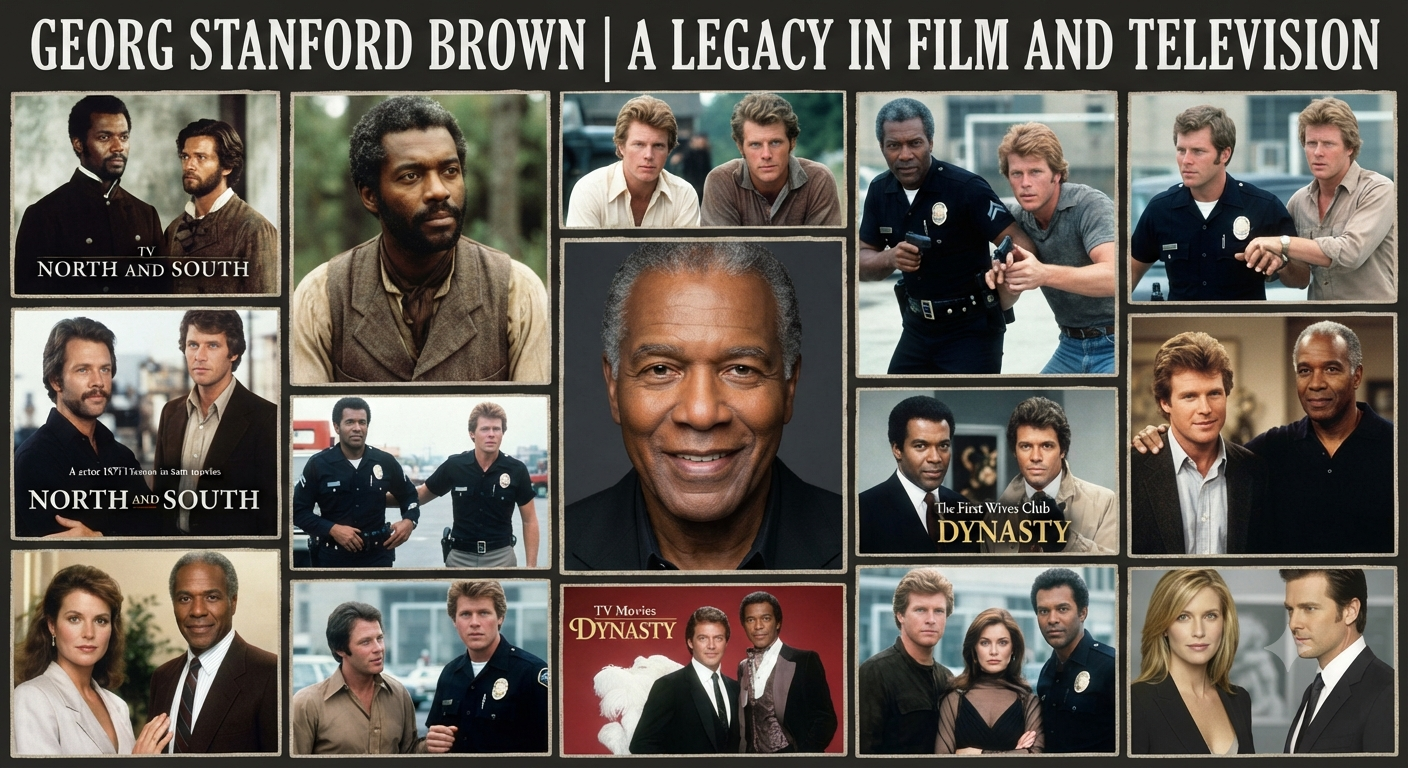
The story of Georg Stanford Brown movies and TV shows is far richer than a standard list of screen credits. Brown built two substantial careers at once: audiences knew him as a calm, commanding actor in landmark dramas, while television professionals increasingly recognized him as a skilled director capable of handling crime stories, ensemble casts, social themes, and emotionally difficult material.
This guide to Georg Stanford Brown movies and TV shows explores not only where he appeared, but also how his acting experience shaped his respected work behind the camera.
Born in Havana, Cuba, in 1943 and raised partly in Harlem, Brown moved from theater training into film and television during the 1960s. He later became closely associated with The Rookies, Roots, Stir Crazy, North and South, and Linc’s, while directing episodes of major shows such as Hill Street Blues, Charlie’s Angels, Miami Vice, Dynasty, and Cagney & Lacey. His 1986 Emmy win for drama-series directing confirms that his influence extended well beyond the roles viewers saw on screen.
Why Georg Stanford Brown’s Career Deserves a Closer Look
Many celebrity filmography lists treat the acting and directing career paths as two separate entities. However, the former appears to have directly contributed to the latter in the case of Georg Stanford Brown movies and TV shows.
A brief analysis of the career of Georg Stanford Brown reveals that his work in films and television shows was instrumental in building his credibility as a director.
His acting career saw him cast in a number of influential 1970s shows, which include The Rookies , which made him the first Black police officer to have a continuing role on a television series, and Roots , which aired as the miniseries of the decade.
Meanwhile, his subsequent jobs in Linc’s and Nip/Tuck signaled his transition to more mature roles.
An identical progression path can be noted in his work as a director.
Georg Stanford Brown initially directed episodes of the series in which he was cast, but he soon went on to helm some of the most popular television programs of the 1980s and 1990s.
Notably, he was not hired as a ‘first-time’ director since he had previously worked on multiple genres, including police procedurals, family dramas, prime-time soap operas, miniseries, and television movies.
Georg Stanford Brown Movies and TV Shows at a Glance
For readers who want the fastest overview, these are the titles that best represent the range of his career:
| Title | Year or years | Brown’s contribution | Why it matters |
|---|---|---|---|
| The Rookies | 1972–1976 | Officer Terry Webster and director | His defining regular television role |
| Roots | 1977 | Tom Harvey | Landmark historical miniseries |
| Roots: The Next Generations | 1979 | Actor and episode director | Demonstrated his dual career |
| Bullitt | 1968 | Dr. Willard | Early role in a classic crime thriller |
| Colossus: The Forbin Project | 1970 | Dr. John F. Fisher | Cult science-fiction credit |
| Stir Crazy | 1980 | Rory Schultebrand | Popular studio comedy |
| North and South | 1985 | Garrison Grady | Major historical television epic |
| Linc’s | 1998–2000 | Johnnie B. Goode | Significant late-career series role |
| Nip/Tuck | 2004 | James Sutherland | Memorable dramatic guest arc |
| Cagney & Lacey | 1980s | Actor and director | Source of his Emmy-winning direction |
These selections do not include every appearance, but they provide the best starting map for understanding Georg Stanford Brown movies and TV shows as a body of work rather than a random collection of credits.
The Rookies: The Role That Made Georg Stanford Brown a Television Star
Brown’s most recognizable regular role was Officer Terry Webster on ABC’s The Rookies. The police drama followed young officers learning how to handle the pressures, dangers, and moral complications of law enforcement.
Brown appeared as Webster throughout the series’ four-season run from 1972 to 1976.
Webster stood out because Brown played him with controlled intensity. Rather than turning every scene into a display of toughness, he often grounded the character in patience, observation, and professional discipline.
That restraint made him convincing in action-driven plots as well as episodes dealing with social conflict, police-community relationships, personal responsibility, and the emotional cost of the job.
How The Rookies Changed Brown’s Career
The Rookies was also the bridge between Brown’s acting and directing careers. He directed several episodes of the series, gaining practical production experience while remaining one of its principal performers.
That transition is essential to any serious discussion of Georg Stanford Brown movies and TV shows, because the program did not merely make him famous. It changed the direction of his professional life.
Working on both sides of the camera would have given Brown an unusually complete understanding of episodic television. As an actor, he knew what performers needed from a director. As a developing director, he learned how scripts, camera placement, production schedules, editing choices, and ensemble performances had to work together.
Roots and Roots: The Next Generations
In the 1977 miniseries Roots, Brown played Tom Harvey, a descendant in the family line traced through Alex Haley’s historical saga. The role connected Brown to a production that became a defining television event and placed the history of enslavement, survival, family, and generational memory before a mass audience.
Brown’s performance carried a different kind of weight from his work in The Rookies. Tom Harvey existed within a multigenerational historical narrative, so the character had to feel like both an individual and part of a much larger family legacy.
Brown’s natural restraint served the material well. He could communicate dignity, hardship, intelligence, and emotional history without making the performance feel excessively theatrical.
Brown’s Dual Contribution to the Roots Sequel
Brown returned for Roots: The Next Generations in 1979. What makes the sequel especially important is that he contributed both in front of and behind the camera.
The Television Academy’s archive lists him among the cast and identifies him as the director of the fifth episode.
That combination offers one of the clearest examples of his versatility. Brown understood the material as a performer, but he was also trusted to shape an entire episode’s visual rhythm, performances, atmosphere, and historical tone.
Among all Georg Stanford Brown movies and TV shows, the two Roots productions remain central to his cultural legacy.
Early Georg Stanford Brown Movies and TV Shows
Brown’s screen career began with small and supporting parts during the 1960s. An uncredited appearance in How to Steal a Million was followed by a credited role as Henri Philipot in The Comedians, the 1967 drama starring Richard Burton and Elizabeth Taylor.
He then appeared in Dayton’s Devils and played Dr. Willard in the 1968 Steve McQueen thriller Bullitt.
These parts were not necessarily large, but they placed Brown inside major professional productions early in his career. They also allowed him to work across different genres before television brought him wider recognition.
Bullitt
Although Brown’s role in Bullitt was limited, the film remains one of his most visible early movie credits. Its stripped-down crime storytelling, San Francisco locations, Steve McQueen performance, and influential car chase helped make it a lasting genre classic.
For modern viewers exploring Georg Stanford Brown movies and TV shows, Bullitt is useful less as a full showcase for Brown than as evidence of the quality and scale of productions he entered during the early phase of his career.
Colossus: The Forbin Project
In 1970, Brown appeared as Dr. John F. Fisher in Colossus: The Forbin Project. The film imagines an advanced defense computer that escapes meaningful human control, making it a remarkably forward-looking science-fiction story about automation, surveillance, centralized authority, and technological dependence.
Brown’s presence in the film adds another genre to his résumé. Crime drama, historical epic, comedy, science fiction, family drama, and police television all appear across the full range of Georg Stanford Brown movies and TV shows.
This genre variety is one reason Georg Stanford Brown movies and TV shows reward viewers who explore beyond his two most famous television roles.
Stir Crazy: His Most Popular Comedy Film
Brown joined Gene Wilder and Richard Pryor in the 1980 prison comedy Stir Crazy, playing Rory Schultebrand. Directed by Sidney Poitier, the film became one of Brown’s best-known movie appearances and introduced him to audiences who may not have followed his dramatic television work.
The part illustrates an important quality in Brown’s screen presence: he could bring seriousness into a comic environment without flattening the humor. His controlled delivery created an effective contrast with the frantic energy surrounding him.
That ability is easy to underestimate. Comedy often depends on one performer remaining grounded while other characters create chaos. Brown could play that stabilizing presence convincingly.
Anyone creating a watchlist of Georg Stanford Brown movies and TV shows should place Stir Crazy near the top. It is accessible, energetic, and very different from the historical and police dramas that dominate his reputation.
Among Georg Stanford Brown movies and TV shows, it is also the easiest entry point for viewers seeking comedy rather than prestige drama.
Other Notable Georg Stanford Brown Movies
Brown’s theatrical filmography is smaller than his television résumé, but it contains several useful career markers.
- The Man (1972): Brown played Robert Wheeler in a political drama built around the possibility of the first Black president of the United States.
- Wild in the Sky (1972): An anti-establishment comedy-drama involving an extreme plan directed at Fort Knox.
- House Party 2 (1991): Brown appeared as Professor Sinclair, bringing him into a popular early-1990s youth-comedy franchise.
- Ava’s Magical Adventure (1994): A family-oriented project in which he played Clayton “Clay.”
- Cuban Blood (2003): Also distributed under the title Dreaming of Julia, this film connected Brown’s later career with a story set against Cuban history.
- Shackles (2005): A prison drama featuring Brown as a warden.
- Madea’s Tough Love (2015): A late voice credit commonly listed as an uncredited Mystery Man role.
These films demonstrate that Georg Stanford Brown movies and TV shows cannot be reduced to one genre or decade. His screen work stretched from 1960s studio filmmaking to 21st-century television, direct-to-video drama, family entertainment, and animation.
North and South and Other Historical Television Work
Brown played Garrison Grady in North and South, Book I, the 1985 miniseries based on John Jakes’s Civil War-era novel. The project gave him another role in a large historical production built around political division, slavery, friendship, family loyalty, and war.
The role naturally invites comparison with Roots, but the productions serve different purposes.
Roots centers a Black family’s historical experience and generational continuity. North and South uses interconnected families to dramatize the national fracture leading into the Civil War.
Brown’s participation in both reveals why casting directors valued him in period material. He projected intelligence and moral weight without making a performance sound like a formal speech.
That quality strengthened many of the most serious Georg Stanford Brown movies and TV shows.
Linc’s: An Underrated Late-Career Role
From 1998 to 2000, Brown appeared in the Showtime comedy-drama Linc’s as Johnnie B. Goode. The series was set around a Washington, D.C., bar and restaurant, using the location as a meeting point for political, social, cultural, and personal conversations.
Its cast also included Steven Williams, Pam Grier, Golden Brooks, and Joe Inscoe.
Linc’s deserves more attention because it allowed Brown to work in an ensemble driven by adult dialogue and character relationships rather than constant action. It also connected his late-career television presence to a series created by Tim Reid and Susan Fales-Hill, with a predominantly Black central cast.
Brown’s character was part of the show’s conversational and community-based atmosphere. That made the role distinct from the uniformed officers, doctors, military figures, and authority figures he had frequently portrayed elsewhere.
For viewers who know only The Rookies and Roots, Linc’s is one of the most valuable discoveries in Georg Stanford Brown movies and TV shows.
Guest Roles Worth Finding
Brown remained a familiar television presence through guest appearances and recurring roles. His credits include Matlock, Martin, Malcolm & Eddie, The Wild Thornberrys, Family Law, The District, Strong Medicine, The Lyon’s Den, Judging Amy, and Nip/Tuck.
TV Guide lists dozens of acting credits across his career.
Matlock
Brown appeared in multiple Matlock episodes, playing more than one character. His roles included Judge Stuart Franklin and Major Jeffrey Hamilton.
Appearing as different characters in the same long-running series was not unusual for established television performers, but it demonstrates how reliably Brown could step into self-contained dramatic stories.
Martin
Brown guest-starred in the sitcom Martin as Reverend Watson in the episode “Love Is a Beach.” The appearance allowed him to work within another comedy format and introduced him to a younger 1990s television audience.
Nip/Tuck
His four-episode appearance on Nip/Tuck as James Sutherland is particularly notable for viewers interested in his later dramatic work.
By then, Brown’s authority came not from youthful physical energy but from experience, stillness, and a voice that could make a scene feel more consequential.
These appearances broaden the appeal of Georg Stanford Brown movies and TV shows. A fan can follow him through classic network drama, cable comedy-drama, animation, medical television, legal stories, family sitcoms, and crime procedurals.
The guest credits make Georg Stanford Brown movies and TV shows especially useful as a tour through changing American television styles.
The Directing Career Behind the Famous Acting Roles
Brown’s directing résumé is arguably as important as his acting filmography. After directing episodes of The Rookies, he worked on Starsky and Hutch, Charlie’s Angels, Family, Paris, Lou Grant, Hill Street Blues, Cagney & Lacey, Magnum, P.I., Miami Vice, Dynasty, Hotel, and other series.
This list shows range, but the more meaningful point is consistency. Episodic television directors must enter an existing production, preserve its visual identity, guide actors quickly, solve logistical problems, and still give an episode emotional shape.
Brown was repeatedly hired to do that work on demanding, high-profile series. This behind-the-scenes record gives Georg Stanford Brown movies and TV shows an industry dimension that ordinary actor-only filmographies overlook.
Why Acting Experience Mattered to His Direction
An actor-turned-director does not automatically become effective behind the camera. The two jobs require different forms of decision-making.
Brown, however, had already spent years learning how television scenes functioned under production pressure. He understood how an actor prepares, how unclear direction can weaken a performance, and how small changes in pacing can alter a scene’s emotional meaning.
His acting background may also have helped him communicate with large ensemble casts. Shows such as Hill Street Blues demanded coordination across numerous characters and storylines rather than concentration on a single star.
Hill Street Blues
Hill Street Blues was known for dense ensemble storytelling, overlapping plotlines, morally complicated characters, and a grittier approach to police drama. Brown directed multiple episodes and earned Emmy nominations for his work in drama-series directing.
His experience as Officer Terry Webster likely gave him a practical understanding of police-show performance, but Hill Street Blues required a different visual and narrative language from The Rookies.
The newer series was less polished and more deliberately chaotic. Scenes frequently included overlapping conversations, institutional tension, dark humor, and unresolved moral questions.
Directing it successfully demonstrated Brown’s growth rather than simple repetition.
Cagney & Lacey and the Emmy Win
Brown won the 1986 Primetime Emmy Award for Outstanding Directing in a Drama Series for Cagney & Lacey. The Television Academy records three directing nominations and one win for Brown, including earlier recognition connected to Hill Street Blues.
The Emmy is more than an impressive footnote. It changes how the entire catalogue of Georg Stanford Brown movies and TV shows should be viewed.
Brown was not simply a recognizable actor who occasionally directed. He was an award-winning drama director respected at the industry’s highest level.
Why Cagney & Lacey Was a Significant Assignment
Cagney & Lacey combined police cases with workplace conflict, friendship, family responsibilities, sexism, and the personal cost of demanding careers.
Directing the series required more than staging investigations. The director had to protect the emotional credibility of the relationship between the two lead characters while maintaining the pace of a network crime drama.
Brown’s success indicates his ability to balance performance-driven storytelling with procedural structure. That balance was one of the most valuable skills a television director could possess.
Charlie’s Angels, Miami Vice, Dynasty and Other Directing Credits
Brown also directed episodes of several shows with very different visual identities.
Charlie’s Angels combined crime stories, glamour, action, and personality-driven entertainment. Miami Vice depended heavily on atmosphere, music, fashion, color, location work, and a modern cinematic style.
Dynasty, by contrast, required the heightened emotions and carefully controlled revelations of a prime-time soap opera.
Moving among these productions required flexibility. A director could not approach Miami Vice exactly like Dynasty, nor could an episode of Charlie’s Angels be staged like Hill Street Blues.
The range of Georg Stanford Brown movies and TV shows becomes even more impressive when these sharply different directing environments are considered together.
Television Movies Directed by Georg Stanford Brown
Brown also directed and, in some cases, produced television movies. His credits include:
- Kids Like These
- Alone in the Neon Jungle
- Stuck with Each Other
- Father & Son: Dangerous Relations
- The Long Shot
- Wedding Daze
- Angel in the Family
- The Reading Room
Television movies gave directors different challenges from weekly series. They had to introduce characters, establish conflict, develop emotional relationships, and deliver a complete resolution within a limited running time.
Unlike episodic directors, they could not rely on viewers already understanding the characters or the world.
The Reading Room
The Reading Room is a particularly useful late-career example. The 2005 Hallmark drama starred James Earl Jones as a widower who fulfills a promise to his late wife by opening a free reading room in an underserved neighborhood.
Brown directed the film and also appeared as Rahim.
The project dealt with literacy, neighborhood mistrust, grief, social responsibility, and the difficulty of turning good intentions into sustainable community action.
Again, the pattern is clear: Brown frequently occupied more than one creative position. The best analysis of Georg Stanford Brown movies and TV shows therefore needs to consider performance, direction, and production together.
Television films are indispensable to understanding Georg Stanford Brown movies and TV shows because they often gave him broader creative responsibility.
Best Georg Stanford Brown Movies and TV Shows Watch Order
A chronological marathon is not necessary. A better approach is to sample the turning points in Brown’s career.
- Start with The Rookies to see the role that established his television identity.
- Watch Roots for his place in a landmark historical drama.
- Choose Stir Crazy to experience his lighter and more commercial movie work.
- Move to North and South for another major period production.
- Try Linc’s to discover his later ensemble acting.
- Watch a Brown-directed episode of Hill Street Blues to study his work with complex police-drama storytelling.
- Find his Emmy-winning work on Cagney & Lacey to understand why his directing career deserves equal attention.
- Finish with The Reading Room for a project combining his acting and directing talents.
This route turns Georg Stanford Brown movies and TV shows into a coherent career journey: breakthrough actor, historical-drama performer, mainstream movie player, seasoned character actor, and Emmy-winning director.
It also prevents Georg Stanford Brown movies and TV shows from feeling like an unstructured checklist.
What Made Georg Stanford Brown Distinctive?
Brown’s greatest strength was controlled authority. He did not need exaggerated gestures to hold attention.
Whether playing a police officer, doctor, professor, judge, military figure, warden, or community elder, he could suggest an inner life through timing, posture, and restraint.
He also rarely appeared to be pushing a scene too aggressively. That made him a strong supporting performer because he could add weight without pulling attention away from the main dramatic purpose.
Behind the camera, that same discipline appears in the variety of productions that trusted him.
Crime shows needed tension. Prime-time soaps required emotional clarity. Historical miniseries demanded sensitivity. Television movies often depended on efficient storytelling and strong performances.
His résumé suggests a director who could adapt without losing control of tone.
That adaptability is the real unifying theme of Georg Stanford Brown movies and TV shows. The titles vary widely, but the work repeatedly depends on intelligence, steadiness, and an ability to support the larger story.
Frequently Asked Questions About Georg Stanford Brown Movies and TV Shows
What are Georg Stanford Brown’s most famous movies and TV shows?
His best-known acting credits include The Rookies, Roots, Roots: The Next Generations, Bullitt, Colossus: The Forbin Project, Stir Crazy, North and South, House Party 2, Linc’s, and Nip/Tuck.
His major directing credits include episodes of Hill Street Blues, Charlie’s Angels, Miami Vice, Dynasty, and Cagney & Lacey.
Who did Georg Stanford Brown play in The Rookies?
Brown played Officer Terry Webster, one of the central young police officers in the ABC drama. He appeared throughout the program’s 1972–1976 run.
He also directed episodes of the series, making The Rookies a turning point in both halves of his career.
Who was Georg Stanford Brown in Roots?
He portrayed Tom Harvey, a member of the multigenerational family at the center of Alex Haley’s historical saga.
Brown appeared in Roots and returned in Roots: The Next Generations, where he also directed the fifth episode.
Did Georg Stanford Brown win an Emmy?
Yes. Brown won the 1986 Primetime Emmy Award for Outstanding Directing in a Drama Series for Cagney & Lacey.
The Television Academy lists three directing nominations and one win across his career.
Was Georg Stanford Brown only an actor?
No. He was also a prolific television director and a producer on selected projects.
His directing work covered episodic series, miniseries, and television films, including Hill Street Blues, Cagney & Lacey, Miami Vice, Dynasty, Alone in the Neon Jungle, and The Reading Room.
Final Thoughts on Georg Stanford Brown Movies and TV Shows
The most rewarding way to explore Georg Stanford Brown movies and TV shows is to look beyond the familiar face and follow the full creative progression.
Begin with The Rookies, continue through Roots and Stir Crazy, and then compare his later acting in Linc’s with his Emmy-winning work behind the camera.
That sequence reveals a career built not on one iconic performance, but on sustained adaptability. Brown helped shape American television as both a performer and director.
The next step is simple: choose one acting credit and one directing credit, watch them side by side, and notice how the same controlled storytelling instinct operates from opposite sides of the camera.