


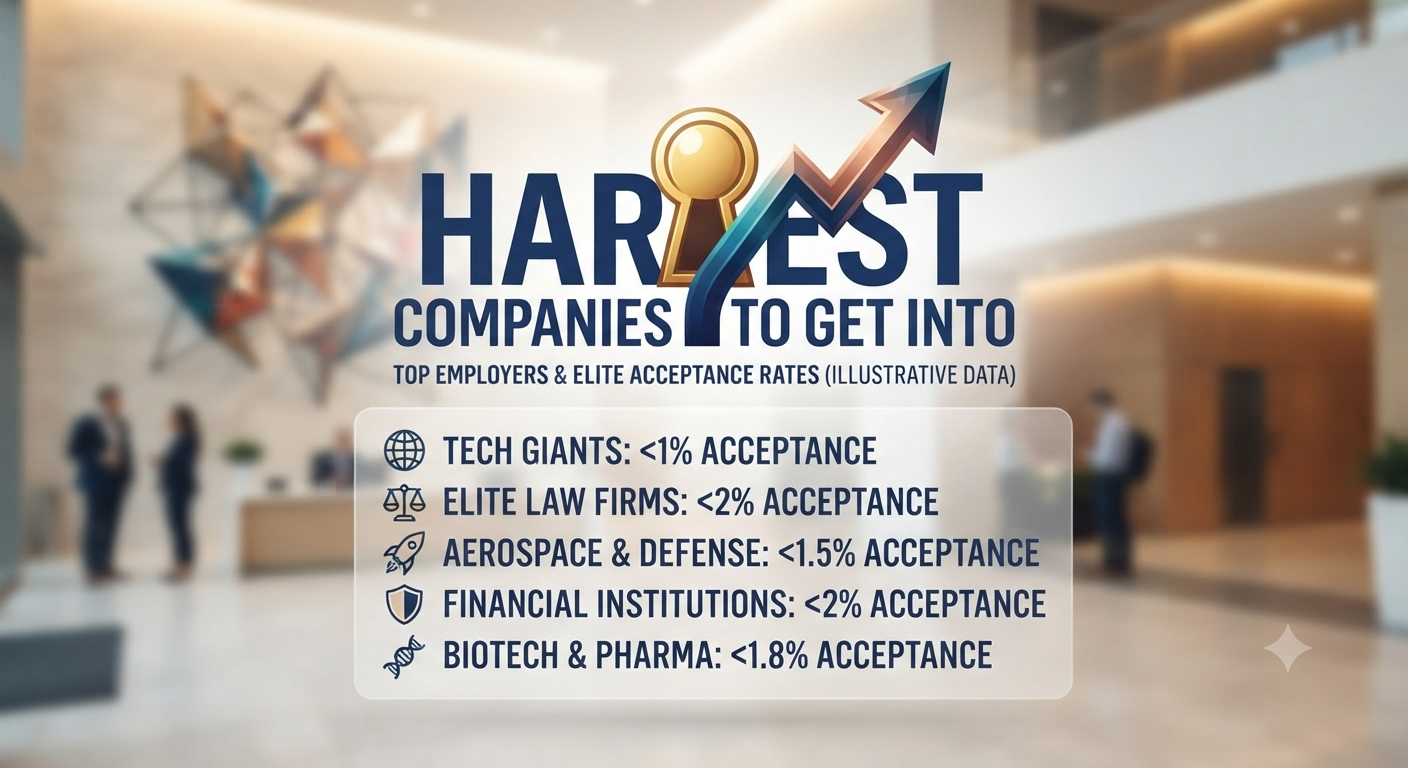
Getting hired by the hardest companies to get into is not simply a matter of having a famous university on your résumé or memorizing common interview questions. The toughest employers combine huge applicant pools, limited openings, demanding assessments, multiple interview rounds, and extremely specific expectations about how candidates think, communicate, and perform.
That distinction matters. A company may receive hundreds of thousands of applications but use a fairly conventional interview process. Another may hire more people overall yet remain exceptionally difficult for quantitative researchers, AI scientists, strategy consultants, or aerospace engineers because the skill bar is unusually narrow.
This guide evaluates the hardest companies to get into using the strongest public evidence available in 2026. It also separates verified selectivity data from unsupported acceptance-rate claims that circulate online.
What Makes a Company Difficult to Get Into?
There is no public database that lists the acceptance rate for every single employer. Most organizations will not give the number of applications, interviews, offers, and hires for every position.
Therefore, a good way to understand the likelihood of getting hired is to look at the following:
1. The ratio of applications to hires for a specific position.
2. The number of positions available for hiring.
3. The level of screening and evaluation (case, presentation, technical test, work trial, etc.) required.
4. The level of specialized knowledge required for the job (vs. a generalist position).
5. The number of independent assessments/criteria that one has to pass.
6. The caliber of the applicant pool (vs. entry-level positions).
The most difficult employers to get hired from tend to score high on most of the above criteria.
Hardest Companies to Get Into: Evidence-Based Shortlist
The hardest companies to get into cannot be reduced to a perfect global league table. Difficulty changes by office, role, seniority, hiring cycle, citizenship requirements, and economic conditions.
| Company or group | Why it is unusually difficult |
|---|---|
| Bending Spoons | Extremely low reported hiring rate and structured cognitive screening |
| Goldman Sachs | Enormous internship applicant volume and sub-1% reported selection |
| JPMorgan | Hundreds of thousands of applicants for a limited internship class |
| McKinsey, Bain, and BCG | Competitive résumé screening plus case and behavioral interviews |
| Jane Street | Advanced probability, reasoning, coding, and trading interviews |
| Citadel and Citadel Securities | Technical depth, quantitative reasoning, and multi-stage evaluation |
| OpenAI | Scarce frontier-AI roles and highly specialized technical interviews |
| Anthropic | Deep technical assessment, research judgment, and mission alignment |
| Massive global interest and structured role-specific evaluation | |
| SpaceX | High technical expectations, hands-on engineering scrutiny, and eligibility constraints |
1. Bending Spoons
Bending Spoons currently has one of the strongest documented claims to being among the hardest companies to get into. The Wall Street Journal reported that the Milan-based technology company received roughly 800,000 applications in 2025 and hired 286 people, equivalent to about 0.04% of applicants.
The company reportedly uses a structured process involving cognitive and psychological testing, interviews, behavioral observations, and post-hire performance analysis. That combination makes selection difficult even for candidates with strong credentials because the company is testing reasoning patterns and behavioral consistency, not just experience.
What successful candidates need
- Strong numerical and verbal reasoning
- Evidence of rapid learning
- Clear, precise written communication
- Comfort with ambiguity and demanding assessments
- A résumé showing measurable impact rather than task lists
Bending Spoons is a reminder that employer size can be misleading. A smaller firm with a huge global applicant pool may be more selective than a household-name corporation.
2. Goldman Sachs
Goldman Sachs regularly appears in discussions about the hardest companies to get into, especially for students pursuing investment banking, asset management, engineering, and markets roles.
For its 2025 internship class, Goldman reportedly selected about 2,600 interns from more than 360,000 applicants, producing an acceptance rate of roughly 0.7%. In June 2026, Fortune reported that the firm’s internship acceptance rate remained below 1% for a third consecutive year.
The difficulty is not limited to technical finance knowledge. Candidates must demonstrate judgment, communication, resilience, commercial awareness, and the ability to build trust under pressure.
How to improve your chances
Study the exact division before applying. “Why Goldman Sachs?” is not enough; you should understand the team’s clients, products, recent transactions, and revenue model.
Prepare concise examples covering:
- Leadership without formal authority
- A difficult analytical decision
- A mistake and what changed afterward
- Working under intense deadlines
- Handling disagreement professionally
3. JPMorgan
JPMorgan belongs near the top of any serious list of the hardest companies to get into because of the scale of competition for its early-career programs.
Financial News reported that JPMorgan received approximately 630,000 applications for around 4,100 internships in 2025, implying a success rate near 0.6%. That volume exceeded even Goldman’s reported applicant total.
A large bank hires across many functions, so difficulty varies. Investment banking, markets, quantitative research, software engineering, and selective rotational programs are generally more competitive than broad operational hiring.
Candidates often fail because they prepare for “banking” in general rather than the specific business. Someone interviewing for markets should be able to discuss risk, pricing, and current market drivers; an investment-banking candidate should understand valuation, transactions, and client service.
4. McKinsey, Bain, and BCG
McKinsey, Bain, and Boston Consulting Group—often called MBB—are consistently treated as some of the hardest companies to get into for strategy consulting.
No reliable, audited company-wide acceptance rate is publicly available for all three firms. Online estimates should therefore be treated cautiously. What is verifiable is the structure of the selection process: application screening, experience or skill interviews, case interviews, and additional team or final rounds depending on the role and office.
Bain says consulting candidates will likely complete case interviews and may also face online assessments or written assignments. BCG describes skill, case, and team interviews for client-facing roles.
Case interviews test more than memorized frameworks. Candidates must structure an unfamiliar problem, identify relevant information, perform quick calculations, interpret data, adapt to interviewer feedback, and communicate a recommendation.
Bain and BCG both emphasize clear reasoning, practical assumptions, and communication rather than a single predetermined answer.
Why strong applicants still fail
Many candidates know the standard profitability and market-entry frameworks. Fewer can:
- Build a custom issue tree
- Prioritize the most important branch
- Calculate accurately while speaking
- Extract a decision from messy data
- Synthesize findings into an executive-level recommendation
For MBB recruiting, structured practice with live partners is far more valuable than silently reading dozens of case solutions.
5. Jane Street
Jane Street is one of the hardest companies to get into for quantitative trading, research, and certain software-engineering roles. It does not publish a universal acceptance rate, so precise figures found on unofficial sites should not be presented as fact.
The firm’s own interview guidance emphasizes problem-solving, preparation, and role-specific evaluation. Its software-engineering materials explain that the process is designed to assess candidates across multiple dimensions.
Jane Street does not require every candidate to arrive with a finance background. The harder requirement is demonstrating rigorous reasoning without becoming rigid or defensive.
Best preparation strategy
Practice problems aloud. State assumptions, test edge cases, and explain why an answer makes sense.
For trading roles, focus on:
- Probability and conditional probability
- Expected value
- Mental arithmetic
- Estimation
- Game strategy
- Updating beliefs when new information appears
For software roles, prioritize clean coding, data structures, debugging, and collaborative problem-solving.
6. Citadel and Citadel Securities
Citadel and Citadel Securities are frequently grouped with the hardest companies to get into because they compete for elite quantitative, engineering, research, and investment talent.
Citadel’s official engineering interview guidance describes a first-round interview covering coding, data structures, algorithms, problem-solving, technical interests, and previous projects. Its quantitative-research process can include programming, research ability, algorithms, and problem-solving in a 45- to 60-minute screen.
The challenge is breadth plus depth. A candidate may need to write correct code, explain complexity, reason statistically, discuss research design, and defend decisions—all while communicating calmly.
A polished résumé cannot compensate for weak fundamentals here. Build evidence through research projects, competitive programming, mathematical modeling, open-source work, or production systems with measurable scale.
7. OpenAI
OpenAI has become one of the hardest companies to get into for candidates targeting frontier artificial intelligence, research engineering, model behavior, safety, infrastructure, and high-impact product roles.
OpenAI’s official interview guide outlines application review, introductory conversations, and later interviews that vary by team. The company also offers some early-career roles for candidates with zero to three years of experience, but those opportunities remain role-specific rather than a broad graduate intake.
The strongest candidates usually show more than familiarity with AI terminology. They can demonstrate technical depth, original work, sound experimental judgment, and an ability to connect research or engineering decisions to real-world outcomes.
What creates differentiation
- Reproducing or extending a research result
- Publishing high-quality open-source work
- Building evaluation or safety tooling
- Showing systems expertise at meaningful scale
- Explaining trade-offs without exaggerating claims
A generic “passion for AI” statement carries little weight without visible evidence.
8. Anthropic
Anthropic is also among the hardest companies to get into in the AI sector, particularly for technical research, interpretability, alignment, security, and large-scale engineering roles.
Its careers guidance says technical interviews may use live coding tools such as Colab and CodeSignal. The company evaluates experience, motivation, and role-specific skills, while some research programs include application review, reference checks, technical assessments, interviews, and a research discussion.
Anthropic has also published guidance on designing longer-horizon technical evaluations that resemble real work and can remain meaningful even when AI tools are allowed. That signals an emphasis on comprehension, debugging, tooling, and independent judgment rather than puzzle memorization.
Candidates should understand both the technical role and the company’s safety-focused mission. Superficial agreement is not enough; interviewers will notice whether your reasoning is specific, balanced, and technically grounded.
9. Google
Google remains one of the hardest companies to get into because it attracts global applicants across engineering, product, research, design, sales, and operations.
Google’s official hiring information describes a structured process that can include résumé review, assessments, short conversations, and interviews tailored to the job. The exact sequence varies by role, which is why candidates should prepare from the actual job description rather than relying on a single “Google interview” template.
For software engineering, algorithm practice still matters, but candidates also need to clarify requirements, communicate their approach, test code, discuss trade-offs, and respond constructively to feedback.
The biggest mistake is solving silently. Interviewers cannot evaluate reasoning they cannot hear.
10. SpaceX
SpaceX rounds out this list of the hardest companies to get into, especially for aerospace, avionics, propulsion, manufacturing, software, and mission-critical engineering work.
The company’s internship information says selected candidates may undergo multiple technical phone screens, with the process varying by role. Its jobs span highly specialized disciplines tied to rockets, spacecraft, satellites, manufacturing, and infrastructure.
Technical credibility matters more than polished buzzwords. Candidates should be ready to explain what they personally designed, built, tested, broke, repaired, and improved.
For engineering interviews, prepare detailed stories about:
- A difficult failure analysis
- A design trade-off
- Working with physical constraints
- Improving reliability or throughput
- Making decisions with incomplete data
Why Prestige Does Not Define the Hardest Companies to Get Into
A famous employer is not automatically one of the hardest companies to get into for every applicant. Some global corporations hire tens of thousands of people across hundreds of job families, while a less famous quantitative firm may recruit only a tiny number of specialists.
When comparing the hardest companies to get into, role-level difficulty is more useful than company-level reputation. Ask four questions:
- How many openings exist for this exact role?
- How specialized is the required skill set?
- How strong is the likely applicant pool?
- How many independent stages can eliminate a candidate?
A data-center technician role, research-scientist role, sales position, and legal role at the same company can have completely different odds.
How to Prepare for the Hardest Companies to Get Into
Applicants targeting the hardest companies to get into should stop treating applications as a volume game. Ten deeply matched applications can outperform 100 generic submissions.
Build a proof-based résumé
Replace claims with evidence. “Strong analytical skills” is weak; “built a forecasting model that reduced inventory error by 18%” is specific and verifiable.
Each bullet should show:
- The problem
- Your action
- The method or skill used
- The measurable result
- The scale or constraint
Prepare for the actual evaluation format
Do not practice coding when the decisive round is a case interview. Do not memorize consulting frameworks when the role requires a research presentation.
Map every stage:
- Résumé screen
- Recruiter conversation
- Online assessment
- Technical or case interview
- Behavioral interview
- Work sample
- Final panel
Then prepare separate evidence for each.
Use targeted networking
A referral cannot rescue a weak profile, but relevant conversations can help you understand team priorities and avoid an unfocused application.
Contact people who share a meaningful connection: similar research, university, industry, open-source project, or professional community. Ask informed questions instead of requesting an immediate referral.
Demonstrate uncommon depth
Selective employers see many candidates who are broadly competent. Depth makes you memorable.
Choose one or two areas where you can show unusually strong evidence:
- Published research
- A production-grade project
- Competition results
- Revenue or cost impact
- Domain expertise
- Leadership in a difficult environment
A 30-Day Plan for the Hardest Companies to Get Into
For candidates targeting the hardest companies to get into, a focused month will not replace years of skill development, but it can make an already qualified candidate much more interview-ready.
Week 1: Diagnose the gap
Select one role and compare your résumé against ten current job descriptions. Identify repeated requirements, missing evidence, and likely interview formats.
Week 2: Build role-specific proof
Improve one portfolio project, write a case study, publish technical documentation, or quantify past results. Your goal is to create evidence that an interviewer can inspect.
Week 3: Simulate interviews
Complete at least five realistic mock interviews. Record yourself and review clarity, structure, pace, accuracy, and how well you handle follow-up questions.
Week 4: Apply and refine
Submit tailored applications, conduct targeted outreach, and track where rejection occurs.
If you receive no screens, fix your positioning. If you fail assessments, strengthen your fundamentals. If you reach final rounds but lose offers, improve judgment, communication, and team fit.
Common Mistakes When Applying to the Hardest Companies to Get Into
Candidates pursuing the hardest companies to get into often make the process harder than necessary.
- Applying to too many unrelated roles: This creates a vague résumé and weak interview story.
- Overusing prestige language: Employers care about contribution, not admiration.
- Memorizing answers: Rehearsed responses collapse under follow-up questions.
- Ignoring the job description: The posting usually reveals the evaluation criteria.
- Hiding uncertainty: Strong candidates clarify assumptions and reason transparently.
- Neglecting communication: Correct answers delivered poorly can still fail.
- Depending on referrals: A referral may increase visibility, but it does not lower the bar.
Frequently Asked Questions
What are the hardest companies to get into in 2026?
Based on documented applicant volume, screening intensity, and specialized hiring standards, the strongest candidates include Bending Spoons, Goldman Sachs, JPMorgan, McKinsey, Bain, BCG, Jane Street, Citadel, OpenAI, Anthropic, Google, and SpaceX.
The exact order depends on the role, location, seniority level, and current hiring cycle.
Is Google harder to get into than Harvard?
The comparison is usually misleading. Harvard publishes a centralized undergraduate admission rate, while Google hires across thousands of roles, countries, and experience levels without publishing one company-wide acceptance rate.
A particular Google research role may be extraordinarily selective, but there is no verified universal percentage that allows a reliable direct comparison.
Which industry has the most difficult job interviews?
Quantitative finance, frontier AI, strategy consulting, investment banking, and specialized aerospace engineering are among the toughest.
Each tests a different combination of technical knowledge, reasoning speed, communication, judgment, and role-specific expertise.
Can an average student get hired by the hardest companies to get into?
Yes, but average academic credentials usually need to be offset by exceptional evidence elsewhere.
Strong projects, internships, research, measurable business impact, competition performance, open-source contributions, or deep domain expertise can significantly change how a candidate is evaluated.
Do referrals help with highly selective employers?
Referrals can help a qualified application receive attention, especially when the referrer knows your work. They rarely compensate for weak experience or poor interview performance.
The most valuable referral is an informed endorsement based on direct evidence, not a casual online connection.
Conclusion
The hardest companies to get into are not impossible to enter. They are simply unforgiving of vague positioning, generic preparation, and unsupported claims.
Choose one role, study its real evaluation process, build visible proof of the required skills, and practice under realistic conditions.
Your next step is straightforward: select three target employers, collect ten relevant job descriptions, identify the five most repeated requirements, and rebuild your résumé and interview plan around that evidence.