



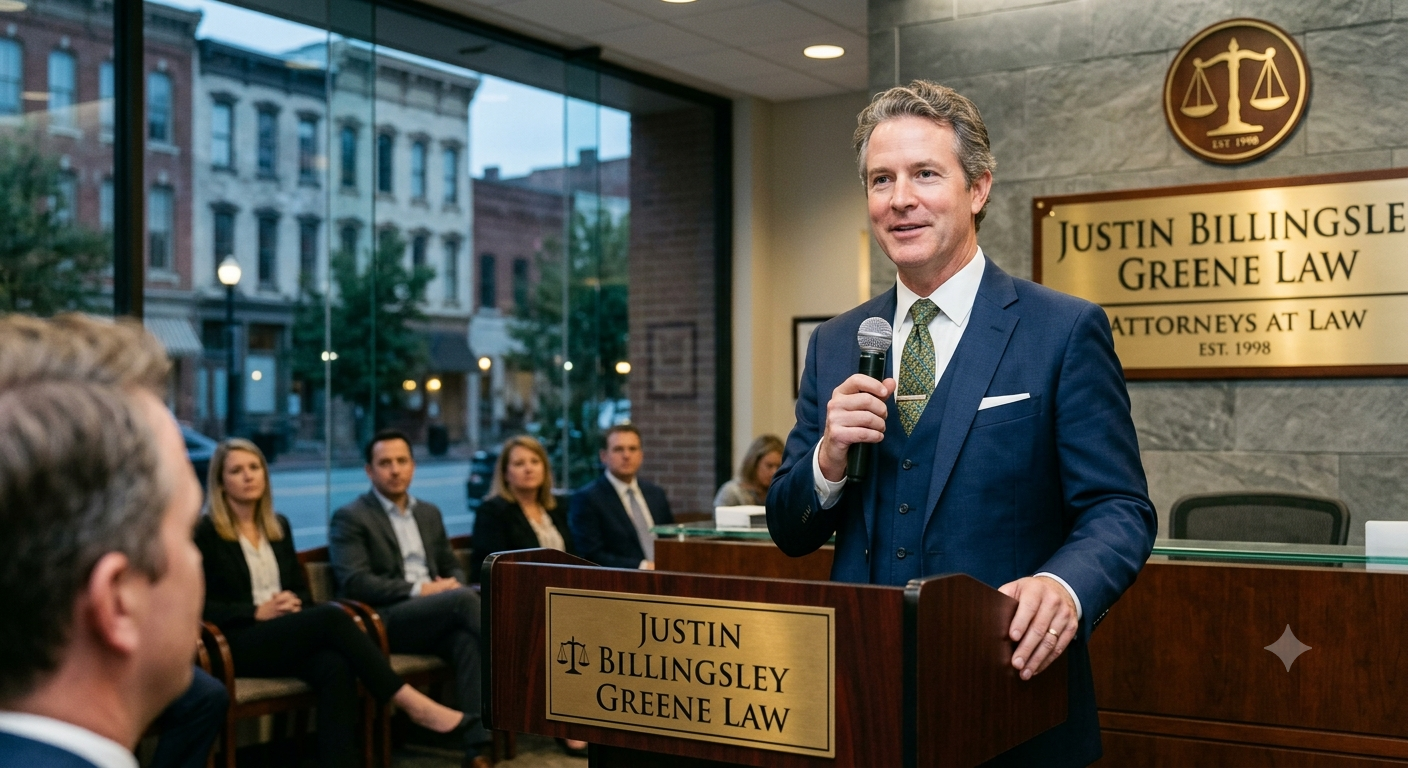
The search term Justin Billingsley Greene Law has attracted attention because it appears to connect a business-operations professional with Greene Law, P.C., a Connecticut general-practice firm. Yet the public record is not as straightforward as many online summaries suggest.
The strongest available evidence supports a cautious conclusion: third-party sources have associated Justin C. Billingsley with Greene Law PC in an administrative or operations capacity, while the firm’s current official staff page does not list him among its attorneys or support team.
That distinction matters. A law-firm administrator can influence systems, staffing, technology, billing workflows, intake, and client communication, but an administrator is not automatically a licensed attorney.
Anyone researching Justin Billingsley Greene Law should separate verified firm information from claims repeated by low-authority websites, especially when deciding who will provide legal advice or represent a client.
Justin Billingsley Greene Law: What Is Actually Verified?
Publicly indexed information suggests that Justin C. Billingsley has experience connected with Greene Law PC. A LinkedIn search result describes him as an operations executive focused on AI-driven, KPI-based infrastructure for personal-injury law firms and shows Greene Law PC among his experience.
A November 2025 third-party profile goes further, calling him an administrator and operations innovator at the firm.
However, that third-party article is not an official biography, regulatory record, or law-firm announcement. Several of its claims—including broad statements about AI adoption, expansion, training programs, and service areas—are not confirmed on the current Greene Law website.
For E-E-A-T purposes, those assertions should be treated as secondary reporting rather than established fact.
The firm’s official attorneys-and-staff page currently identifies:
- Gary Greene as principal
- Christopher Boy as an attorney
- Michele Greene as a paralegal
- Christopher Vargo Jr. as a paralegal
- Casey Greene as a legal assistant
Justin Billingsley is not shown on that page as of July 7, 2026.
This does not prove that no past, consulting, administrative, or off-page relationship existed. It simply means that a current role should not be presented as confirmed without direct verification from the firm.
Justin Billingsley Greene Law: Attorney or Administrator?
There is no reliable primary-source evidence in the reviewed materials showing Justin Billingsley as an attorney at Greene Law, P.C. The firm’s official site lists Gary Greene and Christopher Boy as its attorneys, while third-party content describes Billingsley in administrative and operational terms.
That difference is legally important. The American Bar Association explains that lawyers are licensed by state authorities and recommends checking the relevant state licensing agency to determine whether someone is authorized to practice.
Readers searching Justin Billingsley Greene Law should therefore avoid assuming that a management title, law-firm affiliation, or online article means the person is licensed counsel.
Ask the firm who will be responsible for the legal work, who will sign filings, and which attorney will appear in court if litigation becomes necessary.
Understanding Greene Law, P.C.
Greene Law, P.C. is based in Farmington, Connecticut. Its official website describes it as a general-practice firm with more than 40 years of service and a focus on litigation, financial matters, family law, real estate, collections, landlord-tenant disputes, personal injury, and related civil issues.
The firm’s history page states that Gary Greene practiced as a solo attorney for more than 25 years and expanded the practice as principal and lead litigator of Greene Law, P.C. beginning in 2008. The firm presents its model as combining personalized service with the experience of a larger practice.
For readers evaluating Justin Billingsley Greene Law, this verified background is more useful than promotional speculation. People entering the phrase may actually be trying to learn whether Greene Law is legitimate, what it handles, or who works there.
The official site answers those questions more reliably than recycled profiles.
Practice Areas Connected to the Justin Billingsley Greene Law Search
Financial Problems, Bankruptcy, and Foreclosure
Greene Law says it assists clients facing financial hardship, including bankruptcy and foreclosure-related matters. These cases can involve strict deadlines, extensive financial documentation, creditor communication, and decisions that affect property, credit, and long-term obligations.
A prospective client should ask which attorney handles the matter, whether the firm represents debtors, creditors, or both, and how fees are structured.
Do not rely on the Justin Billingsley Greene Law phrase alone to determine who has the relevant legal experience.
Family Law
The firm identifies family law as a core practice area and describes its approach as personal and understanding. Family cases may involve divorce, custody, support, property division, parenting disputes, or post-judgment issues, depending on the facts.
Before retaining counsel, ask about the lawyer’s recent experience with cases similar to yours. Also clarify who will communicate with you day to day: the attorney, a paralegal, a legal assistant, or an administrative professional.
Civil Litigation and Appeals
Greene Law’s litigation page states that it handles civil disputes and may explore negotiation, arbitration, or mediation before trial. It also lists appellate work, business disputes, collections, landlord-tenant matters, and other civil claims.
That breadth is significant. It also means clients should not assume every lawyer at a general-practice firm has equal depth in every category.
A useful Justin Billingsley Greene Law article must therefore do more than list services. It should tell readers to match the attorney’s actual experience to the specific dispute.
Business Law and Contract Matters
The firm’s official litigation page lists business formation and restructuring, mergers and acquisitions, asset sales, commercial disputes, and contract drafting or negotiation.
For business clients, the most important questions often concern scope. Will the firm only prepare documents, or will it also advise on risk allocation, due diligence, financing, employment concerns, and post-closing disputes?
Clear engagement terms prevent misunderstandings.
Real Estate and Landlord-Tenant Work
Greene Law describes services involving residential and commercial transactions, title issues, financing, leases, development, association matters, boundary disputes, easements, lien foreclosures, loan modifications, quiet-title actions, and partition cases.
It also represents parties in landlord-tenant disputes, including rent, eviction, habitability, security-deposit, and lease issues.
This area may explain why searches for Justin Billingsley Greene Law became associated with business and property operations. Still, the official website—not an outside biography—should control when identifying the services the firm currently advertises.
Personal Injury and Estate Planning
The firm lists personal-injury matters such as vehicle collisions, falls, workplace incidents, wrongful death, dog bites, and construction accidents.
It also advertises wills, trusts, estate planning, incapacity planning, guardianship provisions, and estate or trust administration.
These are very different legal disciplines. Clients should ask whether the lawyer regularly handles the exact type of claim or planning problem involved, rather than treating a broad practice list as proof of specialization.
Why Legal Operations Matter Even When the Administrator Is Not the Lawyer
The Justin Billingsley Greene Law search is useful because it highlights a part of legal service that clients often overlook: law-firm operations.
Case outcomes depend on legal analysis, but the client experience is also affected by intake systems, deadline controls, document management, billing accuracy, communication, cybersecurity, staffing, and workflow design.
The ABA describes legal operations as a combination of strategic planning, financial management, project management, technology, and process improvement that allows legal professionals to focus more effectively on legal work.
It also notes that successful legal operations depend on people, process, technology, and change management.
A capable administrator may improve:
- Response times through organized intake and follow-up systems
- Deadline reliability through calendaring and task controls
- Billing clarity through consistent timekeeping and invoice review
- Document handling through secure, searchable case files
- Client communication through portals, reminders, and defined points of contact
- Performance visibility through meaningful service and workload metrics
These functions are valuable, but they do not replace legal judgment. The person advising on rights, strategy, settlement, court procedure, or legal exposure should be appropriately licensed and responsible for the representation.
Separating Confirmed Facts From Online Claims
Many pages attempting to attract Justin Billingsley Greene Law clients contain unsubstantiated boasts. Statements range from transformative technology and artificial intelligence to geographic expansion, mentoring programs, or leadership qualities. The official pages of Greene Law do not include the mentioned attributes. A competent article about Justin Billingsley Greene Law would have used the following hierarchy of evidence:
Level 1: The firm’s website, official records (state bar, court resources), and statements from the firm.
Level 2: Professional networking profiles, which should be used with caution.
Level 3: Reputable secondary sources that include verifiable information.
Level 4: Generic SEO blogs that usually serve as lead magnets.
The hierarchy helps avoid the mix-up of different people called Justin Billingsley. In particular, LinkedIn search results return over 30 entries for a person named Justin Billingsley. Some of them are marketing directors, engineers, government officials, real estate agents, and people from other professions. The mix is also present in the search results for Billingsley Greene. Therefore, the middle initial, location, employer, and job title are important for distinguishing between people with the same name.
How to Evaluate Greene Law Before Hiring the Firm
The Justin Billingsley Greene Law query may be the first step in choosing representation, but it should not be the last. Use the consultation to test whether the firm fits your case.
Ask these questions:
- Who will be the attorney of record?
- Is that attorney licensed and in good standing in the relevant state?
- How many similar matters has the attorney handled recently?
- Who will complete most of the work?
- How often will the firm provide updates?
- What are the hourly, flat, contingent, or retainer terms?
- Which expenses are billed separately?
- What outcomes are realistic?
- What risks could change the legal strategy?
- How are files, personal data, and client communications protected?
- What happens if the assigned attorney becomes unavailable?
The ABA recommends using state licensing authorities and bar-supported directories to verify whether a person is authorized to practice and to locate qualified counsel.
Red Flags to Watch For
Be cautious if anyone guarantees a result, avoids identifying the responsible attorney, pressures you to sign immediately, gives legal advice before reviewing key documents, or will not explain fees in writing.
Also question webpages that call someone a lawyer without identifying a jurisdiction, license, law school, bar admission, or official firm biography.
In the Justin Billingsley Greene Law context, the most responsible wording is that public third-party material associates Billingsley with firm operations, but current official pages do not identify him as an attorney or list him on the staff page.
Justin Billingsley Greene Law and E-E-A-T
The Justin Billingsley Greene Law topic demonstrates why experience, expertise, authoritativeness, and trustworthiness matter in legal content.
A high-ranking page is not automatically an accurate page. Legal information affects money, property, family relationships, deadlines, and access to courts, so unsupported biographical claims can cause real confusion.
The strongest content does three things well:
- It cites primary sources.
- It distinguishes an attorney from a non-attorney professional.
- It gives readers a practical verification process.
That approach may sound less dramatic than calling someone a “visionary legal leader,” but it provides far more value.
For publishers targeting Justin Billingsley Greene Law, the best SEO opportunity is not to copy vague competitor claims. It is to answer the real search intent:
- Who is the person?
- What is the verified connection?
- Is he a lawyer?
- What does the firm do?
- Who is officially listed?
- How should a client verify representation?
Frequently Asked Questions
1. Who is Justin Billingsley in relation to Greene Law?
Third-party sources and a LinkedIn search result associate Justin C. Billingsley with Greene Law PC in an administrative, operational, or advisory context.
However, Greene Law’s current official staff page does not list him. Any present title or employment relationship should therefore be confirmed directly with the firm.
2. Is Justin Billingsley a licensed attorney?
The reviewed primary sources do not identify him as an attorney at Greene Law. The official site lists Gary Greene and Christopher Boy as attorneys, while outside material describes Billingsley as an administrator or operations professional.
Anyone needing certainty should search the relevant state licensing authority using the person’s full legal name.
3. What legal services does Greene Law, P.C. provide?
People researching Justin Billingsley Greene Law may be looking for information about the firm’s services rather than Billingsley’s biography.
The firm advertises financial-issue representation, family law, civil litigation, appeals, collections, business law, landlord-tenant disputes, personal injury, real estate matters, and wills, trusts, and estates. The precise scope and suitability of representation depend on the facts and the assigned attorney’s experience.
4. Where is Greene Law located?
The official website lists the firm at 1055 Farmington Avenue, Unit C, Farmington, Connecticut 06032 and provides weekday operating hours.
Because business addresses can change, prospective clients should confirm the location through the firm’s current contact page before visiting.
5. How can I verify information found under Justin Billingsley Greene Law?
Start with the firm’s official website. Then check the state attorney-licensing authority, relevant court records, and bar-supported directories.
Treat anonymous or thinly sourced blog posts as unverified until their claims are confirmed through a primary source.
Conclusion: Verify the Lawyer, the Role, and the Scope
The most accurate reading of Justin Billingsley Greene Law is not that Justin Billingsley is a confirmed Greene Law attorney.
Available third-party sources connect him with legal operations, while the current official Greene Law staff page names other individuals and does not include him. That gap should be disclosed, not filled with assumptions.
Before hiring the firm, contact Greene Law directly, identify the attorney who would handle the matter, verify that lawyer’s license, request a written fee agreement, and ask how communication and case responsibilities will be divided.
That simple process turns an uncertain web search into an informed legal-services decision.