



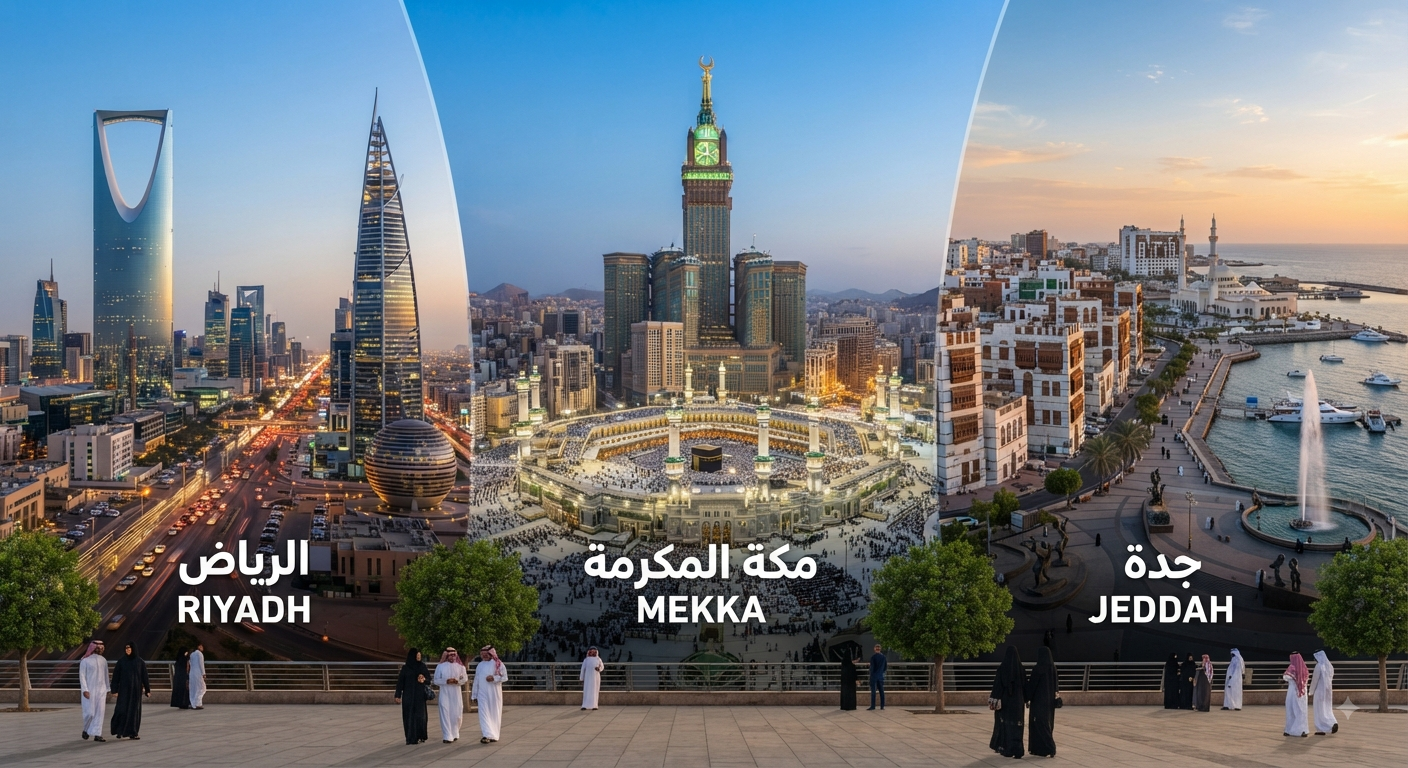
The popular cities in Saudi Arabia reveal a country far more geographically and culturally varied than many first-time visitors expect. Riyadh delivers big-city energy and contemporary culture; Jeddah combines Red Sea life with centuries-old architecture; Makkah and Madinah carry extraordinary religious significance; while AlUla, Abha and Al Ahsa introduce travelers to sandstone heritage, green highlands and palm-filled oases.
That diversity is the key to planning well. Instead of treating the Kingdom as a single desert destination, think of the popular cities in Saudi Arabia as distinct travel regions, each with its own climate, pace, landmarks and ideal trip length.
Quick Answer: Which Popular Cities in Saudi Arabia Should You Visit?
For most first-time itineraries, Riyadh, Jeddah and AlUla create a strong introduction to the country because they cover modern urban life, Red Sea culture and archaeological heritage. Travelers focused on Islamic history naturally prioritize Makkah and Madinah, while visitors seeking cooler landscapes should look toward Abha and Taif.
Key destinations to know include:
- Riyadh for museums, dining, events, modern architecture and nearby Diriyah.
- Jeddah for Al-Balad, the Corniche, Red Sea activities and a more coastal atmosphere.
- Makkah for Al Masjid Al Haram and the spiritual center of Islam.
- Madinah for the Prophet’s Mosque, Quba Mosque, Mount Uhud and Islamic heritage.
- AlUla for Hegra, desert scenery, archaeology and oasis landscapes.
- Dammam and Al Khobar for Arabian Gulf waterfronts and Eastern Province city life.
- Abha for mountains, forests, Aseeri culture and comparatively mild summer weather.
- Taif for mountain scenery, rose-growing traditions and an easy highland escape.
- Al Ahsa for its UNESCO-listed oasis, date palms and eastern heritage.
- Diriyah for At-Turaif and the historic roots of the Saudi state.
Together, these popular cities in Saudi Arabia cover the Kingdom’s strongest combinations of urban culture, sacred heritage, coast, mountains and archaeological landscapes.
Why the Popular Cities in Saudi Arabia Feel So Different
Saudi Arabia stretches across the Arabian Peninsula from the Red Sea to the Arabian Gulf, with major changes in elevation, climate and landscape between regions. That is why a trip combining Jeddah, Riyadh and Abha can feel dramatically different at every stop: coastal humidity gives way to an inland desert capital, then to cooler southwestern mountains.
Cultural identity also changes from place to place. Historic Jeddah reflects centuries of trade and pilgrimage, AlUla preserves Nabataean archaeology, Aseer is known for distinctive mountain culture, and the Eastern Province has its own Gulf-facing character.
UNESCO currently lists several Saudi World Heritage properties that connect directly with major destinations, including Hegra, Historic Jeddah, At-Turaif and Al Ahsa Oasis. These sites add historical depth that many generic city guides overlook.
1. Riyadh: The Capital and Urban Powerhouse
Among the popular cities in Saudi Arabia, Riyadh is the clearest window into the Kingdom’s contemporary transformation. The capital mixes business districts, museums, galleries, large-scale entertainment, ambitious architecture and traditional markets, making it particularly strong for travelers who want to understand modern Saudi life rather than simply photograph landmarks.
Compared with several other popular cities in Saudi Arabia, Riyadh rewards travelers who give equal attention to neighborhoods, dining and cultural programming—not only headline landmarks. The Saudi Tourism Authority describes Riyadh as a meeting point of heritage and modernity, while attractions such as Kingdom Centre provide a distinctly contemporary counterpoint to the region’s historical sites.
What to do in Riyadh
Start with a panoramic city view, then dedicate time to museums, traditional food and local neighborhoods rather than rushing between shopping malls. Nearby Diriyah is particularly valuable because it lets visitors connect modern Riyadh with an earlier chapter of Saudi history.
If your dates coincide with major seasonal events, check schedules before booking because entertainment programming can materially change what is available during your stay. Riyadh works best when you leave some flexibility rather than planning every hour in advance.
Best for: first-time visitors, business travelers, food lovers, events and urban culture. Suggested stay: 2–4 days.
2. Jeddah: Red Sea Culture, History and Waterfront Life
Jeddah is one of the most recognizable popular cities in Saudi Arabia because it offers something Riyadh cannot: direct access to the Red Sea. Its identity has been shaped by trade, pilgrimage and maritime exchange, and that history remains visible in Historic Jeddah (Al-Balad), a UNESCO World Heritage Site known for coral-built houses, traditional markets and historic lanes.
The city also has a distinctly modern coastal side. The Jeddah Corniche, contemporary art, seafood restaurants, cafés and marine experiences produce a travel atmosphere that feels noticeably different from the inland capital.
Why Jeddah deserves more than a stopover
Many travelers use Jeddah primarily as a gateway to Makkah, but doing so can mean missing one of Saudi Arabia’s strongest urban destinations. Give yourself enough time to explore Al-Balad in the late afternoon and experience the Red Sea waterfront after sunset.
Travelers interested in the water can also look into snorkeling, diving and boat-based activities, depending on weather and operating conditions. Visit Saudi actively promotes both heritage and marine experiences in the city.
Best for: heritage, food, couples, families, Red Sea experiences and photography. Suggested stay: 2–3 days.
3. Makkah: The Spiritual Heart of Islam
No discussion of popular cities in Saudi Arabia can ignore Makkah. The city is home to Al Masjid Al Haram and the Kaaba, and its role is fundamentally different from a conventional sightseeing destination because worship, pilgrimage and Islamic history shape the city’s identity and daily rhythm. Visit Saudi describes Makkah as the spiritual heart of Islam.
For Muslim travelers performing Umrah or visiting outside the Hajj period, accommodation location deserves careful thought. Staying close to Al Masjid Al Haram can reduce transport time, particularly around busy prayer periods, while official guidance notes that crowds and road access can vary significantly during peak seasons.
Beyond the central mosque area, Makkah also contains museums and sites connected with Islamic history, including cultural experiences related to the development of the Holy Mosque. These can add context to a longer stay without shifting attention away from the city’s religious purpose.
Best for: Muslim pilgrims and travelers exploring Islamic heritage. Planning note: pilgrimage rules, permits and access requirements can change by season, so verify them through official Saudi channels before travel.
4. Madinah: Sacred Heritage With a Calmer Pace
Madinah belongs high on any list of popular cities in Saudi Arabia for travelers interested in Islamic history. Major places associated with the city include the Prophet’s Mosque, Quba Mosque, Mount Uhud, Masjid Al Qiblatayn and the Hijaz Railway Museum, alongside newer cultural and visitor experiences.
Compared with Makkah, many itineraries allow for a slower exploration of Madinah’s heritage landscape. That makes it worth allocating dedicated time instead of viewing it simply as the second stop on a religious journey.
Official tourism guidance states that access to Al Rawdah Al Sharifah requires advance booking through Nusuk. Visitors are also advised to plan around prayer times, Ramadan and major seasons, when demand and crowd levels can increase considerably.
Best for: pilgrimage, Islamic history, reflective travel and heritage. Suggested stay: 2–3 days for many visitors, depending on religious plans.
5. AlUla: Saudi Arabia’s Archaeological Showpiece
AlUla has become one of the most internationally visible popular cities in Saudi Arabia, although its appeal is less about conventional city life and more about archaeology, desert geology and cultural landscapes. Its headline site is Hegra, the southernmost major city of the Nabataean Kingdom and Saudi Arabia’s first UNESCO World Heritage Site.
Monumental rock-cut tombs, sandstone formations, an oasis landscape and carefully managed heritage experiences make AlUla particularly compelling for travelers who like history with a strong sense of place. UNESCO highlights Hegra’s monumental Nabataean tombs and decorated rock-cut façades as defining elements of the archaeological site.
How long do you need in AlUla?
Two full days is a practical minimum if Hegra is a priority. Three days gives you more flexibility for oasis areas, desert landscapes, viewpoints and slower exploration without turning the entire visit into a sequence of timed activities.
AlUla also fits naturally into an itinerary involving Madinah or northwestern Saudi Arabia. That geographic logic matters because unnecessary backtracking can consume large portions of a Saudi trip.
Best for: archaeology, desert landscapes, photography, luxury travel and cultural tourism. Suggested stay: 2–4 days.
6. Dammam and Al Khobar: The Arabian Gulf Side of Saudi Arabia
For a different coastal experience, the popular cities in Saudi Arabia on the Eastern Province side include Dammam, Al Khobar and nearby Dhahran. Visit Saudi presents the region as a combination of beaches, cultural attractions and Gulf-facing urban life, with Dammam and Khobar serving as convenient regional bases.
Al Khobar is especially appealing for waterfront time and access to Half Moon Bay, while Dammam provides parks, family attractions and a useful transport hub. Dhahran can add a stronger cultural component to a wider Eastern Province itinerary.
The region works particularly well for travelers who have already experienced Riyadh and western Saudi Arabia. Its waterfront geography, pace and proximity to Al Ahsa make it suitable for an entirely separate multi-day route.
Best for: families, Gulf coast scenery, business travel and relaxed weekends. Suggested stay: 2–3 days.
7. Abha: Mountain Air and Aseeri Culture
Abha stands apart from many other popular cities in Saudi Arabia because of its elevation and southwestern mountain setting. The wider Aseer region is associated with forests, misty peaks, hiking, heritage settlements and distinctive local arts, giving travelers a dramatically different visual impression of the Kingdom.
Climate is one of Abha’s biggest travel advantages. Official tourism information shows substantially milder predicted summer conditions in Aseer than in major lowland cities such as Riyadh or Dammam, helping explain the region’s importance as a warm-season destination.
What makes Abha worth the detour?
Come for the scenery, but leave room for culture. Traditional architecture, Aseeri cuisine, local museums, historic settlements and mountain viewpoints make the area more rewarding than simply treating it as a place to escape the heat.
Outdoor travelers can also explore hiking routes, juniper landscapes and heritage villages across the wider Aseer region. Official tourism material increasingly presents nature and local culture as complementary parts of the same trip.
Best for: nature, road trips, hiking, summer travel and regional culture. Suggested stay: 3–4 days.
8. Taif: Mountains, Roses and a Classic Summer Escape
Taif earns its place among the popular cities in Saudi Arabia through altitude, mountain scenery and its long-standing reputation as a seasonal retreat. The surrounding highlands, including Al-Hada and Al-Shafa, offer scenic drives and elevated landscapes that contrast sharply with the hotter western lowlands.
Saudi Tourism Authority listings continue to promote Taif through its mountain scenery and rose-related identity. Al-Shafa Mountain lies about 30 kilometers by road from Taif, making the surrounding landscape relatively easy to incorporate into a short stay.
Taif works especially well as an extension of a western Saudi itinerary. Travelers moving through Jeddah and the Makkah region can add a mountain stop without committing to the considerably longer journey toward Abha and Aseer.
Best for: couples, families, scenic drives, mountain weather and short escapes. Suggested stay: 1–2 days.
9. Al Ahsa: A Living Oasis in the Eastern Province
Al Ahsa is one of the most rewarding popular cities in Saudi Arabia for travelers who want landscapes that challenge the stereotype of an empty desert. The region centers on a vast oasis environment of palms, agricultural land, springs and historic sites, while Al Ahsa Oasis is UNESCO-listed as an evolving cultural landscape.
Visit Saudi describes Al Ahsa as a UNESCO-listed destination where culture and nature overlap. Its oasis environment creates a striking contrast with nearby desert landscapes and makes the destination especially valuable for photographers and travelers interested in traditional agricultural landscapes.
Because Al Ahsa sits in eastern Saudi Arabia, it combines naturally with Dammam, Al Khobar and Dhahran. That makes it a strong addition to an itinerary centered on the Arabian Gulf rather than the more common Riyadh–Jeddah route.
Best for: oasis landscapes, heritage, local food, photography and repeat visitors. Suggested stay: 1–2 days.
10. Diriyah: The Historic Counterpoint to Modern Riyadh
Diriyah is often treated as part of a Riyadh trip, but it deserves recognition in a guide to popular cities in Saudi Arabia because of its historic significance and distinct identity. The At-Turaif District is a UNESCO World Heritage property and preserves an important architectural and political chapter in Saudi history.
Its proximity to Riyadh makes Diriyah one of the easiest high-value additions to a capital itinerary. Visitors can devote substantial time to heritage areas without necessarily changing hotels or adding another domestic flight.
The experience also creates useful contrast. Modern Riyadh makes much more sense when travelers have seen the historic settlement that represents an earlier center of Saudi political development.
Best for: history, architecture, culture and short excursions. Suggested stay: half a day to one full day.
Popular Cities in Saudi Arabia by Traveler Type
A useful way to compare popular cities in Saudi Arabia is by traveler intent. Choosing between destinations becomes much easier when you start with the experience you actually want instead of selecting whichever city has the greatest international name recognition.
For a first trip, prioritize Riyadh, Jeddah and AlUla. For a religious journey, Makkah and Madinah are central; for summer scenery and cooler elevations, look toward Abha and Taif.
For coastal travel, compare Jeddah’s Red Sea character with Al Khobar and Dammam on the Arabian Gulf. For UNESCO and heritage depth, a route connecting Historic Jeddah, Diriyah, AlUla and Al Ahsa covers several markedly different periods and landscapes.
How to Build an Itinerary Around the Popular Cities in Saudi Arabia
Saudi Arabia is large, so one of the easiest ways to weaken a trip is to connect too many distant places in too little time. A seven-day itinerary is generally more enjoyable when it focuses on two or three geographic clusters rather than creating a schedule dominated by airports, hotel check-ins and transfers.
A strong first-time route is Riyadh → AlUla → Jeddah. It combines the modern capital, Saudi Arabia’s standout archaeological destination and the country’s major Red Sea city without repeating essentially the same travel experience three times.
Travelers incorporating Islamic heritage can add Madinah and, according to their pilgrimage plans and relevant access requirements, Makkah. A later journey could focus on southern Saudi Arabia with Taif and Abha, or the east with Dammam, Al Khobar and Al Ahsa.
Domestic flights are often practical for long distances, while cars become more useful for regional excursions involving mountains, coastlines and oasis destinations. Check current transport schedules before finalizing a multi-city route because operating times and seasonal demand can change.
Best Time to Visit Popular Cities in Saudi Arabia
There is no single perfect month for every region. Riyadh, Jeddah, Makkah, Madinah and the Eastern Province can experience intense summer heat, while higher-elevation destinations such as Abha and parts of Aseer are substantially milder. Visit Saudi’s regional temperature guidance illustrates just how large that climatic difference can be.
For walking-heavy city sightseeing, cooler months will generally be more comfortable. Summer becomes more attractive when your focus shifts toward Aseer, Abha, Taif and other elevated destinations rather than lowland urban exploration.
Religious travelers need another layer of planning because Ramadan, Umrah and Hajj-specific regulations influence crowds, accommodation demand, transport and permits. Hajj and Islamic-calendar dates shift against the Gregorian calendar, so old travel guides should never be your final source for pilgrimage logistics.
Practical Travel Tips Before Visiting Popular Cities in Saudi Arabia
Entry rules should be checked shortly before departure rather than copied from an old blog post. As of August 2026, the official Saudi eVisa portal says citizens of 66 eligible countries can apply online; it describes the eVisa as a one-year, multiple-entry visa permitting stays of up to 90 days and covering tourism and Umrah, but not Hajj.
Visitors should also familiarize themselves with local public-decency expectations, customs and dress norms. Saudi Arabia’s official tourism portal states that people in public places are expected to respect local values, customs and traditions.
Travel conditions also deserve a last-minute check. Current UK and U.S. government advisories in 2026 identify elevated regional-security risks and specific areas where travel is discouraged, so international visitors should review their own government’s latest advice, insurance coverage and flight status shortly before departure.
That is particularly important for articles about Saudi travel published online. Visa procedures, transport systems, event calendars, pilgrimage requirements and regional advisories are exactly the kinds of details that become stale fastest.
FAQ About Popular Cities in Saudi Arabia
What are the most popular cities in Saudi Arabia for first-time tourists?
For a first visit, Riyadh, Jeddah and AlUla provide one of the strongest combinations. Riyadh shows contemporary capital life, Jeddah blends UNESCO-listed heritage with Red Sea culture, and AlUla introduces world-class archaeology and desert landscapes.
Travelers with more time can add Abha for mountains or the Eastern Province for an Arabian Gulf perspective. Muslim travelers planning pilgrimage or Islamic-heritage travel will naturally structure the itinerary differently around Makkah and Madinah.
Which Saudi city is best for tourists?
There is no universal winner because the cities serve very different travel intents. Jeddah is excellent for travelers who want heritage and the sea, Riyadh is strongest for contemporary urban culture, and AlUla is particularly compelling for archaeology and landscape.
The better question is what kind of Saudi experience you want. Once you identify whether your priority is history, food, nature, religious heritage, coast or entertainment, the best city becomes much easier to choose.
Is Riyadh or Jeddah better for a first visit?
Choose Riyadh if you want museums, contemporary Saudi culture, large-scale events, modern architecture and easy access to Diriyah. Choose Jeddah if you prefer coastal scenery, Historic Jeddah, Red Sea activities and a city shaped strongly by maritime exchange.
For many travelers, visiting both is more valuable than declaring one superior. Their contrast explains far more about modern Saudi Arabia than either destination can on its own.
Which cities in Saudi Arabia have UNESCO World Heritage Sites?
Important destination-based UNESCO properties include Historic Jeddah, At-Turaif in Diriyah, Hegra in AlUla and Al Ahsa Oasis. Saudi Arabia also has other World Heritage properties elsewhere in the Kingdom, including rock-art and archaeological landscapes outside the cities covered in this guide.
That makes UNESCO heritage a useful way to organize a longer cultural itinerary. Instead of simply visiting famous cities, travelers can follow different layers of Arabian, Islamic, Nabataean and Saudi history across several regions.
How many days do you need to see the main Saudi cities?
A useful starting point is 7–10 days for three major destinations. Roughly two weeks works better if you intend to combine western Saudi Arabia, religious destinations, the south or the Eastern Province without constantly rushing.
Saudi Arabia’s scale matters more than many first-time visitors realize. Fewer destinations with two or three nights in each will usually create a more rewarding trip than collecting city names while spending much of the holiday in transit.
Conclusion: Choose Cities That Match the Trip You Actually Want
The best popular cities in Saudi Arabia are not interchangeable. Riyadh delivers capital-city energy, Jeddah brings Red Sea culture, AlUla offers archaeology, Makkah and Madinah carry extraordinary religious significance, Abha and Taif open the door to mountain landscapes, and the Eastern Province presents a different Gulf-facing side of the country.
When comparing popular cities in Saudi Arabia, start by choosing three experiences, not three city names. Decide whether you want urban culture, heritage, pilgrimage, coast, desert or mountains, then build the route around destinations that deliver those experiences with minimal backtracking.
That approach gives you more than a checklist. It creates a Saudi Arabia itinerary with genuine contrast, enough time to understand each place, and far fewer hours lost simply moving between airports.