


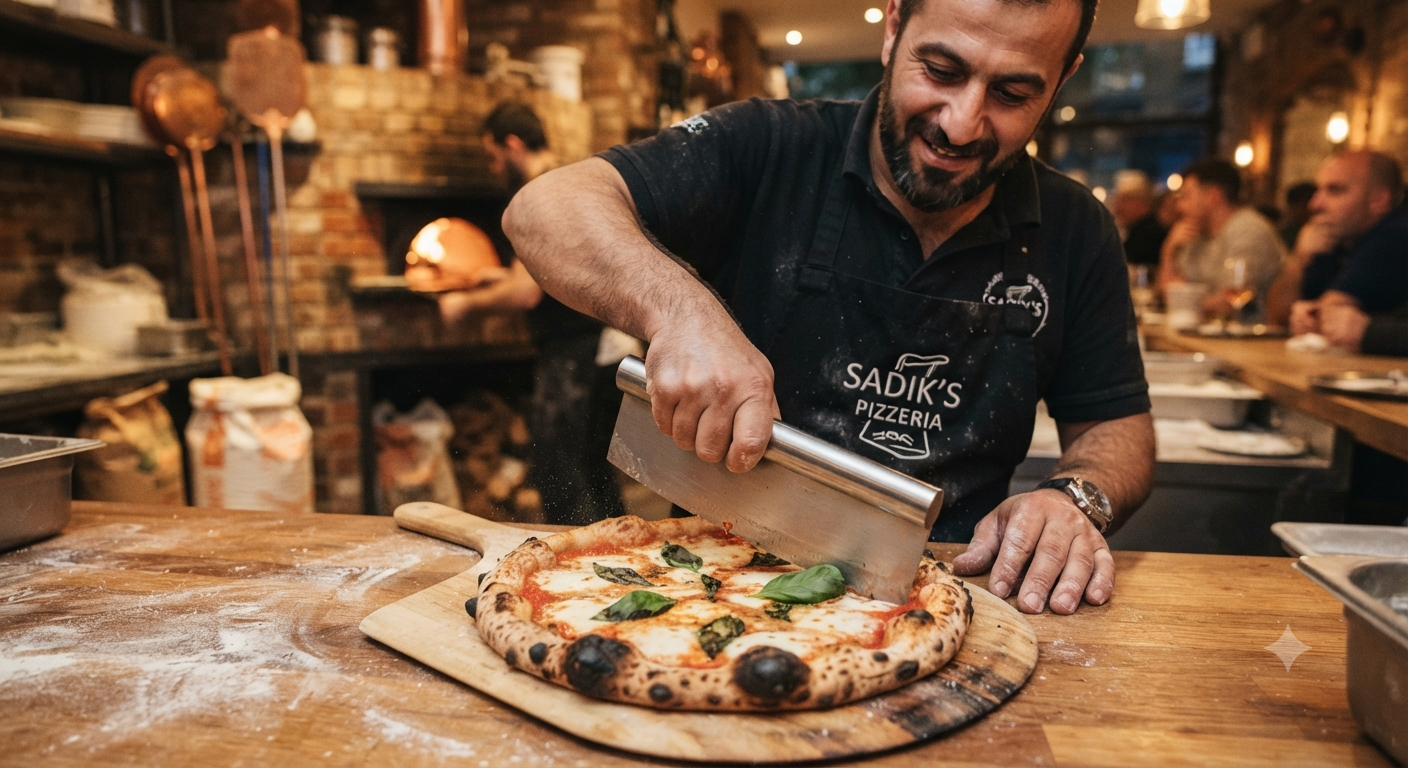
If you searched for Slice by Sadik expecting a pizza restaurant, menu, address, or food review, you are not alone. The phrase has spread across Google, YouTube, social platforms, maps listings, and low-quality articles that often describe it as a genuine restaurant. The more accurate story is much more unusual: the better-documented name is “Slices by Sadik,” and it became associated with a Scammer Payback anti-scam stunt in which a suspected scam-call-center location was presented online as a pizzeria. Scammer Payback itself published a video titled We Turned a Scam Call Center into a Pizzeria.
That distinction matters. Search results now mix the original joke, fan content, merchandise, unrelated map entries, scraped restaurant pages, and articles that invent culinary details. This guide separates what can actually be verified from what appears to be speculation, while explaining why the name became such a memorable piece of anti-scam internet culture.
What Is Slice by Sadik?
At its core, Slice by Sadik is a search variant of “Slices by Sadik,” the name of the fictional product at the center of the content created by Scammer Payback. Scammer Payback is a major anti-scam media company that positions itself as a source of information, humor, and entertainment about scammers and their schemes.
The most compelling proof that this was never intended to be an actual restaurant comes from within the ecosystem of Scammer Payback itself. Its official store features a “Slices by Sadik” collection, which includes a T-shirt and an apron, and a free downloadable menu.
Notably, the description of the last item clearly states that it is not an actual menu, thus explicitly refuting any assumptions about the legitimacy of the pizza shop.
Finally, the anti-scam company published the pizzeria-themed video described above, which has since amassed tens of millions of views. In other words, the identity of Slice by Sadik as a pizza restaurant was always a joke and a creative device to entertain viewers by juxtaposing pizza culture and scam-related content.
The spelling issue: Slice by Sadik vs. Slices by Sadik
People frequently search Slice by Sadik, but the official Scammer Payback merchandise collection uses Slices by Sadik with an “s.” That small difference helps explain why search results look inconsistent.
For SEO and user intent, both forms matter. The singular version captures the way many users remember or type the phrase, while “Slices by Sadik” is the better-supported branded wording. A trustworthy article should acknowledge both instead of pretending they are two separate businesses.
How Slice by Sadik Became an Internet Phenomenon
The story gained traction after Scammer Payback published its pizzeria-themed scam-disruption video. The premise was simple enough to understand instantly: take a location the team said was associated with scam operations and transform its online identity into something completely unexpected—a pizza shop.
That contrast was the hook.
Scam operations typically depend on trust, urgency, phone access, and convincing victims that they represent legitimate organizations. Turning the same phone presence into a source of pizza inquiries flips that dynamic and makes the operation look absurd.
The resulting pizzeria joke had several qualities that make internet stories spread quickly:
- Immediate visual humor: a scam center presented as a pizzeria is easy to understand.
- Participatory culture: viewers could grasp the joke without knowing cybersecurity terminology.
- A strong narrative: anti-scam audiences already understand the damage caused by impersonation and tech-support fraud.
- Memorable branding: “Slices by Sadik” sounds enough like a neighborhood pizza shop to make the concept work.
- Shareable artifacts: menus, merchandise, video clips, comments, screenshots, and reviews gave people multiple ways to reference the joke.
That combination helped the story move beyond a single YouTube upload. It became a meme, a search query, a merchandising theme, and eventually a source of confusion for people encountering copied listings or SEO articles without the original context.
Is Slice by Sadik a Real Restaurant?
The safest evidence-based answer is: the Scammer Payback version is not a real restaurant.
That conclusion is supported by Scammer Payback’s official store, where the downloadable “Slices By Sadik Menu” is explicitly described as not an actual menu. The official collection also places Slices by Sadik alongside Scammer Payback merchandise rather than presenting it as a restaurant ordering service.
This is important because several third-party websites now treat the name as though it referred to a genuine dining destination.
Some describe supposedly exceptional pizza, customer service, atmosphere, ingredients, artistic food presentation, or even a “culinary philosophy.” Yet these claims do not appear on the official Scammer Payback sources connected to the original phenomenon.
That is a major reliability problem.
Why do restaurant listings for Slice by Sadik appear online?
There are several reasons a fictional or prank restaurant name can eventually begin to look real in search results.
First, mapping platforms and restaurant aggregators can contain user-generated, automatically collected, or syndicated business information. Once a business name appears in a database, other sites may reproduce its category, rating, location, opening hours, or reviews.
For example, searches now surface apparently unrelated “Slices by Sadik” restaurant-style listings in locations outside the context of the original Scammer Payback story. Their existence does not automatically establish a connection to the original prank.
Second, viral names get copied. Fans, parody creators, pranksters, or entirely unrelated businesses may reuse a memorable phrase.
Third, automated content websites often attempt to answer high-interest search queries even when authoritative information is scarce. That can lead to invented descriptions being repeated until fiction starts looking like fact.
For this reason, a search result should not be considered authentic merely because it appears on a map, restaurant directory, or review website.
The Scammer Payback Connection
The most authoritative connection is direct: Scammer Payback publishes both the pizzeria-themed video and the official Slices by Sadik merchandise collection.
The channel describes its broader purpose as bringing awareness to scams while using humor and entertainment to make the subject accessible. That context helps explain why the pizza concept resonated so strongly with viewers.
A conventional consumer-fraud warning can feel distant.
A scam operation suddenly being associated with pizza orders? People remember that.
This is where the prank has more significance than the joke alone. It can act as a gateway into scam awareness.
Someone might arrive because they saw a funny pizzeria name. They leave understanding that many fraud schemes depend on social engineering, impersonation, manufactured urgency, remote access, and psychological pressure.
Why the Story Matters Beyond the Meme
It is tempting to treat the story as nothing more than internet comedy. Yet the subject behind the prank is financially serious.
The U.S. Federal Trade Commission reported that adults aged 60 and older reported losing $159 million to tech-support scams in 2024. The agency also noted substantial overall fraud losses among older consumers.
The problem has continued. In May 2026, the FTC stated that adults aged 60 and over reported losing more than $3 billion to fraud during 2025.
Those figures put the comedy in perspective.
The information-gain lesson is important: the real value of anti-scam entertainment is not encouraging random internet users to harass suspicious phone numbers. Its value is making fraudulent tactics easier for ordinary people to recognize.
A funny pizza story may stick in someone’s memory longer than a generic security warning.
That memory becomes useful when someone later receives a frightening call claiming their bank account has been compromised, their computer contains malware, or they urgently need to move money somewhere “safe.”
What Slice by Sadik Teaches About Tech-Support Scams
The best takeaway is not “call scammers back.” It is learning how fraudsters create pressure.
Tech-support and impersonation schemes frequently rely on recognizable psychological triggers:
- Fear: “Your computer has been hacked.”
- Authority: “We are calling from your bank, Microsoft, or a government agency.”
- Urgency: “You need to fix this immediately.”
- Isolation: “Do not discuss this with anyone.”
- Payment pressure: “Move your money, purchase gift cards, send cryptocurrency, or make a transfer.”
- Remote access: “Install this software so we can fix the problem.”
The FTC explicitly warns that it will never demand money, threaten consumers, tell them to transfer money, or promise a prize in return for payment.
The practical response is simple.
Stop when someone creates panic and immediately demands money, login information, security codes, or remote access.
Do not rely on the caller’s phone number or links they provide. Independently verify the organization using a website, app, bank statement, card, or other source you already trust.
Should You Call a Slice by Sadik Number You Find Online?
No. There is little benefit in calling a number simply because a page attaches it to the prank.
This is especially important now that the original story has been copied across different websites and directories.
Old phone numbers can be reassigned. User-generated listings can contain errors. Another person or legitimate company could eventually receive a number that was previously associated with completely different activity.
Calling, flooding, or review-bombing an unverified target could therefore affect someone who has nothing to do with the original story.
A safer rule is simple:
Watch the original content. Don’t try to recreate the disruption yourself.
If you encounter genuine suspected fraud, document what happened and report it through appropriate channels. The U.S. Federal Trade Commission provides ReportFraud.ftc.gov specifically for reports involving scams, fraud, and deceptive business practices.
If money has already been transferred, contact the relevant bank, credit-card issuer, payment provider, or financial institution as quickly as possible.
Slice by Sadik Menu, Merchandise, and Fan Culture
One reason the story continues to appear in search is that it developed a life beyond the original video.
Scammer Payback’s official store currently lists a Slices by Sadik T-shirt, a Slices By Sadik apron, and the downloadable menu.
For users searching for the menu, the critical fact is that the official download is novelty content. It is not evidence that you can order pizza from a functioning Slices by Sadik restaurant. Scammer Payback explicitly labels the downloadable product as not being a real menu.
That distinction is exactly the sort of detail many competing articles miss.
They see “menu,” assume “restaurant,” and build an entire narrative around it.
The primary source says otherwise.
Can you buy Slice by Sadik merchandise?
Yes. Scammer Payback’s official storefront has offered Slices by Sadik merchandise, including apparel and an apron.
Availability and prices can change, however, so old screenshots should not be treated as evidence of current inventory.
The merchandise also provides an important authenticity signal. If a third-party page claims to represent an official restaurant while the strongest primary source presents the name as Scammer Payback-themed merchandise and labels the menu fictional, that restaurant claim requires much stronger supporting evidence.
How Misinformation Grew Around Slice by Sadik
Viral search terms attract content farms quickly. This case is a textbook example of how that process creates an alternate story.
Some web pages describe “Sadik” as a chef, food artist, founder, culinary visionary, or creator of an innovative dining experience.
One such page, for example, describes supposedly artistic food presentation and an experiential dining concept, despite the official Scammer Payback material pointing to a prank rather than a functioning culinary brand.
This is exactly why source hierarchy matters.
A primary source connected directly with the phenomenon generally deserves more weight than a generic blog repeating an unsupported story.
A strong E-E-A-T approach should:
- Separate primary evidence from scraped listings and aggregator pages.
- Clearly label uncertainty instead of manufacturing answers.
- Avoid inventing a biography for “Sadik.”
- Never treat anonymous restaurant reviews alone as proof that a business is genuine.
- Verify whether an alleged menu is actually meant for ordering food.
- Distinguish the original prank from unrelated businesses using similar names.
- Check dates so later copycat listings are not mistaken for original evidence.
That approach is less sensational.
It is also considerably more useful.
Who Is Sadik in Slice by Sadik?
This is one of the most common questions—and one of the easiest places to overstate the available evidence.
The name “Sadik” is central to the prank branding, but the primary Scammer Payback sources readily available to the public do not provide enough independently verified biographical information to justify many of the elaborate personal stories published elsewhere.
That matters because some pages go far beyond explaining the meme. They assign identities, occupations, histories, and accusations to a supposedly identifiable person without clearly showing where the claims came from.
The responsible answer is more limited:
Sadik is the name used in the “Slices by Sadik” prank identity.
Claims identifying a specific private individual, assigning that person a role, or providing a detailed criminal biography should be treated cautiously unless backed by credible journalism, court records, law-enforcement documentation, or another appropriately authoritative source.
For readers, this restraint is not a weakness.
It is exactly what good E-E-A-T content should do: know where the evidence stops.
Why Slice by Sadik Still Gets Searches
The continued interest in the phrase comes from a mixture of curiosity and confusion.
Some users want to find the Scammer Payback video. Others have encountered the name through comments, memes, map screenshots, merchandise, reviews, short-form videos, or copied restaurant listings.
Another group genuinely believes it is a pizza restaurant.
That creates several overlapping search intents:
- “What is Slice by Sadik?”
- “Is Slices by Sadik real?”
- “Where is Slice by Sadik located?”
- “Who is Sadik?”
- “What is the Slice by Sadik phone number?”
- “Is there a Slice by Sadik menu?”
- “What happened in the Scammer Payback pizza prank?”
- “Can I buy Slices by Sadik merchandise?”
A strong informational page should satisfy all of these intents while resisting the temptation to manufacture certainty.
That is where this topic offers genuine information gain. The answer is not another fictional restaurant review. It is a clear explanation of why so many different kinds of search results exist in the first place.
FAQ About Slice by Sadik
1. Is Slice by Sadik a real pizza restaurant?
The Scammer Payback-related version is not a conventional pizza restaurant. Scammer Payback’s official store offers a downloadable “Slices By Sadik Menu” and explicitly states that it is not an actual menu. The name is associated with the channel’s pizzeria-themed anti-scam content and merchandise.
Unrelated or later listings using similar names may exist, but they should not automatically be confused with the original viral concept.
2. Why is Slice by Sadik connected to Scammer Payback?
Scammer Payback published a video called “We Turned a Scam Call Center into a Pizzeria” and operates an official Slices by Sadik merchandise collection. Those primary sources establish a substantially stronger connection than speculative blogs or copied restaurant-directory listings.
The concept fits Scammer Payback’s broader content style, which combines scam awareness with humor and entertainment.
3. Where is Slice by Sadik located?
Search results have associated the original prank with West Bengal, India, but users should not treat an old map location as a currently operating pizza restaurant. Search-indexed material about the Scammer Payback stunt describes converting a scam-center location’s Google Maps presence into a pizzeria-themed listing.
The safest interpretation is therefore that the location was part of the prank narrative, not a verified restaurant accepting normal customer orders.
4. Is there a real Slice by Sadik menu?
There is a downloadable Slices By Sadik Menu on Scammer Payback’s official store.
But there is an important catch.
The product page specifically says it is “not an actual menu.” It should therefore be understood as novelty or fan content rather than a food menu from which customers can place restaurant orders.
5. What should I do if I find a Slice by Sadik phone number?
Do not assume the number is still associated with the original prank or with any scam operation.
Phone numbers can be reassigned, websites can copy incorrect numbers, and user-generated map listings can become outdated. Calling or harassing an unverified number risks involving an unrelated person or business.
If you encounter an actual fraud attempt, preserve useful evidence such as messages, emails, payment requests, or transaction details and use official reporting channels. In the U.S., suspected scams can be reported through the FTC’s ReportFraud service.
Conclusion: Understand the Joke, Keep the Scam-Awareness Lesson
The real story is more interesting than the fictional restaurant descriptions circulating online. Slice by Sadik is best understood as a search variation of “Slices by Sadik,” a Scammer Payback-linked pizzeria prank that turned scam disruption into a memorable piece of viral internet culture.
If you arrived looking for a menu, restaurant review, location, or phone number, do not rely blindly on scraped listings or unsupported blogs. Start with the original Scammer Payback material and its official store, where the downloadable menu is explicitly identified as not being an actual restaurant menu.
Then take the most useful part of the story with you.
Learn to recognize manufactured urgency, impersonation, unexpected remote-access requests, unusual payment instructions, and demands to move money. Verify suspicious communications independently, share reliable fraud-prevention information with friends and family, and report genuine scam attempts through official channels rather than attempting to recreate the prank yourself.
The pizza was fictional.
The scam-awareness lesson is very real.