


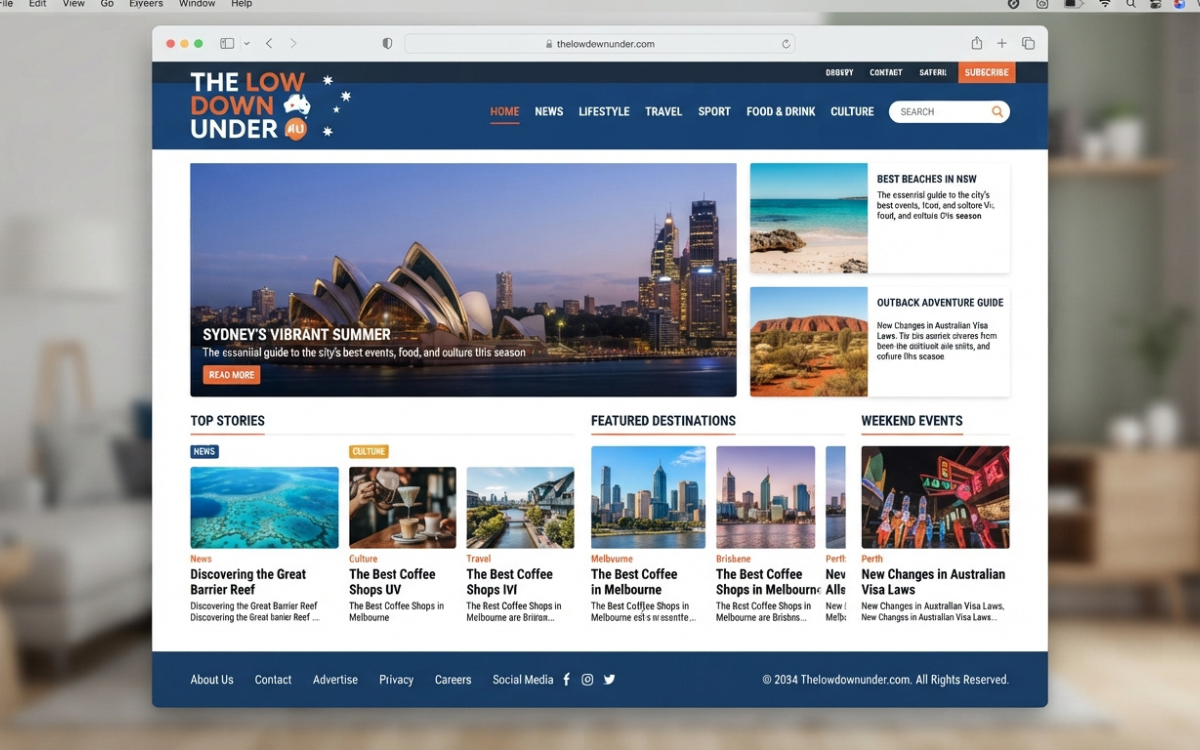
Thelowdownunder.com is easy to mistake for a tightly focused Australia-and-New Zealand travel publication. Its name points “Down Under,” while its About page describes a destination built around fitness, travel, food, global culture, workout advice, recipes, and healthy-lifestyle inspiration. Spend more time in the archive, though, and a broader picture appears: this is a multi-topic digital magazine that also publishes entertainment, home, technology, gaming, relationships, business, finance-adjacent content, online gambling pieces, and highly specific search-driven explainers.
That distinction matters. If you understand what the site actually is—and where its public trust signals are strong or incomplete—you can use it much more effectively.
The Quick Verdict on Thelowdownunder.com
Thelowdownunder.com appears to be an active general-interest content website with named contributors, dated articles, a searchable archive, a contact page, privacy information, and published terms. The homepage shows posts spanning multiple years and continued publishing activity into 2026, while the About page identifies four editorial contributors and assigns each a broad role.
Its best use is discovery and introductory reading: finding travel ideas, lifestyle inspiration, food topics, fitness concepts, home tips, and general-interest explainers. For medical, legal, financial, gambling, safety, immigration, or other high-impact decisions, readers should verify claims against qualified professionals and authoritative primary sources before acting.
Key takeaways:
- The site is broader than its branding suggests. Travel, food, and fitness are prominent, but the archive extends into many unrelated subjects.
- Named authorship is a positive signal, not proof of subject expertise. Several contributors publish outside the specialties described on the About page.
- The website publishes basic trust pages. These include About, Contact, Privacy Policy, and Terms & Conditions.
- Some claims made in a 2026 article about site features are difficult to confirm from the visible navigation.
- The site’s own terms say it does not warrant that information is complete, accurate, or kept up to date. That is an important reason to verify consequential claims elsewhere.
What Is Thelowdownunder.com?
Thelowdownunder.com presents itself with the tagline “Taste the Thrills, Train the Skills.” Its primary navigation emphasizes entertainment, fun facts, travel, food, fitness, home, and contact, while its About page says the publication aims to cover fitness, travel, and food from cultures around the world.
That positioning is only part of the story. The homepage and author archives contain articles on subjects as varied as travel logistics, home selling, cooking, online casino games, FinTech, entertainment, social media, health-related topics, technology, and niche informational queries. In practical terms, the website functions more like a broad lifestyle and general-interest magazine than a specialist Australian travel resource.
This is useful context for searchers. A brand name can create expectations, but topical authority should be judged by the actual article, its author, evidence, date, and sources—not by the domain name alone.
What Content Does Thelowdownunder.com Publish?
Travel and destination content
Travel is one of the clearest pillars. The site publishes destination inspiration, route and luggage advice, travel accessories, country guides, and Australia/New Zealand-oriented material alongside coverage of places such as San Diego, France, the Dolomites, Armenia, Georgia, Tennessee, and Florida.
A 2026 travel guide on the site discusses Australia and New Zealand, including seasonal planning, transport, budgets, insurance, and sample itinerary ideas. That kind of content can be a useful planning starter, but time-sensitive details such as visas, border requirements, transportation schedules, park closures, fees, and insurance conditions should always be checked with official sources.
Food, cooking, and culinary culture
Food content ranges from recipes and cooking techniques to restaurant-business topics and culinary travel. The About page identifies Rachel Panenchko as the site’s “Culinary Explorer” and says she is trained as a chef.
Her public author archive, however, includes not only food material but also technology, sports betting, home makeovers, weight-management content, and travel. That does not automatically make those articles unreliable, but it demonstrates why readers should evaluate expertise at the page level rather than assuming every post sits within an author’s stated specialty.
Fitness, wellness, and health-adjacent topics
The fitness section includes exercise guidance, healthy-eating material, pain-related topics, and general wellness content. The About page describes Danny Smith as a fitness-focused contributor with more than a decade of experience as a certified personal trainer and nutrition expert.
Yet Danny’s archive also includes Australian entertainment, FinTech, New Zealand digital leisure, swimming, and other subjects. The public bio reviewed here does not show a certification number, awarding body, professional register, or external credential link, so readers should treat the qualification description as a site-published credential claim unless independently verified.
Entertainment, gaming, technology, and search-driven explainers
This is where Thelowdownunder.com becomes much more expansive. Its archive includes technology questions, gaming, casino content, pop culture, parenting, relationships, business-oriented explainers, education-style queries, and other topics that do not fit neatly into travel, food, fitness, or home.
Breadth is not inherently bad. A general magazine can cover many subjects well, but broader coverage raises the bar for editorial controls because expertise does not transfer automatically between fields.
Who Writes for Thelowdownunder.com?
The About page names four editors or contributors: Mark Henry, Content and Community Manager; Lizzy Maitland, Travel Enthusiast; Rachel Panenchko, Culinary Explorer; and Danny Smith, Fitness Guru. Short biographies describe their interests and, in some cases, claimed professional experience.
The site also maintains author archive pages, which is helpful because readers can inspect each contributor’s publication history. Mark Henry’s archive, for example, includes travel, cooking, home/property, and casino-related content, while Lizzy Maitland’s archive includes digital entertainment, slot games, social media, food, and travel.
This creates an important E-E-A-T lesson: an author name is a transparency signal, not an expertise certificate. Stronger author pages would ideally include detailed bios, relevant qualifications, first-hand experience, professional profiles, portfolio links, editorial roles, and clear subject-matter boundaries.
Thelowdownunder.com Trust Signals: What Works in Its Favor?
Several visible features make the publication easier to assess than a completely anonymous content site.
First, articles commonly display author names, publication dates, and estimated reading times. Second, the site provides an About page, contact form, domain-based contact email, privacy policy, terms page, cookie controls, and an on-site search function.
The privacy policy explains that log files may capture technical information such as IP addresses, browser type, internet service provider, timestamps, referring or exit pages, and click activity. The site also exposes cookie settings covering necessary, functional, performance, analytics, advertising, and other cookie categories.
Those are useful transparency elements. They tell you something about how the publication operates, but they do not establish that every factual claim in every article has been independently checked.
Where Thelowdownunder.com Needs More Transparency
The public editorial identity and the archive do not fully align
The About page centers fitness, travel, and food. The live archive is substantially broader, encompassing gambling, technology, finance-adjacent subjects, entertainment, home content, education-style questions, relationships, health-adjacent material, and more.
For readers, this means the safest approach is to assess each article as its own information product. Look for sourcing, author relevance, date, original experience, specialist review, and clear distinctions between opinion and evidence.
Some author-role labels are broader in practice
A culinary contributor publishing betting or technology content, or a fitness contributor publishing FinTech and entertainment material, does not prove poor editorial quality. It does, however, weaken the assumption that the role label alone tells you why that person is qualified to write a specific article.
For stronger E-E-A-T, subject-sensitive posts would benefit from expert review, source notes, credential verification, and clearer author-page documentation.
Site-feature claims deserve verification
A June 2026 article published on Thelowdownunder.com says users can search and filter content, register, save guides, create trip lists, receive alerts, submit tips, and allow local businesses to claim listings and add photos. The same article also describes fact-checking and editorial standards.
The visible public navigation reviewed for this article clearly exposes categories, search, About, Contact, Privacy, and Terms, but it does not make all of those richer account, directory, or business-listing features obvious. That does not prove the claims are false; it means readers should treat them as self-published statements that require direct confirmation.
Business and legal details could be clearer
The footer displays the location “5678 Vexandor Boulevard, Xyriath, WV 20873,” while the Terms & Conditions state that agreements are subject to the prevailing law of the Netherlands. The reviewed public pages do not clearly explain the relationship between that displayed location, legal jurisdiction, corporate ownership, or a registered business entity.
This inconsistency should not be treated as evidence of wrongdoing. It is simply an area where clearer ownership and company information would materially improve transparency.
Is Thelowdownunder.com Legit?
If “legit” means a functioning website with a substantial article archive, visible contributors, public contact information, and legal/privacy pages, the observable evidence supports that description. The site is active and publicly accessible, with posts dated across multiple years and material continuing into 2026.
If “legit” means every article is authoritative, independently fact-checked, current, and written by a demonstrably qualified specialist, the public evidence does not support making that blanket claim. In fact, the site’s own Terms & Conditions state that it does not ensure its information is correct, complete, accurate, continuously available, or kept current.
That clause deserves attention. It is a reminder to use the publication proportionately: low-stakes lifestyle ideas require less verification than medical treatment, legal interpretation, financial decisions, gambling advice, immigration rules, or expensive travel bookings.
How to Evaluate Any Thelowdownunder.com Article Before You Rely on It
Use a simple verification routine. It takes only a few minutes and dramatically improves the value you get from broad content sites.
- Check the author. Open the author archive and see whether the writer regularly covers the subject.
- Check the publication date. Rules, prices, software, transport, health guidance, financial products, and travel requirements can change quickly.
- Look for primary sources. Government agencies, official companies, professional bodies, academic research, and original documentation carry more weight than unsourced assertions.
- Separate inspiration from instruction. “Places worth considering” is different from “this visa rule applies to you.”
- Verify high-impact claims independently. Do not make medical, legal, financial, safety, gambling, or major purchasing decisions from a single lifestyle article.
- Watch for internal contradictions. Conflicting numbers, dates, names, or recommendations are signs that more checking is needed.
- Prefer first-hand evidence. Original photos, documented visits, testing methodology, interviews, and clearly described experience strengthen a page.
This approach turns Thelowdownunder.com into what broad magazines are often best at: a discovery engine for ideas and questions to research further.
Privacy, Cookies, and Contact Information
Thelowdownunder.com publishes a privacy policy explaining its use of standard server log information and includes cookie-consent controls. Its contact page provides a message form and a domain-based email address, and it says the team usually replies to relevant messages within one business day; that response-time statement is the site’s own claim rather than an independently tested service guarantee.
The terms also discuss intellectual-property rights, comments, hyperlinking, cookies, liability, and content reuse. Anyone submitting information, interacting with forms, or relying on site content should read those pages directly because policies can change.
Who Will Get the Most Value From the Site?
The site is most useful for readers who want a starting point rather than a final authority. Its breadth makes it easy to jump between topics, discover unfamiliar ideas, and get a quick overview before deeper research.
It may be particularly useful for:
- travelers brainstorming destinations, itineraries, or packing ideas;
- readers looking for recipes, cooking inspiration, or food-culture stories;
- people seeking general fitness or lifestyle motivation;
- casual readers exploring entertainment, home, technology, or fun-fact content;
- searchers who want a plain-language introduction to a niche topic before consulting specialist sources.
Readers should be more cautious when a page crosses into health, law, finance, safety, gambling, immigration, or technical instructions. In those areas, the cost of an error is higher, so the evidence standard should be higher too.
What Makes This Site Different From Similar General-Interest Blogs?
The main differentiator is not that Thelowdownunder.com owns one narrow subject. It is the opposite: the site combines an “Australia/Down Under” identity with a remarkably broad archive that behaves like a general web magazine.
That mix can be convenient, but it also explains why evaluating the specific page is more important than trusting the site as a single-topic authority. The best articles on a broad publication can still be useful, while weaker or outdated pages should not inherit credibility from unrelated sections.
A second differentiator is the gap between the site’s concise navigation and the size of its underlying content footprint. Readers who rely only on the top menu may not realize how many categories and search-driven topics exist deeper in the archive.
Conclusion: How to Use Thelowdownunder.com Wisely
Thelowdownunder.com is best approached as a broad discovery and lifestyle publication—not as a universal expert source. Browse it for ideas, inspiration, introductory explanations, travel possibilities, recipes, fitness topics, home content, and entertainment, then judge important claims by their evidence.
Your next step is simple: open the article you care about, check the author and date, inspect its sources, and independently verify anything that could affect your health, money, legal rights, safety, or travel plans. That habit gives you the convenience of a wide-ranging magazine without outsourcing your judgment to it.
Frequently Asked Questions
1. What is Thelowdownunder.com?
Thelowdownunder.com is a general-interest publishing website whose visible navigation focuses on entertainment, fun facts, travel, food, fitness, and home content. Its About page emphasizes fitness, travel, and food, but its broader archive includes technology, gaming, gambling, business, relationships, health-adjacent material, and many search-specific explainers.
The most accurate description is therefore a multi-topic lifestyle and informational magazine rather than a narrowly focused Australia-only travel site.
2. Is Thelowdownunder.com a legitimate website?
It is an active, publicly accessible website with a large archive, named contributors, dated posts, contact information, a privacy policy, cookie controls, and terms. Those are meaningful operational signals.
They are not a guarantee that every page is authoritative. The site’s own terms explicitly decline to warrant the correctness, completeness, accuracy, availability, or ongoing freshness of all information, so important claims should be verified elsewhere.
3. Who owns Thelowdownunder.com?
The public About page reviewed for this guide names Mark Henry, Lizzy Maitland, Rachel Panenchko, and Danny Smith as editorial contributors, but it does not clearly identify a legal owner, registered company, or corporate entity. The footer displays an address labeled “Xyriath, WV,” while the terms refer to the prevailing law of the Netherlands.
Until clearer company information is publicly documented, it is more precise to distinguish the named editorial team from verified legal ownership.
4. What topics can I find on Thelowdownunder.com?
Expect travel guides, food and cooking content, fitness and wellness articles, home and lifestyle material, entertainment, technology, gaming, casino-related posts, business topics, and niche explainers. The breadth is considerably larger than the main menu suggests.
That variety is convenient for browsing, but it also means readers should check whether an individual author has relevant experience and whether a post cites reliable sources.
5. Can I trust advice from Thelowdownunder.com?
For low-stakes inspiration—such as destination ideas, general cooking topics, entertainment reading, or lifestyle brainstorming—the site can be a useful starting point. Trust should increase only when the article provides strong sourcing, current information, relevant author expertise, first-hand evidence, or qualified review.
For medical, legal, financial, gambling, immigration, safety, or other consequential decisions, verify the information with official sources or appropriately qualified professionals before acting.