


Why was perfume called toilet water when the phrase now sounds like something from a bathroom rather than a fragrance counter? The answer is a striking example of semantic drift: a word kept changing while an old product name remained frozen in time. “Toilet water” originally described a lightly scented liquid used during washing, dressing, shaving, and personal grooming—not water from a toilet bowl.
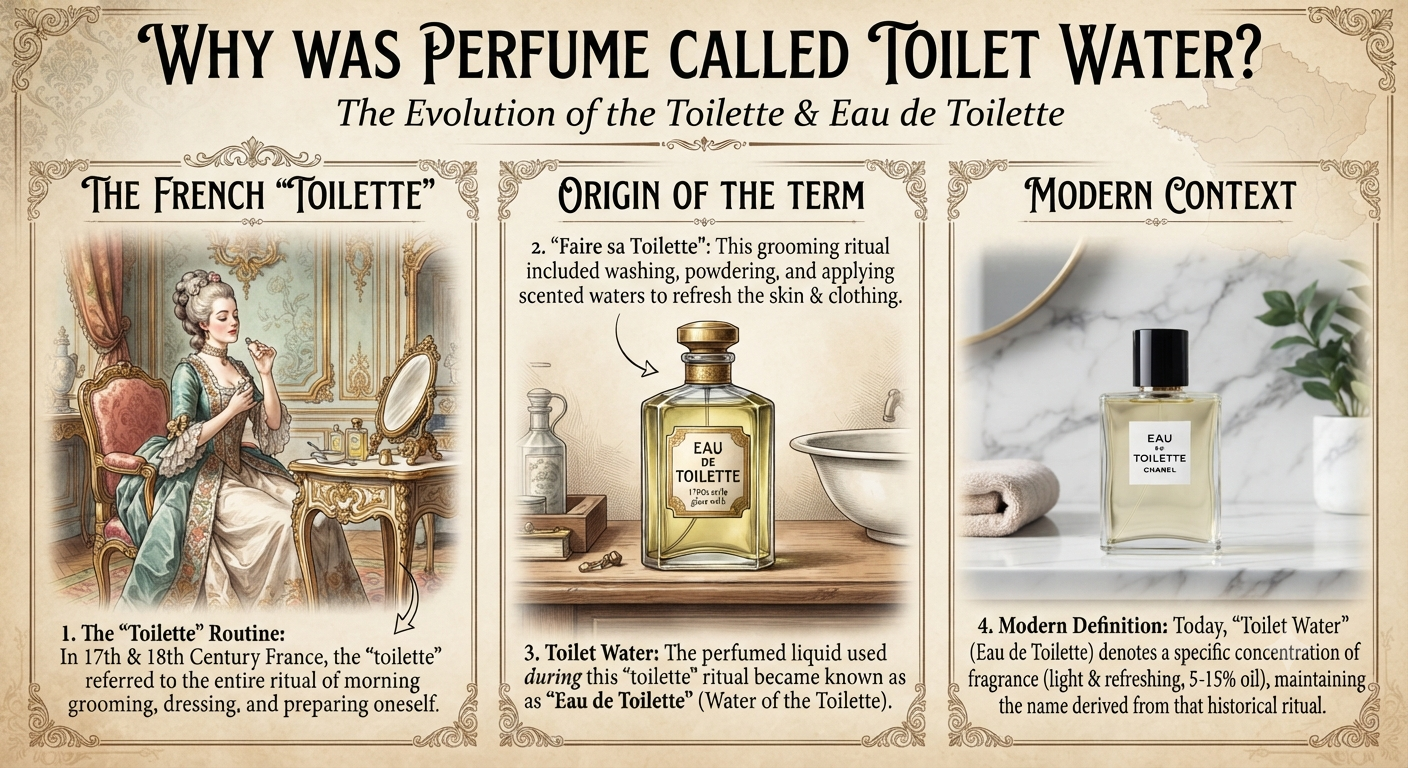
The historical answer to why was perfume called toilet water begins with that older grooming vocabulary. Perfume was not universally renamed “toilet water.” More precisely, toilet water was the traditional English name for eau de toilette, a lighter fragrance preparation used as part of one’s daily “toilet,” meaning the process of getting washed, groomed, dressed, and ready.
The Quick Answer: Why Was Perfume Called Toilet Water?
Why was perfume called toilet water? Because the older meaning of toilet referred to personal grooming and dressing. The French phrase eau de toilette therefore meant “water for washing and dressing” or, in more natural modern English, grooming water. Merriam-Webster still defines eau de toilette as a perfumed liquid with less fragrant oil than ordinary perfume or eau de parfum, and notes that it is also called toilet water.
The phrase only sounds unpleasant because modern English narrowed “toilet” toward the lavatory and its plumbing fixture. The fragrance term preserved the older, elegant meaning long after everyday speech moved on.
Key takeaways:
- Eau means water.
- Toilette originally referred to dressing and grooming.
- Eau de toilette meant scented grooming water.
- Toilet water was a legitimate cosmetic term, not a joke or mistranslation.
- The bathroom meaning became dominant later.
Why Was Perfume Called Toilet Water? Follow the Word Back to Cloth
To understand why was perfume called toilet water, start with a piece of fabric.
The French word toile meant cloth. Its diminutive, toilette, meant a small cloth. Merriam-Webster explains that this cloth could be placed over the shoulders while someone’s hair was dressed or while they shaved. English borrowed the term in the 16th century, eventually using “toilet” alongside the French-looking spelling “toilette.”
From there, the meaning expanded in a logical sequence:
- A small cloth used while dressing or grooming.
- A cloth covering a dressing table.
- The brushes, combs, bottles, powders, and other articles placed on that table.
- The dressing table itself.
- The entire act of washing, styling hair, applying cosmetics, dressing, and preparing to be seen.
This is why historical writing contains expressions such as “making one’s toilet” or “at her toilet.” Those phrases did not mean using the bathroom. They meant getting ready, often with careful attention to appearance, clothing, hair, and scent.
“Toilet” Once Meant a Grooming Ritual
The older meaning was broader than applying perfume. A person’s toilet could include washing the face, arranging the hair, shaving, choosing clothes, applying powder, and using scented preparations.
That makes the name much easier to understand. A scented liquid used during this routine was water for the toilet, just as shaving water, lavender water, rose water, or hair tonic described a product by its purpose. In that historical context, asking why was perfume called toilet water would have sounded no stranger than asking why mouthwash is called mouthwash.
The word also carried social meaning. Among wealthier households, the dressing table was a private but important stage for presentation. Bottles, powders, combs, mirrors, pomades, and scented waters belonged to a ritual of preparing the body for public life.
What Did “Eau de Toilette” Originally Mean?
The literal word-for-word translation is “water of the toilet,” but that rendering is misleading to modern ears. Merriam-Webster gives the historical sense more clearly: “water for washing and dressing.”
A better functional translation would be:
- Grooming water
- Dressing water
- Scented washing water
- Light personal fragrance
So, why was perfume called toilet water rather than simply perfume? Because the term identified both its use and its strength. It was generally a fresher, lighter preparation intended for liberal use during or after grooming, rather than a highly concentrated perfume extract applied sparingly.
Was All Perfume Actually Called Toilet Water?
No. This is one of the most important corrections missing from many explanations.
When people ask why was perfume called toilet water, they often assume the two terms were perfect synonyms. Historically, “toilet water” referred to a category of scented liquid comparable to what we now call eau de toilette. It did not automatically include every parfum, extract, cologne, floral water, or scented cosmetic.
Merriam-Webster records “toilet water” as an English term dating to at least 1772, while its entry for the French phrase eau de toilette gives 1907 as the first known English use of that exact borrowing. Etymonline, using a different body of evidence, cites “toilet-water” in the sense of a perfumed grooming liquid from 1855. These dates are not necessarily contradictory; dictionary “first known use” dates depend on the texts and databases each lexicographer has examined.
The useful conclusion is not that one date must be wrong. It is that English speakers used the translated cosmetic expression before the French label became the dominant luxury-market wording.
Why the Phrase Sounds So Strange Today
Why was perfume called toilet water without embarrassing customers? Because “toilet” had not yet become so tightly associated with a ceramic bowl.
The shift happened gradually. After “toilet” came to mean the act of washing and dressing, it could also describe the room where those activities happened. As indoor plumbing spread, the water closet was often placed in or near that room. The name of the grooming space then became associated with the lavatory and, eventually, the fixture itself. Merriam-Webster traces this movement from cloth, to dressing table, to grooming process, to room, and finally to the modern bathroom meaning.
This creates a linguistic time capsule. The phrase toilet water preserves an older definition, while the standalone word toilet moved on. English has many such “fossilized” expressions, but few create such a dramatic collision between luxury and sanitation.
A Simple Timeline of the Meaning
The question why was perfume called toilet water becomes clearer when the semantic changes are arranged in order. This timeline also shows why was perfume called toilet water long before the phrase gained its modern comic undertone:
- 1500s: English borrows toilet/toilette from French for a cloth or clothing covering.
- 1600s–1700s: The term becomes associated with dressing tables, grooming objects, and the act of dressing.
- 1700s: “Toilet water” appears as a scented grooming preparation; Merriam-Webster’s earliest known example is dated 1772.
- Late 1700s–1800s: “Toilet” expands to the room used for washing and dressing.
- 1800s–1900s: The lavatory and plumbing-fixture meanings become increasingly familiar.
- Early 1900s onward: The French label eau de toilette becomes standard on perfume packaging, avoiding the awkward modern associations of the literal English translation. Merriam-Webster dates its first known English use to 1907.
The exact boundaries overlap because language rarely changes on schedule. Older and newer meanings can coexist for decades.
Toilet Water vs. Perfume: What Is the Practical Difference?
Beyond etymology, why was perfume called toilet water is also a product-classification question. A complete answer to why was perfume called toilet water must therefore separate the name’s history from the concentration printed on today’s bottle.
The International Fragrance Association says terms such as eau de cologne, eau de toilette, eau de parfum, and perfume extract are general descriptors, not concentration categories fixed by one universal international standard. It lists typical industry ranges rather than rigid legal definitions.
Typical ranges are:
- Eau de cologne: About 3%–8% fragrance concentration
- Eau de toilette: About 5%–15%, commonly around 10%
- Eau de parfum: About 10%–20%, commonly around 15%
- Perfume extract or extrait: About 15%–40%, commonly around 20%
Fragonard’s Musée du Parfum gives a simplified traditional ladder of roughly 5% for cologne, 10% for eau de toilette, 15% for eau de parfum, and 20%–24% for perfume or extract.
These figures are useful guides, not promises. A powerful eau de toilette can outlast a soft eau de parfum because performance also depends on the formula, raw materials, volatility, climate, dosage, and the wearer’s skin.
Eau de Toilette Is Not Always “Watered-Down Perfume”
A common shopping mistake is assuming that every eau de toilette is merely the same perfume with extra alcohol and water.
Sometimes it is a lighter concentration of a closely related formula. In other cases, the perfumer rebalances the composition—emphasizing citrus, herbs, transparent florals, or aromatic top notes while reducing heavier woods, resins, vanilla, amber, or musk.
Frédéric Malle’s glossary notes that eau de toilette historically described lighter versions of established perfumes, while its FAQ warns that EDT and EDP classifications are not official and can also function as market positioning.
That means two bottles with the same fragrance name may smell noticeably different. Test the specific concentration on skin instead of assuming the eau de parfum is simply a stronger, longer version.
Why Did Brands Keep the French Phrase?
If why was perfume called toilet water has such a simple answer, why do brands still print eau de toilette instead of translating it?
Keeping the French phrase solves an obvious communication problem. Eau de toilette sounds established and technical; “toilet water” sounds comic because modern English speakers usually process “toilet” through its bathroom meaning first.
The French wording also works as a recognizable product label. Shoppers understand EDT as a fragrance family generally positioned between eau de cologne and eau de parfum, even when they do not know the phrase’s literal history.
Is Toilet Water Made From Toilet Water?
Absolutely not. Commercial eau de toilette is generally made from a fragrance concentrate diluted in an alcohol-and-water base.
Fragonard explains that a perfume composition combines raw materials with perfume oil, alcohol, and water. A 12% concentration, for example, means 12% perfume oil and 88% alcohol plus distilled water.
The “water” in the name describes the scented preparation, not its source. It has no connection to wastewater, sewage, or the contents of a lavatory.
Does Eau de Toilette Mean Low Quality?
No. Concentration and quality are separate questions.
An eau de toilette may be designed to feel sparkling, airy, crisp, or easy to wear in warm weather. Its faster evaporation can make top and heart notes feel more vivid. A heavier concentration may last longer, yet feel denser or less suitable for daytime, crowded offices, or hot climates.
When evaluating a fragrance, consider:
- The quality and balance of the formula
- How it develops on your skin
- Projection and sillage
- How long you need it to last
- Climate and season
- Whether you prefer freshness or depth
- Price per wear, not concentration alone
A well-constructed EDT can be the best version of a fragrance. “Lighter” does not mean “cheap,” just as “stronger” does not automatically mean “better.”
How to Choose Between EDT, EDP, and Parfum
Understanding why was perfume called toilet water is useful, but the label should also help you buy intelligently.
Choose eau de toilette when you want a fresher opening, moderate projection, easier reapplication, or a scent suited to daytime and warm weather. Choose eau de parfum when you prefer greater depth or longer wear. Choose parfum or extrait when you enjoy a richer, often closer-to-skin composition and are comfortable using fewer sprays.
Do not buy by acronym alone. Spray each version on separate areas of skin, wait through the opening, and compare them after several hours. The version that smells best after the dry-down—not the one with the highest percentage—is usually the smarter purchase.
Common Myths About Toilet Water
Several myths persist because people answer why was perfume called toilet water using the modern bathroom definition instead of the older grooming definition.
Myth 1: The Name Refers to Bathroom Water
False. The name comes from the historical meaning of toilette as grooming and dressing.
Myth 2: People Used Perfume to Hide the Smell of Toilets
Scent has certainly been used historically to freshen bodies, clothing, rooms, and objects, but that is not the linguistic reason for the term. Why was perfume called toilet water is fundamentally an etymology question, not evidence that the liquid came from or was designed specifically for lavatories.
Myth 3: Eau de Toilette Is Fake Perfume
False. It is an established fragrance format with a typical, though not universally fixed, concentration range.
Myth 4: Eau de Parfum Is Always the Same Scent, Only Stronger
Not necessarily. Concentration labels can accompany reformulated or rebalanced interpretations.
Myth 5: “Toilet Water” Is a Bad Translation
It is a literal and historically valid translation. It is simply a poor modern translation because the English meaning of “toilet” changed.
FAQs About Why Perfume Was Called Toilet Water
Why was perfume called toilet water in old advertisements?
Why was perfume called toilet water in old advertising? “Toilet water” was then a normal cosmetic term for a scented liquid used after washing, bathing, shaving, or dressing.
Readers understood “toilet” in the grooming sense, so the wording did not carry the same unpleasant implication it carries today.
Is eau de toilette the same as perfume?
Eau de toilette belongs to the broader perfume or fragrance family, but it is usually lighter than eau de parfum or perfume extract.
IFRA gives a typical EDT range of 5%–15%, while stressing that these labels are industry conventions rather than universally fixed concentration standards.
What is the literal English meaning of eau de toilette?
The literal rendering is “toilet water,” but the historically accurate sense is water for washing and dressing.
In natural modern English, “grooming water” communicates the original idea more clearly.
When did “toilet” begin to mean a bathroom fixture?
The change occurred through stages rather than one sudden switch. “Toilet” moved from cloth, to dressing equipment, to the act of grooming, to the room where grooming occurred, and then to the lavatory and fixture.
Etymonline dates the American plumbing-fixture sense to the late 19th century, while Merriam-Webster describes the room association developing earlier.
Why was perfume called toilet water but cologne was not?
Why was perfume called toilet water while another light fragrance was called cologne? The names came from different histories.
Eau de toilette was named for its role in the grooming routine, while eau de Cologne literally meant “water of Cologne,” referring to the German city associated with that fragrance tradition. The labels later became overlapping concentration categories, but their names began from different ideas.
Conclusion: Read the Label With Its Original Meaning
Before repeating the old joke, remember why was perfume called toilet water in the first place. It was a respectable personal-care label, not a reference to plumbing.
So, why was perfume called toilet water? Because “toilet” once meant the complete ritual of washing, grooming, dressing, and preparing oneself. Toilet water was scented water used as part of that ritual, and eau de toilette preserved the same idea in French.
That is the core answer to why was perfume called toilet water. The next time you see EDT on a bottle, read it as “grooming water,” not bathroom water. Then judge the fragrance by what matters: test it on skin, compare its dry-down with the EDP or parfum, and choose the concentration whose scent, performance, and character fit your life.