



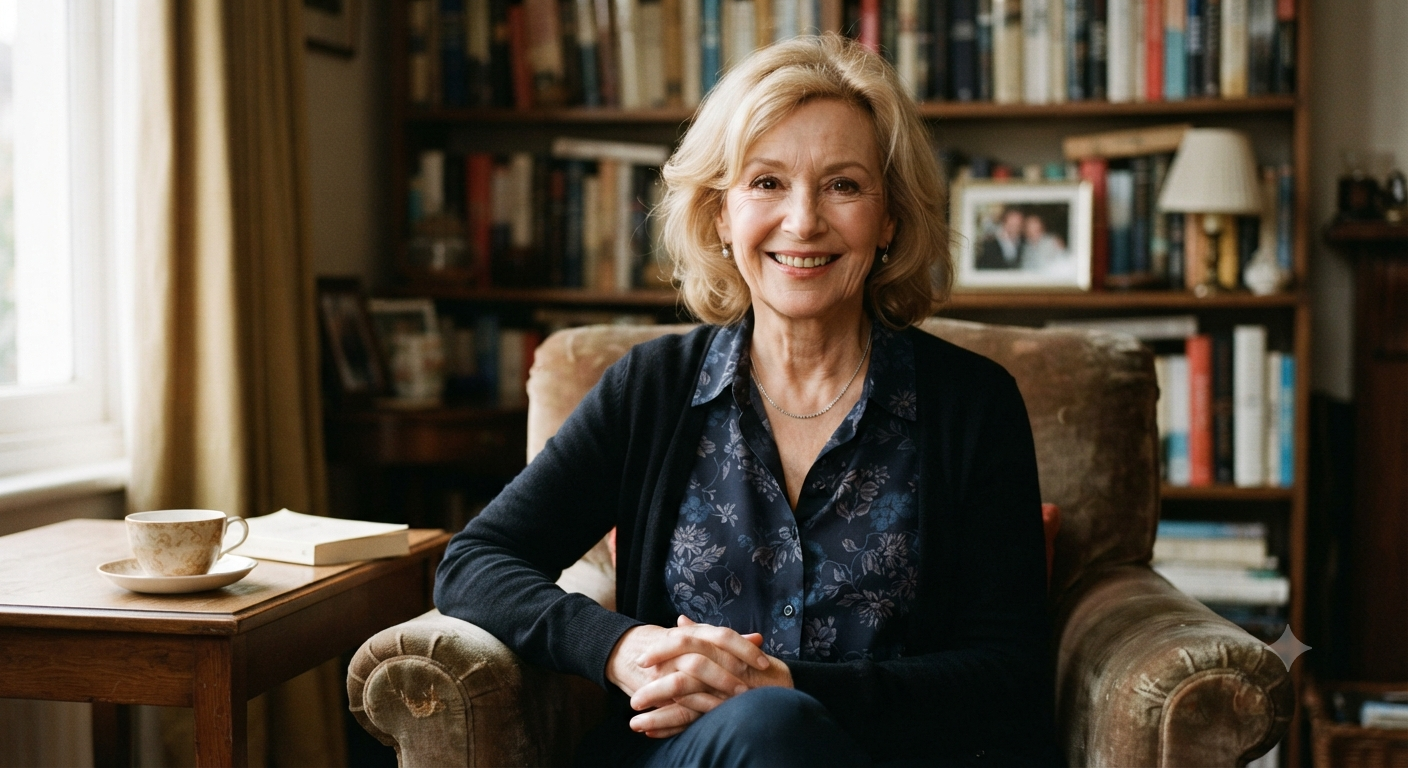
Actress Janine Duvitski has built the kind of career that many performers quietly envy: long, varied, respected and instantly recognisable without depending on celebrity spectacle. Across more than five decades, she has moved between theatre, film, sitcoms, period drama, children’s television and voice acting, creating characters who often seem fragile, eccentric or socially awkward—but are rarely as simple as they first appear.
Her face may trigger different memories for different generations. Some viewers know her as Angela in Mike Leigh’s Abigail’s Party. Others remember Jane Edwards in Waiting for God, Pippa Trench in One Foot in the Grave, or the cheerfully uninhibited Jacqueline Stewart in Benidorm.
That range is the central story of her career. She does not merely “play quirky.” She finds the emotional logic inside people whom less careful performances might turn into caricatures.
Who Is Actress Janine Duvitski?
Born Christine Janine Drzewicki on 28 June 1952, Duvitski trained at the East 15 Acting School before establishing herself in British stage and screen work. Her professional credits stretch from early-1970s television to projects listed in the mid-2020s, making her career a useful case study in durability, versatility and the value of character acting.
Unlike performers whose public identity is attached to one leading role, actress Janine Duvitski has repeatedly made supporting characters feel essential. She often enters a story without demanding attention, then changes its rhythm through timing, physical detail, vocal hesitation or an unexpectedly sharp emotional reaction.
Quick Facts
- Full birth name: Christine Janine Drzewicki
- Date of birth: 28 June 1952
- Profession: British actress
- Training: East 15 Acting School
- Career span: Early 1970s to the present
- Best-known television work: Waiting for God, One Foot in the Grave and Benidorm
- Breakthrough role: Angela in Abigail’s Party
- Family connection: Her daughter Ruby Bentall is also an actress.
Early Career: Training, Risk and an Unusual Break
The early career of actress Janine Duvitski did not follow a polished, heavily managed route. After drama school, she took small television parts and reportedly promoted herself through the professional casting directory Spotlight when she did not yet have an agent.
That step led to an audition for the BBC2 Playhouse drama Diane. She played a teenage girl in the production despite being in her early twenties at the time.
That casting says something important about her strengths. Duvitski could project vulnerability without making it decorative. She was able to suggest uncertainty, youthfulness and emotional exposure through behaviour rather than obvious performance tricks.
Her early credits also included appearances in programmes such as Z-Cars, Man About the House and The Georgian House. These were not simply résumé fillers; they gave her experience in the fast, technically precise environment of British television production, where actors had to create clear characters with limited screen time.
Actress Janine Duvitski and the Breakthrough of Abigail’s Party
The decisive turning point came when Mike Leigh saw Duvitski performing in Don Juan at Hampstead Theatre and cast her as Angela in the stage production of Abigail’s Party. She later repeated the role in the 1977 television version, which became one of the most discussed British television plays of its era.
Angela could easily have been played as a one-note comic figure. Instead, actress Janine Duvitski made her painfully recognisable: eager to please, nervous around stronger personalities, inclined to laugh at the wrong moment, yet capable of sudden honesty.
Her performance works because the comedy and sadness arrive together. Angela is amusing, but the audience never feels entirely comfortable laughing at her.
The production’s cultural reputation has endured well beyond its original broadcast. In a BFI career discussion, Leigh acknowledged its exceptional popularity even while criticising the rushed studio recording.
The contradiction is revealing. The technical presentation may have dissatisfied its director, but the performances were vivid enough to make the work last.
Duvitski’s Angela also demonstrates a quality that would recur throughout her career. She listens intensely. Even when another character dominates the scene, her face continues the story.
That reactive intelligence is a major reason she became such an effective ensemble performer.
Why Her Acting Style Is More Sophisticated Than It Looks
Actress Janine Duvitski specialises in characters who appear slightly out of step with the social world around them. They may speak too soon, smile too long, misunderstand a cue or reveal more than good manners permit.
Those details create laughs. They also expose how social groups police confidence, class, age, sexuality and belonging.
Three techniques define much of her screen work:
- Precise reaction timing: She often delays a response by a fraction, letting discomfort become visible.
- Physical specificity: A tilted head, compressed smile or uncertain posture can tell the audience who holds power.
- Emotional contradiction: Her characters may look cheerful while feeling excluded, or seem foolish while understanding more than others assume.
This is why her performances reward repeat viewing. The first watch catches the joke. The second often reveals the wound beneath it.
She also avoids the common mistake of announcing a character’s eccentricity. Rather than pushing every unusual mannerism toward the audience, she behaves as though the character considers her actions completely reasonable.
That commitment keeps the humour believable.
Television Success in Waiting for God and One Foot in the Grave
The 1990s gave actress Janine Duvitski two enduring sitcom roles. In Waiting for God, she played Jane Edwards, the anxious and put-upon assistant to retirement-home manager Harvey Bains.
The series ran from 1990 to 1994 and placed her beside experienced comic performers including Graham Crowden and Stephanie Cole.
Jane’s comedy came from pressure. She was constantly trying to satisfy an unreasonable authority figure while preserving some sense of order.
Duvitski made the character’s nervousness rhythmically funny, but never emptied her of sympathy. Viewers could laugh at Jane’s responses while still recognising the unfairness of her situation.
During the same broad period, she appeared as Pippa Trench in One Foot in the Grave, the neighbour of Victor and Margaret Meldrew. Her appearances continued across the programme’s 1990–2000 run, allowing her to contribute to a darker comic universe built on embarrassment, frustration and social catastrophe.
Pippa was often caught between normal neighbourly behaviour and the increasingly bizarre consequences of living near Victor. Duvitski understood that the show’s comedy worked best when the surrounding characters reacted to absurdity as though it were a genuine social emergency.
These parts established her as one of British television’s most dependable comic character actors. She could support a lead without fading into the background, and she could heighten absurdity without breaking the reality of a scene.
Actress Janine Duvitski in Benidorm
For a later generation, actress Janine Duvitski is inseparable from Jacqueline Stewart in ITV’s Benidorm. She played the character from 2007 to 2018, appearing across the show’s long run as part of its rotating ensemble of British holidaymakers on Spain’s Costa Blanca.
Jacqueline was bold, affectionate, sexually open and largely free of embarrassment. That made the role a fascinating reversal of Duvitski’s earlier screen image.
Rather than playing someone crushed by social discomfort, she portrayed a woman who regularly created discomfort for everyone else—and enjoyed herself while doing it.
The role could have become broad or repetitive. Duvitski kept it buoyant by giving Jacqueline genuine warmth.
Her lack of inhibition was not presented only as a joke. It was also a form of confidence, emotional generosity and loyalty to her friends.
Jacqueline and her husband Donald, originally played by Kenny Ireland, became one of the programme’s most memorable couples. Their unconventional relationship gave Benidorm a reliable source of outrageous comedy, but Duvitski also made the partnership feel affectionate rather than merely provocative.
This is one of the clearest signs of her range. The nervous Angela of Abigail’s Party and the exuberant Jacqueline of Benidorm occupy almost opposite ends of the social spectrum, yet both feel emotionally coherent.
Film Career: From Period Horror to Art-House Drama
Although television brought her widest recognition, actress Janine Duvitski has maintained a substantial film career. For actress Janine Duvitski, cinema has provided space to work in genres far beyond the familiar British sitcom.
Her credits include The First Great Train Robbery, Dracula, Breaking Glass, Peter Greenaway’s Drowning by Numbers, The Madness of King George, About a Boy, The New World, Angel and Jessica Hausner’s Little Joe.
These films span commercial entertainment, literary adaptation, historical drama and European art cinema. The variety matters.
Character actors often sustain film worlds by making brief appearances feel inhabited, giving social texture to settings that might otherwise seem designed only for the leading stars.
In Dracula, released in 1979, she appeared in a production led by Frank Langella, Laurence Olivier and Donald Pleasence. In The Madness of King George, she played Margaret Nicholson, a historical figure associated with an attempt to attack King George III.
Her appearance in About a Boy placed her inside a major early-2000s British comedy-drama, while The New World connected her filmography with director Terrence Malick’s visually ambitious historical cinema.
Her film work shows that “comic actress” is too narrow a label. Duvitski can bring unease, pathos or period authenticity without signalling for applause.
She understands how much information a supporting performance must deliver quickly.
In 2024, she voiced Old Pennicruik in The Lord of the Rings: The War of the Rohirrim. Her recent listings also include Sharon in Noah Baumbach’s Jay Kelly and Geraldine in the television series Wild Cherry, indicating continued activity across film, television and voice performance.
Theatre Work Beyond the Famous Television Roles
The stage has remained an important part of actress Janine Duvitski’s professional identity. Beyond Abigail’s Party, her credits include work at the National Theatre and productions such as Le Bourgeois Gentilhomme, The Coast of Utopia, On the Town and Inherit the Wind.
National Theatre records list her as Nicole in Le Bourgeois Gentilhomme in 1992, while theatre archives document later ensemble work.
Her involvement in Tom Stoppard’s ambitious The Coast of Utopia placed her within a major theatrical undertaking. The trilogy required performers to manage complex historical material, multiple relationships and a sweeping narrative structure.
Her theatre résumé also includes classical comedy, modern drama, musicals and pantomime. That breadth helps explain the control visible in her screen performances.
Stage work trains an actor to sustain character over time, respond to a live audience and make physical choices readable without becoming crude.
Pantomime, in particular, requires technical confidence. The performer must manage audience participation, heightened comedy, timing and theatrical convention simultaneously.
Duvitski’s appearances in large seasonal productions, including Goldilocks and the Three Bears at the London Palladium, show that her comic instincts translate beyond the intimacy of a television close-up.
Later Television Roles and Continued Reinvention
After Benidorm, actress Janine Duvitski continued to avoid a predictable career lane. She appeared in Boy Meets Girl as Peggy, in the Anthony Trollope adaptation Doctor Thorne as Lady Scatcherd, and in the workplace comedy Hospital People.
Earlier and overlapping credits include Little Dorrit, This Is Jinsy, Old Jack’s Boat, A Young Doctor’s Notebook, Plebs and Still Open All Hours.
This mix is unusually broad. Children’s programming demands warmth and clarity. Period drama requires restraint and social detail. Sitcoms need rhythm.
Surreal comedy requires something else: total commitment to strange material without stepping outside the scene to wink at the audience.
Her role choices reveal a performer more interested in useful, distinctive characters than in maintaining a narrow brand. That approach has helped her remain relevant across major changes in British broadcasting.
She began in an era dominated by a small number of television channels, studio drama and single plays. Her later career has unfolded across streaming platforms, international co-productions, animation and highly fragmented viewing habits.
Yet the underlying craft remains the same. A character enters. A few gestures establish her history. The audience understands who she is.
Family and Private Life
Publicly available theatre records identify actress Janine Duvitski as married to actor Paul Bentall, and their daughter Ruby Bentall has developed her own acting career. Duvitski has generally maintained a relatively private public profile, with far less media exposure than her volume of work might suggest.
Ruby Bentall is known for television and period-drama work of her own. Rather than turning the family connection into a constant publicity story, both performers have built separate professional identities.
That privacy fits the shape of Duvitski’s career. The audience encounters the characters first. There is little celebrity machinery competing with the performance.
For researchers and fans, this also means caution is necessary. Unsourced claims about wealth, health or family details should not be repeated simply because entertainment websites publish them.
Reliable career records are plentiful. Verified private information is more limited.
Why Actress Janine Duvitski Matters to British Television
The importance of actress Janine Duvitski lies partly in what her career reveals about ensemble acting. Actress Janine Duvitski represents the often-overlooked craft that makes ensemble television believable.
British comedy history is frequently narrated through writers, creators and leading stars. Yet many classic programmes depend on supporting performers who can instantly define a social world.
Duvitski brings credibility to awkwardness. She does not stand outside her characters and mock them.
Even at their most eccentric, she appears to understand what they want, what they fear and why their behaviour makes sense to them.
This distinction is crucial. A performer who treats an unusual character as a collection of funny habits may earn quick laughs. A performer who discovers the character’s internal logic can create something audiences remember for decades.
Her career also challenges the assumption that longevity requires the constant reinvention of a public image. She has reinvented herself through roles rather than publicity—from anxious subordinate to suburban neighbour, uninhibited holidaymaker, period servant, eccentric elder and animated voice.
The result is a body of work that tracks major developments in British entertainment while remaining remarkably consistent in quality.
What Emerging Actors Can Learn From Her Career
The journey of actress Janine Duvitski offers several practical lessons:
- Treat supporting roles as complete human beings. Screen time and dramatic importance are not the same thing.
- Build a recognisable craft, not a repetitive persona. Duvitski’s precision remains consistent even when her characters differ.
- Move between media. Theatre, television, film, children’s work and voice acting can strengthen one another.
- Protect emotional truth inside comedy. A laugh lands harder when the audience believes the character.
- Learn how to listen on screen. Reaction shots often reveal as much as spoken dialogue.
- Value longevity over noise. A durable body of work can carry more cultural weight than a brief burst of fame.
Frequently Asked Questions About Actress Janine Duvitski
What is Janine Duvitski best known for?
She is best known for playing Angela in Abigail’s Party, Jane Edwards in Waiting for God, Pippa Trench in One Foot in the Grave and Jacqueline Stewart in Benidorm.
These roles span several decades and demonstrate her ability to move from restrained social comedy to broad ensemble sitcom performance.
How old is Janine Duvitski?
She was born on 28 June 1952, making her 74 years old in July 2026. Public databases consistently list that birth date, although some secondary profiles disagree about her precise birthplace.
Was Janine Duvitski in Abigail’s Party?
Yes. She played Angela in both the original stage production and the famous 1977 television version directed by Mike Leigh.
The performance became her breakthrough and remains one of the defining portrayals in British television drama.
Who did Janine Duvitski play in Benidorm?
She played Jacqueline Stewart, a cheerful, uninhibited regular at the Solana resort. Duvitski appeared in the role from 2007 to 2018, making Jacqueline one of the longest-running and most recognisable characters of her career.
Is Janine Duvitski still acting?
Yes. Available credit listings show continued work in the mid-2020s.
She voiced a character in The Lord of the Rings: The War of the Rohirrim and is credited in projects including Jay Kelly and Wild Cherry. Listings should always be checked for release-status changes, but the available evidence indicates that she remains professionally active.
Final Takeaway
Actress Janine Duvitski deserves to be understood as more than “that familiar British comedy face.” Her work forms a bridge between landmark 1970s television drama, major 1990s sitcoms, long-running 21st-century ensemble comedy and contemporary screen production.
She has rarely relied on grand speeches or conventional star power. Her strongest tools are smaller: a nervous laugh, an uncomfortable silence, a misplaced smile or a reaction that changes the meaning of a scene.
For anyone discovering actress Janine Duvitski, the best next step is simple: watch Abigail’s Party and one of her later Benidorm episodes back-to-back.
Pay attention not only to the dialogue, but to her pauses, listening, posture and reactions. The contrast reveals the depth of a performer who has spent more than fifty years proving that character acting can be both technically exact and deeply human.