



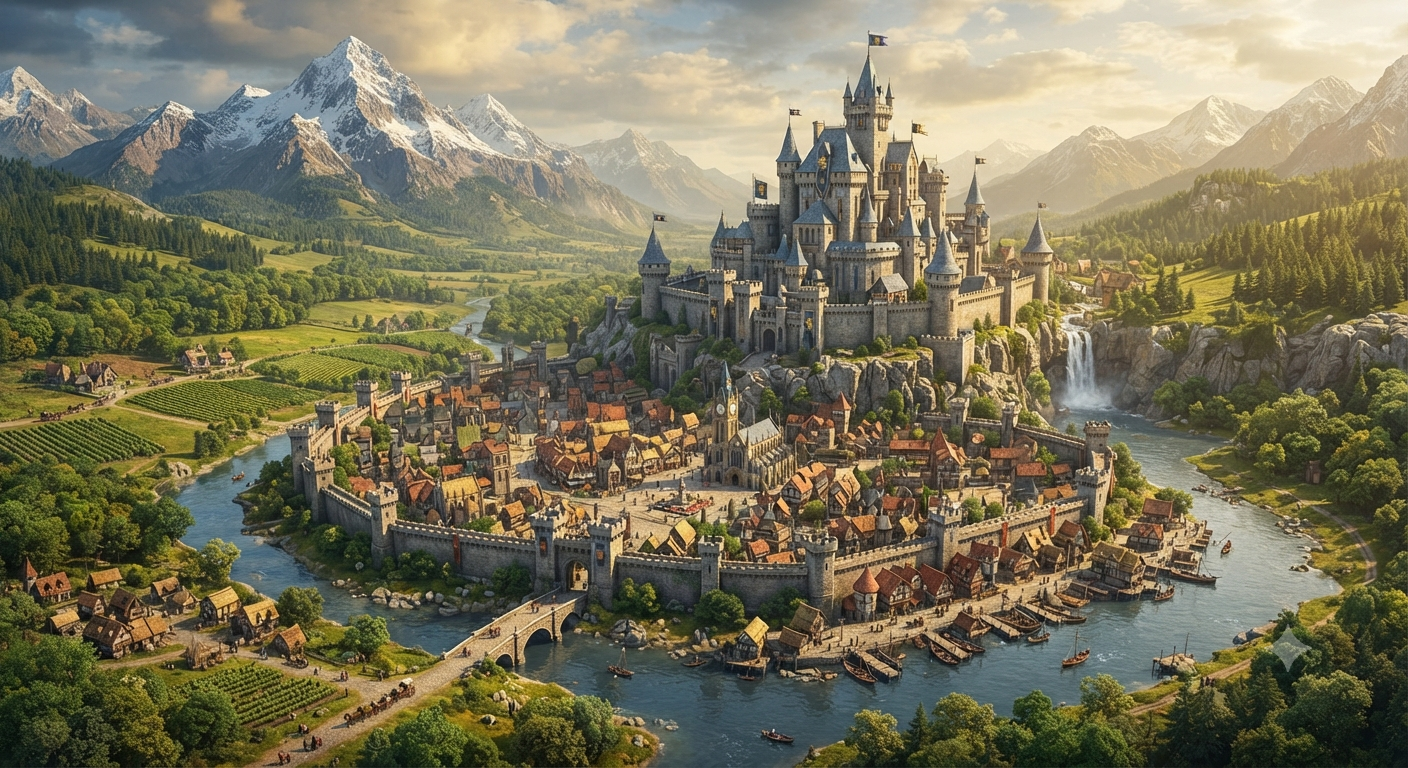
Kingdom is a deceptively simple word. It may describe a sovereign territory ruled by a monarch, a major category in biological classification, a spiritual realm, or one of several unrelated entertainment franchises. That breadth explains why people searching the term often encounter mixed results—and why a useful explanation must begin with context rather than a single definition.
At its core, the word combines the idea of a king with the suffix “-dom,” which signals a state, condition, jurisdiction, or domain. Yet modern usage goes far beyond a place governed by a king. The practical meaning changes according to whether the discussion concerns government, history, science, theology, fantasy, television, manga, film, or games.
What Does Kingdom Mean?
A Kingdom, in the political sense, is a state or territory associated with monarchical rule. Cambridge Dictionary defines the term as a country ruled by a king or queen, while Merriam-Webster expands the concept to a politically organized community or major territorial unit headed by a monarch.
The word can refer to at least four broad concepts:
- A political realm: A state whose head is a king or queen.
- A sphere of control: An area dominated by a person, organization, force, or idea.
- A biological rank: A high-level category used to organize living organisms.
- A symbolic or spiritual realm: A domain described in religious, mythological, or philosophical language.
Context is therefore essential. The animal kingdom is a scientific and popular expression. The Kingdom of Spain is a political name. A “media empire” is metaphorical. A title found on a streaming platform, cinema listing, game store, or bookshop may point to a particular creative property.
This difference matters for search intent. Someone looking for the political definition needs constitutional information. A biology student needs taxonomy. A Netflix viewer may be searching for episodes, cast members, or a possible new season. Treating those searches as identical produces shallow, confusing content.
How a Kingdom Works as a Political System
A monarchy is defined by its head of state, but that does not automatically reveal who exercises day-to-day political power. Some monarchs govern directly or retain substantial executive authority. Others perform constitutional, ceremonial, diplomatic, and representational duties while elected institutions make laws and administer the country.
That is why the presence of a king or queen does not, by itself, tell you whether a country is democratic, authoritarian, parliamentary, federal, centralized, or governed through another political arrangement.
Absolute and Constitutional Monarchy
The most essential distinction is between the absolute and the constitutional monarchy.
In an absolute monarchy, the monarch enjoys a far greater degree of authority than is the case with the second variety. However, one must not forget that even an “absolute” monarch is rarely completely free in his or her decisions. The pressure of various groups, such as religious leaders, royal families, the military, economic interests, traditional authorities, bureaucracy, and popular opinion, may restrain the monarch and influence his or her decisions.
A constitutional monarch’s powers are explicitly limited by law or other authorities, such as tradition. According to the United Kingdom’s royal website, the country’s sovereign is “politically impartial,” while the “making of laws” belongs “in Parliament.” Thus, the UK is a constitutional monarchy that has the ability to limit the powers of a hereditary monarch so that he or she remains a figurehead, while elected MPs rule the country as a parliamentary democracy.
Constitutional monarchies can also differ significantly in the extent of the monarch’s powers, which can range from being merely decorative to retaining real policy-making authority. A monarch can appoint prime ministers, enact or veto laws, summon or dissolve Parliament, receive foreign ambassadors, and serve as commander in chief of the armed forces, formally exercising some of the powers of an elected leader.
The Monarch, the Crown and the Government
Several terms used in discussions of monarchy are related, but they are not interchangeable:
- The monarch is the individual sovereign.
- The Crown may describe the continuing legal institution of the state.
- The royal family consists of relatives connected to the sovereign.
- The government is the political administration exercising public authority.
- The realm is the territory, population, or jurisdiction under the sovereign.
This distinction prevents a common misunderstanding. A change of monarch does not normally create an entirely new state. Laws, public offices, treaties, courts, departments, records, and administrative systems continue even though the person occupying the throne changes.
The institution is designed to outlast the individual. That continuity is one reason monarchies place such importance on succession rules, coronations, oaths, state ceremonies, and constitutional conventions.
Kingdom, Empire, Realm and Nation: What Is the Difference?
These words overlap, but each carries a different political or cultural emphasis.
A kingdom centers on monarchical status. An empire traditionally implies authority over multiple territories, peoples, dependencies, or political units and is usually associated with an emperor or empress. A realm is more flexible; it can describe territory governed by a sovereign or an abstract field of activity, such as “the realm of science.”
A nation primarily refers to a people connected through identity, history, language, culture, political community, or shared institutions. A state is a legal and political organization with territory, population, governing institutions, and external sovereignty.
One state may contain several national identities. At the same time, members of one nation may live across several states. This is why “nation,” “country,” and “state” should not always be treated as perfect synonyms.
The name of a country does not necessarily reveal its complete constitutional structure. Monarchies may officially use terms such as:
- Kingdom
- Principality
- Sultanate
- Emirate
- State
- Grand duchy
For accurate writing, use the country’s official constitutional name rather than assuming that every monarchy formally uses the same designation.
How Kingdoms Formed and Changed Through History
Royal states did not all emerge through one universal process. Some developed from kinship networks, tribal coalitions, and chiefdoms. Others grew through military conquest, control of agricultural land, religious authority, taxation, trade routes, city-state expansion, or alliances between ruling families.
Three forces repeatedly helped rulers consolidate authority:
- Centralized administration: Officials collected revenue, recorded property, enforced decisions, and supervised public projects.
- Military capacity: Armed forces protected borders, suppressed rivals, secured trade routes, and expanded territory.
- Political legitimacy: Dynasties used ancestry, religion, law, ceremony, public service, and alliances to justify their authority.
A ruler who controlled only a palace and a small military following had limited power. Lasting authority required systems capable of reaching villages, cities, border regions, landowners, merchants, religious institutions, and military commanders.
Why Succession Was So Important
Succession was often the most dangerous stage in a monarchy’s political life. Hereditary rules could reduce uncertainty by creating an expected line of inheritance, but they did not eliminate conflict.
Disputed births, rival family branches, child rulers, regencies, royal marriages, religious rules, and competing legal traditions could produce several credible claimants. A succession crisis might divide the army, court, aristocracy, clergy, or foreign allies.
Modern succession systems are generally more predictable because they are established through constitutions, statutes, and detailed legal rules. In the United Kingdom, for example, the order of succession is regulated not only by descent but also by parliamentary statute.
From Personal Rule to Institutional Government
Many royal systems gradually moved from personal rule toward institutional government. Authority became distributed among parliaments, ministers, courts, civil servants, local administrations, and written laws.
Britain provides a prominent example. The official history of the monarchy explains that sovereigns lost executive power from the end of the seventeenth century and became increasingly subject to Parliament, contributing to the development of the modern constitutional system.
The broader lesson is that monarchical government is not a frozen medieval arrangement. It can change through legislation, war, revolution, political bargaining, constitutional reform, economic transformation, and democratic participation.
What Makes a Kingdom Stable?
A crown alone does not create stability. Durable states depend on institutions that continue beyond one ruler’s reign.
Important stabilizing factors include:
- Clear succession rules that reduce competing claims.
- Legitimate public institutions trusted to administer the law.
- Predictable taxation and spending rather than arbitrary extraction.
- Professional civil administration capable of implementing decisions.
- Security institutions that protect the state without constant internal violence.
- A workable relationship between tradition and reform.
- Courts or political mechanisms for resolving disputes peacefully.
- Reliable food, transport, communication, and public-service systems.
Historical fiction tends to focus on royal marriages, assassinations, betrayals, and battlefield victories because those events are dramatic. Real state capacity is often less glamorous.
Records matter. So do roads, courts, tax offices, ports, irrigation systems, local administrators, grain supplies, messengers, physicians, and engineers. These systems determine whether authority extends beyond the capital.
A ruler may win a throne in one battle. Governing the territory for decades is a completely different challenge.
Kingdom in Biology: A Different Kind of Classification
In biology, Kingdom is not a political concept. It is a taxonomic rank used to organize organisms into broad groups based on shared characteristics and evolutionary relationships.
A commonly taught hierarchy moves from broader to narrower classifications:
Domain → Kingdom → Phylum → Class → Order → Family → Genus → Species
OpenStax explains that domain is a highly inclusive level placed above kingdoms, while categories such as phylum, class, order, family, genus, and species become increasingly specific. NCBI also lists kingdom among the standard ranks used where possible in its taxonomy resources.
For example, humans are classified within:
- Domain: Eukaryota
- Animalia
- Phylum: Chordata
- Class: Mammalia
- Order: Primates
- Family: Hominidae
- Genus: Homo
- Species: Homo sapiens
Each level narrows the group until it reaches an individual species.
Is the Five-Kingdom System Still Used?
Students often encounter a fixed five-kingdom system, but modern biological classification is more complicated.
Scientific groupings may change as researchers compare DNA, cell structure, metabolism, anatomy, reproduction, and evolutionary history. Modern frameworks commonly place Bacteria, Archaea, and Eukaryota at the domain level, above many familiar taxonomic groups.
The familiar five-group model remains useful as an educational introduction, but it should not be mistaken for an unchangeable final map of life. Microorganisms, protists, and genetically diverse lineages make classification especially challenging.
Taxonomy databases can also update their rank structures. For example, NCBI announced changes replacing its former “superkingdom” rank with “domain” for Archaea, Bacteria, and Eukaryota, while virus groups use the rank “realm.”
The practical rule is straightforward: identify the classification system being used before comparing groups. Two diagrams may look different because they follow different scientific frameworks, educational conventions, or database standards.
Why the Biological Meaning Matters
This scientific use demonstrates the word’s deeper organizing logic. A taxonomic group brings many distinct organisms into a broader conceptual category, just as a political realm brings territories and communities under one structure.
The analogy is useful, but it has limits. Organisms are categorized through scientific analysis. Citizens are not biological subdivisions of a monarch. Mixing those meanings can result in misleading or dehumanizing language.
Religious and Symbolic Meanings
Religious traditions frequently use royal vocabulary to communicate divine sovereignty, moral order, spiritual authority, judgment, or an ideal future.
Depending on the text and tradition, the term may describe:
- God’s authority or reign
- A spiritual state
- A community guided by divine principles
- A future transformation
- A moral order
- A heavenly realm
It does not always refer to a physical territory with borders, government departments, and armed forces. Some passages use political imagery to explain spiritual ideas to audiences familiar with kings, rulers, courts, and empires.
Interpretation requires attention to who is speaking, the historical setting, the original language, and the literary genre. Readers should also consider whether a passage is literal, metaphorical, ethical, prophetic, or eschatological.
The word appears in secular metaphors as well. A successful entrepreneur may be said to have built a business empire, while a creator may be described as ruling a “content realm.” Such phrases communicate scale or dominance, not a formal constitutional arrangement.
Kingdom in Television, Manga, Film and Games
Entertainment is one of the main reasons the search term produces confusing results. Several unrelated works use the same one-word title.
The Korean Netflix Series
The South Korean Netflix production blends historical political drama with zombie horror. Its story follows a crown prince investigating a mysterious illness and plague while political instability threatens the royal court.
Netflix lists Ju Ji-hoon, Ryu Seung-ryong, and Bae Doona among the leading cast members and credits Kim Eun-hee, Kim Seong-hun, and Park Inje as creators. The official platform currently presents the program as a two-season thriller.
A related special, Ashin of the North, explores the background of Ashin and connects her personal tragedy with the larger plague narrative. Netflix describes it as a revenge-driven special featuring Gianna Jun, Park Byung-eun, and Kim Si-a.
The Japanese Manga and Anime Franchise
The Japanese manga created by Yasuhisa Hara follows Xin, a war orphan pursuing military greatness during a fictionalized version of China’s Warring States period.
VIZ Media’s official description centers on Xin’s journey toward the unprecedented goal of helping unify China. The series has expanded into anime, video games, and Japanese live-action films.
Readers should not confuse this historical manga franchise with the Korean zombie series. They share a title but have different creators, settings, characters, genres, and distribution histories.
Other Programs, Films and Games
An American MMA drama using the title aired from 2014 to 2017. It follows a retired fighter who operates a mixed martial arts gym while dealing with complicated family relationships.
There is also a minimalist strategy and resource-management game franchise in which players build, finance, and defend a realm. Its official website describes the gameplay as a side-scrolling hybrid combining strategy, resource management, exploration, and pixel-art presentation.
Films from several countries have used the title as well. That means a search for the title should normally include at least one disambiguating term:
- Format: Series, anime, manga, movie, documentary, or game
- Country or language: Korean, Japanese, Telugu, or English
- Release year: Particularly useful for films and television
- Creator or actor: Helpful when titles overlap
- Platform: Netflix, VIZ, PC, console, or another distributor
- Character name: Useful for cast and storyline searches
This simple search habit produces more accurate results and prevents users from landing on information about the wrong franchise.
How to Evaluate Information About Kingdom
Because the term covers multiple subjects, source selection matters more than usual. A page may be accurate about one meaning while being completely irrelevant to another.
Use the following source hierarchy:
- Official constitutions, government portals, and royal institutions for political structures.
- Scientific textbooks, nomenclature codes, and recognized databases for taxonomy.
- Official publishers, studios, networks, and streaming platforms for entertainment details.
- Established dictionaries for definitions and language usage.
- Reputable secondary publications for criticism, analysis, and historical context.
Dates require particular attention when the subject involves:
- A current monarch
- Streaming availability
- Release schedules
- Cast announcements
- Episode counts
- New seasons
- Game updates
- Publication dates
These details can change quickly. Definitions and historical frameworks tend to be more stable, but precise sourcing still improves accuracy.
A reliable article must also separate fact from interpretation. “The country is a constitutional monarchy” is a factual claim that can be checked against official documents. “The monarchy is the main reason for the country’s stability” is an argument requiring evidence, context, and qualification.
Common Misconceptions
Every Kingdom Is an Absolute Monarchy
False. Several modern monarchies operate through constitutions and parliamentary systems in which elected institutions exercise legislative and executive authority.
A monarch may remain head of state while the prime minister and cabinet run the government. Ceremony and sovereignty should not automatically be confused with direct political control.
A King Personally Owns the Entire Country
This claim confuses sovereignty with private property.
Public land, Crown property, state assets, royal residences, government buildings, and a monarch’s private possessions may belong to separate legal categories. The exact distinctions depend on the jurisdiction.
Kingdom and Empire Mean the Same Thing
Not exactly.
Both may involve hereditary rulers, but an empire traditionally emphasizes authority over several territories or peoples. The titles, legal systems, and political structures can also differ.
Biological Kingdoms Never Change
They do.
Taxonomy evolves when genetic, cellular, anatomical, and evolutionary evidence changes scientists’ understanding of how organisms are related. Classification is a scientific model, not an untouchable list.
The Entertainment Title Refers to One Franchise
It does not.
The title is shared by unrelated Korean and American television programs, Japanese manga and animation, films, and video games. Always add a format, year, creator, country, or platform to the query.
Why the Idea Still Matters
The concept remains powerful because it connects authority, territory, hierarchy, identity, continuity, and belonging.
In politics, it raises questions about how hereditary traditions coexist with democracy. In history, it helps explain state formation, succession, warfare, administration, and diplomacy. In biology, it demonstrates how humans classify the diversity of life.
Storytelling gives it another function. The word immediately suggests a ruler, a population, a contested throne, an external enemy, and a realm whose future is uncertain. It creates stakes before the first scene begins.
That versatility creates a major SEO challenge. A page targeting only the bare keyword competes with:
- Dictionaries
- Encyclopedias
- Streaming platforms
- Manga publishers
- Movie databases
- Game developers
- Historical resources
- Religious websites
- Current entertainment reporting
Repeating the term more frequently will not solve that problem. The better strategy is to satisfy the mixed intent clearly and then create supporting pages for each major interpretation.
A strong topic cluster might include:
- Meaning and political definition
- Absolute versus constitutional monarchy
- Monarchy versus empire
- Biological classification explained
- Korean Netflix series cast and episodes
- Manga reading order
- Anime season guide
- Live-action movie order
- Game franchise overview
The broad guide becomes the pillar page, while each supporting article targets a narrower search intent.
Frequently Asked Questions
What is the simplest definition of a Kingdom?
It is commonly defined as a country or territory ruled by a king or queen. Depending on context, it can also describe a sphere of influence, a major taxonomic rank, a spiritual realm, or a particular entertainment title.
The surrounding words usually reveal the intended meaning. “Constitutional,” “animal,” “Netflix,” “manga,” and “heavenly” all point to different topics.
What is the difference between a kingdom and a monarchy?
A monarchy is the institution or form of government in which a monarch serves as head of state. The other term usually describes the state, territory, political community, or realm associated with that institution.
In everyday conversation, people may use the words loosely. In political and academic writing, the distinction improves precision.
Can a kingdom be democratic?
Yes. Constitutional monarchies may combine a hereditary head of state with an elected parliament, accountable ministers, independent courts, political parties, and regular elections.
The monarch’s actual powers depend on the constitution, legislation, and established political conventions. Some roles may exist formally but be exercised only on ministerial advice.
How many kingdoms are there in biology?
There is no single number that applies to every classification framework.
Older educational models frequently teach five or six large groups. Modern taxonomy may use three domains, multiple kingdoms, and evolutionary clades informed by genetic evidence. Students should follow the framework required by their course while recognizing that scientific classification continues to develop.
Which Kingdom TV series or franchise are people usually searching for?
Common possibilities include the Korean Netflix historical-zombie thriller, Yasuhisa Hara’s manga and adaptations, the American MMA family drama, and the strategy game franchise.
The fastest way to reach the correct result is to add a year, country, actor, character, platform, or format. Searches such as “Korean series cast,” “manga volume order,” or “2014 MMA show” are far more precise than the one-word query.
Final Takeaway
Kingdom is not one topic. It is a cluster of meanings connected by the idea of an organized realm.
To understand it accurately, identify the context first: political, historical, biological, religious, metaphorical, or entertainment-based. Then consult sources designed for that specific subject.
For readers, the next step is to refine the search with a clear modifier. For publishers, the stronger SEO strategy is to use this comprehensive guide as a hub and connect it to focused supporting pages that answer one intent completely.
That structure reduces ambiguity, strengthens topical authority, and gives users—and search engines—a cleaner route to the information they actually need.