



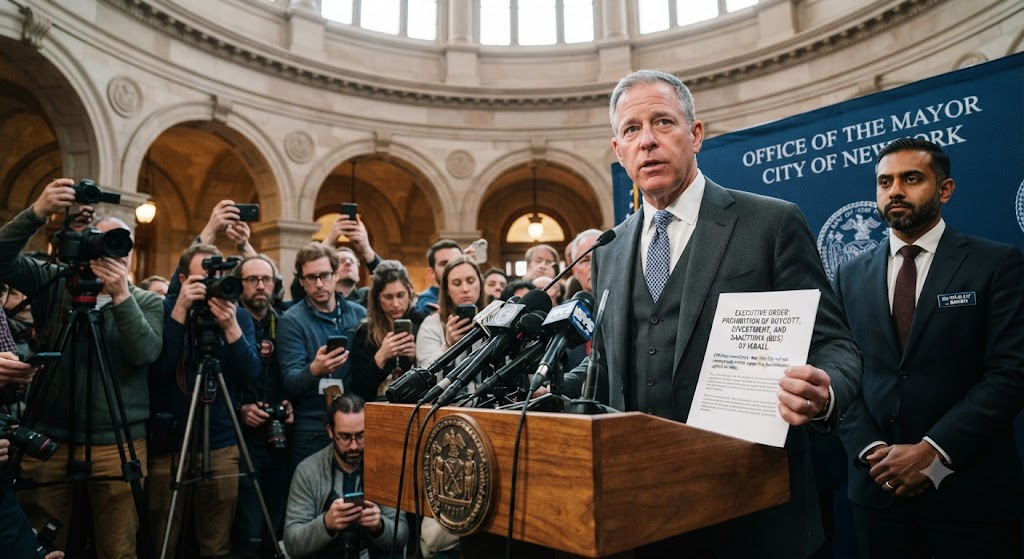
The headline “outgoing NYC mayor bans anti-Israel boycotts ahead of Muslim successor” captured a dramatic December 2025 clash at New York City Hall. Yet the wording needs precision. Mayor Eric Adams did not outlaw private citizens’ boycotts of Israel; he issued an executive order restricting certain procurement and pension decisions by mayoral appointees shortly before Mayor-elect Zohran Mamdani took office.
That distinction changes the story. This was not a citywide criminal ban on consumer activism. It was a late-term administrative directive aimed at how city agencies, contracting officials, and mayor-appointed pension trustees could use public power in relation to Israel and the Boycott, Divestment and Sanctions movement, commonly known as BDS.
Key Takeaways
- Executive Order 60 directed mayoral contracting officials not to adopt procurement practices intended to discriminate against Israel, Israeli citizens, or Israel-associated entities.
- It instructed the chief pension administrator and mayor-appointed pension trustees to oppose politically motivated divestment from Israeli assets, subject to fiduciary duties.
- Executive Order 61 separately asked the NYPD and city lawyers to study possible protest restrictions near houses of worship.
- Mamdani revoked the relevant Adams-era orders on his first day in office.
- The dispute involved antisemitism, Palestinian advocacy, pension governance, executive power, and free speech.
In practical terms, outgoing NYC mayor bans anti-Israel boycotts ahead of Muslim successor describes a restriction on selected government officials—not a prohibition binding every resident, business, or political organization in New York City.
What “Outgoing NYC Mayor Bans Anti-Israel Boycotts Ahead of Muslim Successor” Actually Means
On December 3, 2025, Adams issued two executive orders. With less than a month to go before the swearing-in of the new mayor, the first one (no. 60) dealt with issues of city contracts and pension fund investments in Israel. The second one (no. 61) instructed the NYPD commissioner to devise rules for protests near religious sites.
As such, the caption “outgoing NYC mayor bans anti-Israeli boycotts ahead of Muslim successor” actually combines two utterly different executive orders. While the first one focused on the restrictions imposed on the mayoral transition in terms of procurement and pension funds, the second one dealt with the regulation of demonstrations near places of worship and, consequently, public safety concerns.
Executive Order 60 Was Narrower Than a General Boycott Ban
The order applied to agency heads, chief contracting officers, and mayoral appointees with discretion over contracts. It told them to avoid procurement practices intended to discriminate against Israel, Israeli citizens based on national origin, or people and organizations associated with Israel. Employees who ignored the instruction could face agency discipline.
The pension provision was carefully qualified. It directed the chief pension administrator and trustees appointed by the mayor to oppose divestment undertaken for discriminatory purposes, but only to the extent consistent with their fiduciary obligations. That qualification was important because trustees still had to consider their independent financial and legal responsibilities.
What Executive Order 60 Did Not Do
The order did not ban New Yorkers from refusing to buy Israeli products. It did not criminalize pro-Palestinian organizing, prohibit demonstrations supporting BDS, or punish private advocacy.
A responsible article on outgoing NYC mayor bans anti-Israel boycotts ahead of Muslim successor should not say Adams “made BDS illegal in New York City.” More accurately, he tried to block BDS-style policies inside parts of the municipal contracting and pension apparatus.
Why Adams Acted Before Mamdani Took Office
Adams presented the policy as a defense against antisemitism and politically driven investment decisions. His administration said the city’s five pension systems held almost $300 billion in global securities, including more than $300 million in Israel bonds and Israeli assets, making the order financially consequential as well as symbolic.
Timing gave outgoing NYC mayor bans anti-Israel boycotts ahead of Muslim successor its political force. Mamdani had publicly supported BDS and criticized city investment in Israeli government debt, so Adams’s order forced the incoming administration to retain it or visibly repeal it. Adams acknowledged that his successor could reverse the measure, while Mamdani said his team would review the late-term orders after entering City Hall.
Mamdani was preparing to become New York City’s first Muslim mayor, an historic milestone later recognized during the city’s inauguration ceremonies. Still, his religion was not the legal basis for Adams’s order. His stated positions on BDS, Israel, public investment, and Palestinian rights were the relevant governmental issues.
A Political “Flag in the Ground”
Adams’s team described the policy as a statement that his administration would not retreat in its fight against antisemitism. The order also fit his broader agenda, which included creating a Mayor’s Office to Combat Antisemitism and adopting the International Holocaust Remembrance Alliance working definition.
Critics saw outgoing NYC mayor bans anti-Israel boycotts ahead of Muslim successor as an outgoing mayor using temporary executive authority to constrain a successor with an opposing electoral mandate. That criticism carried weight because a new mayor could revoke the directive without passing legislation.
The Pension-Fund Stakes Behind the Headline
The most important detail hidden by “outgoing NYC mayor bans anti-Israel boycotts ahead of Muslim successor” is that this was partly a fiduciary-governance dispute. City pension assets support more than 750,000 workers, retirees, and beneficiaries, so investment decisions should be tested through risk, return, diversification, liquidity, costs, and applicable legal duties.
Adams argued that Israel-focused divestment would inject discriminatory politics into pension management. BDS supporters answer that public investments already carry ethical consequences, especially when assets are allegedly connected to human-rights abuses.
A credible divestment proposal would need to identify affected assets, transaction costs, expected performance, benchmarks, legal authority, and litigation risks. A credible anti-divestment policy should also explain why Israel-related assets receive special treatment and how trustees retain independent judgment.
Viewed through this financial lens, outgoing NYC mayor bans anti-Israel boycotts ahead of Muslim successor was not merely a culture-war confrontation. It was also a fight over who may translate political and ethical demands into decisions affecting billions of dollars in retirement assets.
Mayoral Control Was Limited
The mayor does not personally control every city pension portfolio. Executive Order 60 addressed the chief pension administrator and trustees appointed by the mayor, not every trustee across all five independent systems.
That limit matters when evaluating outgoing NYC mayor bans anti-Israel boycotts ahead of Muslim successor. The political language was sweeping, but implementation depended on board procedures, fiduciary standards, mayoral appointments, and divided institutional authority.
The First Amendment Question
Political boycotts receive substantial constitutional protection. In NAACP v. Claiborne Hardware Co., the U.S. Supreme Court held that nonviolent elements of a politically motivated boycott—including speech, association, assembly, petitioning, and peaceful picketing—were protected by the First Amendment.
Adams’s order, however, did not directly prohibit private boycotts. It regulated how public officials exercised government contracting and pension authority, raising a different question: when is government managing its own programs, and when is it penalizing protected political expression?
Courts have not treated every anti-BDS measure identically. In Arkansas Times LP v. Waldrip, the Eighth Circuit, sitting en banc, upheld an Arkansas requirement that certain public contractors certify they were not boycotting Israel. The court reasoned that the regulated commercial conduct was not inherently expressive.
The lesson from outgoing NYC mayor bans anti-Israel boycotts ahead of Muslim successor is not that every anti-BDS rule is valid or invalid. The analysis turns on the text, affected speakers, compelled certifications, viewpoint discrimination, unconstitutional conditions, and whether a rule reaches advocacy or only official commercial conduct.
Why the Headline Can Mislead Legal Readers
The phrase outgoing NYC mayor bans anti-Israel boycotts ahead of Muslim successor may imply that Adams restricted ordinary New Yorkers’ speech. The text shows a narrower administrative directive, although critics could still challenge terms such as “association with Israel” or “discriminates” if they resulted in vague or viewpoint-based enforcement.
A sound legal analysis separates three activities: advocating a boycott, personally joining a boycott, and using municipal power to impose a boycott through procurement or pension policy. They overlap politically, but they do not necessarily receive identical constitutional treatment.
Executive Order 61 Created a Separate Protest Dispute
The second order did not itself create a fixed buffer zone around synagogues, mosques, churches, or other houses of worship. It instructed the NYPD commissioner and Law Department to evaluate possible patrol-guide changes, including rules near entrances or during scheduled religious services.
Government may protect worshippers from obstruction, threats, violence, and targeted harassment. Yet restrictions on public demonstrations generally require clear standards and must preserve protected speech and peaceful assembly.
Combining both orders made outgoing NYC mayor bans anti-Israel boycotts ahead of Muslim successor sound like one blanket crackdown. In reality, one order concerned contracts and investments; the other commissioned a review of protest rules.
Supporters and Critics Saw Different Risks
The political battle over outgoing NYC mayor bans anti-Israel boycotts ahead of Muslim successor reflected two competing fears: that municipal institutions could discriminate against Israelis and Israel-associated entities, or that anti-BDS policies could suppress legitimate criticism of a foreign government.
Supporters viewed Adams’s order as protection against singling out Israel and as reassurance to Jewish New Yorkers concerned about antisemitism. They argued that city contracts and retirement funds should not become instruments for ideological punishment.
Opponents said the policy conflated criticism of Israeli government conduct with discrimination against Jews or Israelis. Palestinian-rights and free-speech advocates also argued that anti-BDS rules can chill lawful advocacy even when drafted as procurement or investment standards.
New York’s debate did not divide neatly by religion. AP reported that Mamdani’s criticism of Israel alarmed some Jewish voters while attracting support from other Jewish New Yorkers, especially progressives who rejected the idea that criticism of Israel must automatically be treated as antisemitism.
That complexity is essential to outgoing NYC mayor bans anti-Israel boycotts ahead of Muslim successor. “Jewish,” “pro-Israel,” “Muslim,” “pro-Palestinian,” “anti-BDS,” and “antisemitic” are not interchangeable labels.
What Happened When Mamdani Became Mayor
The confrontation ended quickly. On January 1, 2026, Mamdani issued his first executive order, revoking all Adams executive orders issued on or after September 26, 2024, while selectively reissuing measures his administration wanted to preserve. The action swept away Executive Order 60.
Reuters reported that Mamdani defended removing the Israel-related and IHRA orders while pledging to prevent hate crimes and protect Jewish New Yorkers. He framed the mass revocation as a fresh start following the breakdown of public confidence in the Adams administration.
Mamdani did not dismantle every antisemitism initiative. The Jewish Telegraphic Agency reported that he intended to retain the Mayor’s Office to Combat Antisemitism, showing that repeal of the anti-BDS directive did not equal abandonment of all city action against anti-Jewish hate.
Consequently, outgoing NYC mayor bans anti-Israel boycotts ahead of Muslim successor describes a short-lived transition-era policy, not the current municipal rule. The revocation remained part of Mamdani’s stated record during his first months in office.
What the Episode Means for Future Mayors
The episode shows how executive orders can shape a transition without permanently binding the next administration. A mayor can direct appointees and set agency priorities, but a successor can often reverse those directions quickly.
For durable policy, anti-BDS supporters would likely need legislation, detailed procurement regulations, pension-board action, or state authority. Each route adds procedures, political accountability, and opportunities for judicial review.
More broadly, outgoing NYC mayor bans anti-Israel boycotts ahead of Muslim successor illustrates the limits of governing through executive orders. Such directives can produce immediate headlines and administrative consequences, yet their survival may depend entirely on the next officeholder.
The outgoing NYC mayor bans anti-Israel boycotts ahead of Muslim successor dispute also offers a practical media-literacy test. Whenever a headline says an official “banned” something, ask:
- Who is legally covered?
- What conduct is restricted?
- What penalties exist?
- Who enforces the rule?
- Can a successor reverse it?
Those questions distinguish a broad public prohibition from an internal management order or symbolic political statement.
FAQ: Outgoing NYC Mayor Bans Anti-Israel Boycotts Ahead of Muslim Successor
Did Eric Adams ban every anti-Israel boycott in New York City?
No. Executive Order 60 governed specified mayoral appointees, contracting officials, the chief pension administrator, and mayor-appointed pension trustees. It did not prohibit private residents, advocacy organizations, or consumers from supporting a peaceful boycott.
Why does “outgoing NYC mayor bans anti-Israel boycotts ahead of Muslim successor” mention Mamdani’s religion?
Mamdani was preparing to become the city’s first Muslim mayor, making the transition historically notable. The actual policy conflict concerned his support for BDS, criticism of Israel, and views on public investment—not a legal restriction based on his faith.
In other words, outgoing NYC mayor bans anti-Israel boycotts ahead of Muslim successor is a political headline, not a finding that Mamdani’s religious identity determined his policy views.
What is BDS?
BDS means Boycott, Divestment and Sanctions. It is an international campaign advocating economic and institutional pressure on Israel. Supporters present it as nonviolent action for Palestinian rights, while opponents argue that it unfairly isolates Israel and may contribute to antisemitism.
Was Executive Order 60 constitutional?
The directive was repealed within weeks, leaving its constitutionality unresolved. Its legal vulnerability would have depended partly on implementation—especially whether it merely controlled official procurement choices or penalized protected advocacy and association.
Is the anti-BDS order still in force?
No. Mamdani’s first executive order revoked all Adams orders issued on or after September 26, 2024, including Executive Order 60. The repeal took effect when Mamdani entered office on January 1, 2026.
Conclusion: Read the Order, Not Just the Headline
The outgoing NYC mayor bans anti-Israel boycotts ahead of Muslim successor story was real, but its popular framing overstated the order’s reach. Adams restricted certain city contracting and pension actions, paired that move with a review of protest rules near houses of worship, and handed his successor a politically costly decision.
Mamdani revoked the directive on day one. The next time a similar controversy erupts, read the operative text, identify who is bound, check the enforcement mechanism, and separate private expression from government decision-making. That method produces a more accurate account than any viral headline.