



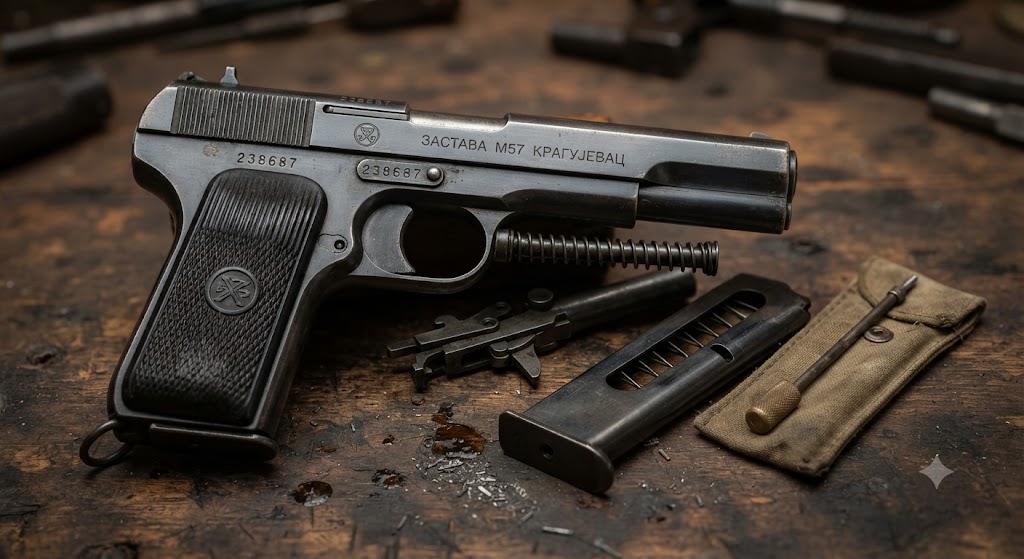
The search term Zaztava-m57-238687 most likely refers to a Zastava M57 pistol associated with the number 238687. “Zaztava” appears to be a spelling error because the recognized manufacturer is Zastava Arms, while “M57” is the firearm model and the six-digit number may be a serial, inventory, auction, or database identifier.
That distinction matters. A model name can be researched broadly, but a number attached to one firearm cannot be interpreted responsibly without examining its complete markings, prefix letters, importer stamp, documentation, and physical condition. This guide explains what can be verified about the M57 and what remains uncertain about the specific Zaztava-m57-238687 identifier.
What Does Zaztava-m57-238687 Mean?
First of all, it should be stated that there is not that much information about the Zaztava-m57-238687. Most likely, this text consists of three parts:
“Zaztava” – most likely misspelled name of Zastava,
“m57” – model,
“238687” – serial number, stock number, listing number, registration number, catalog number, etc.
It can be noted that search engine results tend to include various compressed versions or variations of the names used in the auction house, inventory, filenames, or other sources. Therefore, the entire phrase Zaztava-m57-238687 may not have been used on any particular official website, or may have been included in some sources such as user forums, images, or listings. During the research process, no official sources including the manufacturer’s website mentioned Zaztava-m57-238687 as an officially sold item, special edition, or other type of officially known variation.
Therefore, the correctly identified version is Zastava M57, not Zaztava M57. On the manufacturer’s website, Zastava M57 is described as “a 7.62 mm, 9 round, semi automatic pistol, based on the Soviet TT design with 116 mm barrel length and mass of 0.88 kg.”
Zaztava-m57-238687 and the Zastava M57’s Cold War Origins
The M57 emerged from Yugoslavia’s effort to establish an independent military arms industry after the breakdown in relations between Yugoslavia and the Soviet Union. Its mechanical ancestry is closely connected to the Soviet TT-33 Tokarev, but Yugoslav engineers adapted the platform for domestic requirements.
Historical summaries generally place formal service adoption around 1961 and regular production from 1963 to 1982. Estimates commonly suggest that approximately 260,000 to 270,000 military M57 pistols were produced during that period.
This history gives Zaztava-m57-238687 potential collector interest, but the number alone does not establish a military issue date. A high serial may suggest a later point within a cumulative production sequence, yet prefix letters, replacement parts, refurbishment, and post-service import markings can substantially change the interpretation.
Why the M57 Was More Than a Straight TT-33 Copy
Calling the M57 merely a “Yugoslav Tokarev clone” misses important design differences. The grip was extended to accommodate a nine-round magazine rather than the TT-33’s typical eight-round capacity, and the M57 incorporated a magazine-disconnect system.
The pistol also used revised slide serrations, a different magazine-release treatment, anti-glare cuts, a dovetailed front sight, and several internal changes. These distinctions help separate a genuine M57 from other Tokarev-pattern handguns when photographs, markings, or incomplete listings create confusion.
Key Specifications Associated With Zaztava-m57-238687
When the identifier genuinely belongs to an M57, the underlying firearm should broadly correspond with the factory model specifications below. Variations may exist because of military refurbishment, commercial production, replacement components, or importer-required modifications.
| Feature | Standard Zastava M57 specification |
|---|---|
| Manufacturer | Zastava Arms, Kragujevac |
| Country of origin | Former Yugoslavia or Serbia |
| Type | Semi-automatic pistol |
| Operating system | Short-recoil, locked-breech design |
| Caliber | 7.62×25 mm Tokarev |
| Standard magazine capacity | 9 rounds |
| Barrel length | 116 mm |
| Overall dimensions | Approximately 200 × 130 mm |
| Weight | Approximately 0.88 kg |
| Sights | Fixed iron sights |
| Common finish | Blued steel |
Zastava’s current product information confirms the caliber, magazine capacity, barrel length, dimensions, weight, fixed sights, steel construction, and blued finish.
These specifications can confirm the model family, but they cannot authenticate Zaztava-m57-238687 as a particular historical specimen. Authentication depends on the markings actually present on the frame, slide, barrel, and imported components.
Can Serial Number 238687 Reveal the Production Year?
This is the most important question surrounding Zaztava-m57-238687, and the honest answer is: not reliably by itself. Zastava Arms USA states that serial numbers function primarily as unique identifiers and that Zastava does not publish a comprehensive public year-by-year decoding chart.
Serial ranges can sometimes help collectors group firearms by era, but Zastava recommends using supporting records or requesting direct confirmation. A full number may also be incomplete if the original marking included a letter prefix that was omitted from an online title, spreadsheet, or filename.
One published M57 example links a “J” prefix to 1972 and explains that military production numbers did not necessarily restart every year. That shows why the prefix can be more informative than the six digits alone, but it does not prove that 238687 belongs to any particular year without seeing the complete marking.
Why Online Serial-Date Claims Can Be Misleading
Collector forums frequently offer confident serial-number dates, yet those claims may be based on small samples, remembered import batches, or comparisons with privately owned examples. Such information can be useful as a lead, but it is not equivalent to factory documentation.
A pistol may also contain a replacement slide, barrel, trigger group, or magazine. When major serialized or matching-number parts differ, assigning the entire firearm a date from one visible number may produce a false conclusion about Zaztava-m57-238687.
How to Verify Zaztava-m57-238687 Properly
Verification should begin with documentation rather than assumptions. Do not rely on a cropped photograph, marketplace title, or database slug that contains only the model and six digits.
Use the following non-invasive verification process:
- Record the complete visible marking. Include every letter, symbol, space, and number exactly as stamped.
- Photograph both sides clearly. Capture the frame, slide, caliber marking, crest, importer line, and proof marks.
- Check for matching numbers. Compare the frame and slide markings without attempting unsafe or unnecessary disassembly.
- Identify importer-added features. Some imported pistols have trigger, frame, or slide safety modifications.
- Review receipts and transfer records. An invoice, import record, certificate, or previous appraisal can provide better evidence than online speculation.
- Contact Zastava or a qualified specialist. Submit the model, full serial, prefix, photographs, and importer details.
- Obtain a professional inspection. A licensed gunsmith can assess condition, alterations, mechanical wear, and overall serviceability.
Zastava’s serial-number guidance recommends preserving photographs, receipts, manuals, and records because the serial connects the firearm to service, insurance, import, and theft-reporting documentation.
Markings That May Appear on Zaztava-m57-238687
An authentic military or refurbished M57 may display several layers of identifying information. The exact placement and style can differ by production period and import history.
Common elements may include:
- The Zastava or Crvena Zastava manufacturer identity.
- The M57 model designation.
- A caliber marking for 7.62×25 mm or 7.62 mm.
- A complete serial number, sometimes with a letter prefix.
- Yugoslav military or SFRJ crest markings.
- Proof, inspection, or arsenal stamps.
- An importer’s company name and location.
- A later safety modification required for a particular market.
Factory-refurbished examples sold through Zastava Arms USA retain original factory markings and the Yugoslav SFRJ crest while receiving a renewed blued finish. The same source notes that current refurbished imports may use a factory trigger safety and half-cock system rather than an added slide safety.
Military, Commercial, and Refurbished Examples
Not every M57 encountered today remains in original military-issued condition. Some were commercially produced, some were refurbished by an arsenal or factory, and others were modified to meet import regulations.
That distinction affects historical authenticity and collector value. A clean refurbished pistol may be mechanically appealing, but refinishing can remove its original wear pattern, while an importer-added safety may distinguish it from an untouched Yugoslav-service configuration.
Is Zaztava-m57-238687 a Rare Variant?
There is no verified evidence that Zaztava-m57-238687 represents a recognized rare variant. The number could belong to a normal military-production pistol, a refurbished law-enforcement example, a commercial unit, or simply an online inventory record.
Rarity is established through a combination of factors:
- Documented production variation.
- Unusual but authentic factory markings.
- Original matching-number components.
- Scarce contract or agency provenance.
- Verified presentation, prototype, or trial status.
- Exceptional original condition.
- Credible paperwork connecting the firearm to a historical event or owner.
A serial number that appears late in a production sequence may be interesting, but “high serial” does not automatically mean “rare.” Claims of rarity should be supported by factory correspondence, recognized reference works, or a specialist appraisal.
Condition Factors That Influence Historical and Collector Interest
The condition of Zaztava-m57-238687 cannot be assessed from the identifier alone. Serious evaluation requires clear photographs and an in-person inspection.
Important condition signals include:
- Original finish versus modern refinishing.
- Pitting, corrosion, or deep surface damage.
- Legibility of serials, crests, and proof marks.
- Matching or mismatched numbered parts.
- Cracks, deformation, or improper modifications.
- Bore condition and mechanical integrity.
- Original grips, magazine, holster, and accessories.
- Evidence of arsenal refurbishment.
- Importer-added safety devices or altered markings.
Collectors often value originality, while responsible owners must prioritize mechanical safety. A pistol with attractive external bluing may still contain worn or damaged internal components, so appearance should never replace professional inspection.
Zaztava-m57-238687 Versus the M57A and M70A
Model confusion is common because the M57 family includes related commercial and caliber variants. The M57A retains the classic 7.62×25 mm chambering but adds a modern external safety configuration, while the M70A is a related Tokarev-pattern model chambered in 9×19 mm.
The simplest identification rule is to read the firearm’s actual model and caliber markings. Do not identify a pistol from its grip shape alone because replacement grips, slides, and magazines can create misleading visual similarities.
A genuine Zaztava-m57-238687 reference should correspond to an M57 marking and the 7.62×25 mm model family. When the firearm is marked M70A or 9×19 mm, the online label is likely incorrect.
Safety, Legal, and Recordkeeping Considerations
Any older surplus handgun should be treated as mechanically unverified until examined by a qualified professional. Never assume that an old safety system, half-cock notch, magazine disconnect, or importer modification functions correctly merely because the pistol appears complete.
Legal requirements differ by country, state, province, and municipality. Ownership, transfer, transport, storage, ammunition, and registration rules should be confirmed through the relevant government authority or a qualified local professional rather than a general article.
Never alter, polish away, restamp, or obscure a serial number. Zastava’s own guidance emphasizes that serials are central to service records, insurance, police reports, and import documentation, and it warns against altering or removing them.
Why Zaztava-m57-238687 Attracts Search Interest
The phrase combines a misspelled brand, a historically important model, and a specific number. That pattern often appears when someone is checking an inherited firearm, investigating an auction listing, confirming a police or insurance record, identifying an image, or researching a surplus collection.
The informational opportunity is not to pretend that the exact specimen’s story is known. It is to separate verified model facts from unverified serial-level assumptions, helping readers avoid false production dates, exaggerated rarity claims, and inaccurate descriptions.
Frequently Asked Questions
Is Zaztava-m57-238687 the correct spelling?
No. The established manufacturer name is Zastava, so “Zaztava” is almost certainly a spelling or transcription error. The corrected phrase would be “Zastava M57 238687,” although the final number still needs context before it can be called a serial number.
What caliber is the Zastava M57?
The standard M57 is chambered for 7.62×25 mm Tokarev. Zastava lists the pistol with a nine-round detachable magazine, a 116 mm barrel, fixed sights, and an approximate weight of 0.88 kg.
Was serial number 238687 made in a specific year?
The number alone is insufficient for a defensible date. A letter prefix, complete factory marking, importer information, and documentary evidence may be necessary, and Zastava does not provide a universal public serial-year chart.
How can I tell whether Zaztava-m57-238687 is authentic?
Compare the complete model, caliber, serial, crest, proof marks, and importer stamp with reliable references. Preserve clear photographs and paperwork, then seek confirmation from Zastava, a recognized collector specialist, or a licensed gunsmith.
Does the number 238687 make the pistol valuable?
Not by itself. Value depends on originality, mechanical condition, matching numbers, finish, rarity, provenance, accessories, market demand, and legal status. A documented historical connection can matter far more than an isolated six-digit number.
Final Assessment
Zaztava-m57-238687 is best understood as a search phrase for a likely Zastava M57 connected to the number 238687, not as an officially documented variant. Reliable sources confirm the M57’s Yugoslav origins, Tokarev-based design, 7.62×25 mm chambering, nine-round magazine, and distinctive military history, but they do not publicly verify the identity or production year of this exact numbered example.
The next step is simple: record the complete markings, photograph the pistol without editing the images, preserve all paperwork, and request an expert or factory-level review. That evidence-first approach will produce a more accurate identification than any unsupported serial-number guess, while protecting the historical, legal, and collector significance of the firearm.