



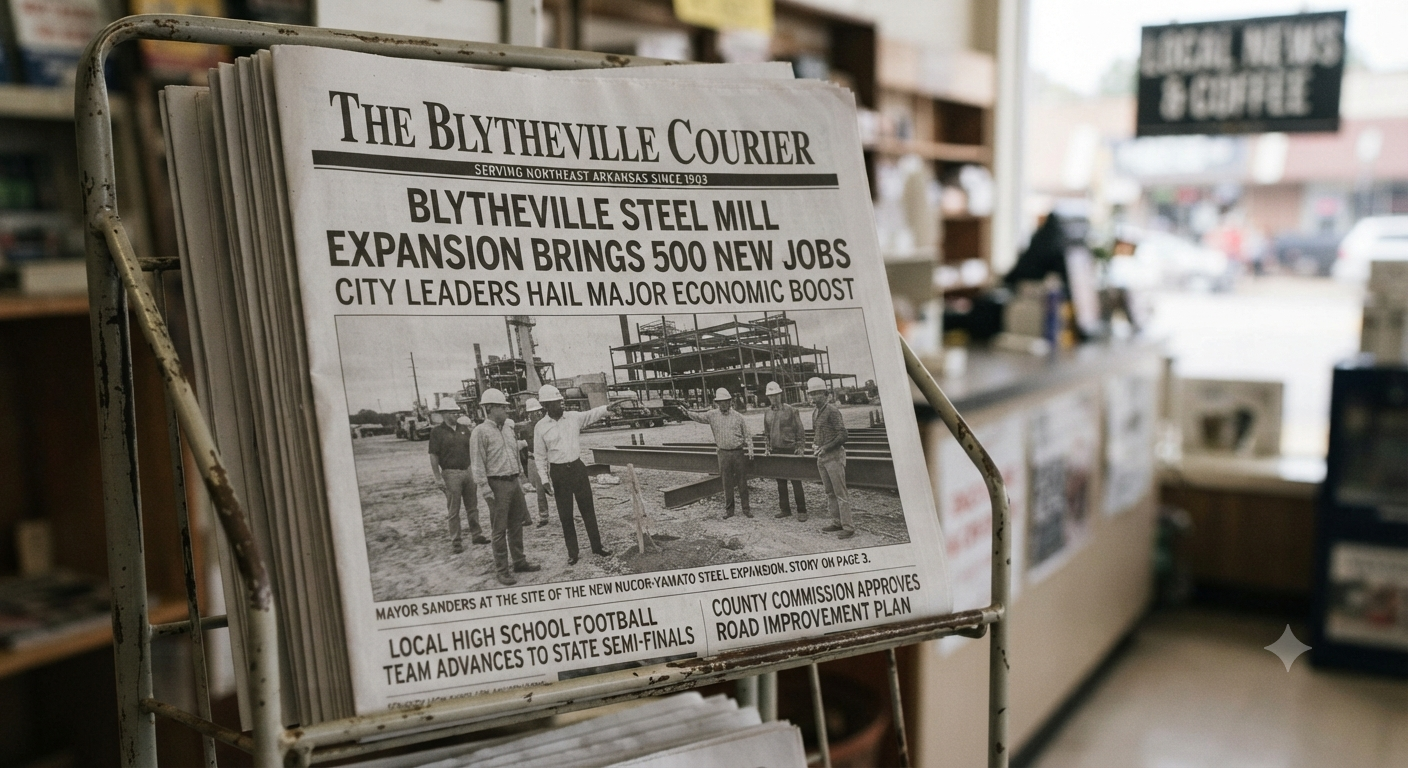
The Blytheville Courier newspaper is best understood as the historic Blytheville Courier News, a long-running local publication in Blytheville, Arkansas. The standalone title merged with The Town Crier on January 1, 2019, and its local-news legacy now continues through the NEA Town Courier. tinction matters. People searching for current Blytheville reporting, an old obituary, a family announcement, or a decades-old front page may need completely different sources.
This guide explains what the newspaper was, what happened to it, where its archives can be found, and how to search those records efficiently.
What Was the Blytheville Courier Newspaper?
The formal name used on the actual page is Blytheville Courier News, or simply The Courier News. It was circulated in Blytheville and the surrounding Mississippi County, providing news on local government, schools, businesses, crime, agriculture, industry, sports, social happenings, births, deaths and marriages.
The available archives records trace back to June 11, 1928. The digitized issues in the collection begin in 1928, but one database reports over 23,000 issues as of 2007; other resources report varying degrees of availability by year. It’s important to note that The Courier News was much more than a local newspaper. It provided a historical, unbiased chronicle of everyday life in northeast Arkansas and southeast Missouri for decades – including information that appeared nowhere else in the region.
The Newspaper’s Geographic Importance
Blytheville is one of Mississippi County’s two county seats and the county’s largest city. The community sits in Arkansas’s northeastern corner, close to Missouri and the Mississippi River, giving the paper a naturally regional audience rather than a strictly city-only focus. ation shaped coverage. Agricultural news, cotton and soybean farming, river commerce, schools, military activity, local elections, and later steel manufacturing all became recurring parts of the area’s public story.
Is the Blytheville Courier Newspaper Still Published?
Not as a separate publication under its historic name. Beginning January 1, 2019, the Blytheville Courier News and The Town Crier merged, creating the publication known as the NEA Town Courier. the most useful answer for anyone who types Blytheville Courier newspaper into a search engine and expects to find a current homepage. The older title remains visible in databases, business directories, social accounts, citations, and scanned pages, but present-day community coverage is associated with the NEA Town Courier.
The successor publication lists a Blytheville location and describes its coverage as serving Blytheville and surrounding northeast Arkansas communities. It publishes local news, sports, obituaries, community stories, and an electronic edition. the Old Name Still Appears Online
Old newspaper brands rarely disappear neatly. Search engines may continue showing former domains, archived story URLs, directory listings, social-media pages, and citations written before a merger.
That is why searchers may encounter all of these labels:
- Blytheville Courier News
- The Courier News
- Blytheville Courier newspaper
- Courier News Blytheville
- NEA Town Courier
- Northeast Arkansas Town Courier
These names are related, but they are not always interchangeable. For historical research, search the old masthead; for current coverage, subscriptions, advertising, or recent obituaries, begin with the NEA Town Courier.
A Brief History of the Blytheville Courier Newspaper
The surviving record indicates that the Blytheville Courier newspaper began in 1928 and grew into a durable local institution. Its pages span the Great Depression, World War II, postwar expansion, civil-rights conflicts, the Cold War era, agricultural change, industrial growth, and the community’s transition into the twenty-first century. r also had ties to the city’s broadcasting history. The call letters of Blytheville radio station KLCN were linked to Charles Leo “Dutch” Lintzenich and the Courier-News, reflecting the newspaper’s wider role in local media. Rust Communications acquired the Blytheville Courier News as part of a multi-newspaper purchase involving publications in Arkansas and Missouri. The title later entered the 2019 merger that produced the NEA Town Courier. wspaper That Recorded More Than Routine Events
Historic local papers are valuable because they capture events at street level. The Blytheville Courier newspaper reported on major disputes and social changes while also publishing school awards, club meetings, business advertisements, court reports, sports results, and family notices.
The Encyclopedia of Arkansas cites the paper extensively in its account of the Blytheville boycotts of 1970–1971, including reporting on protests, arrests, school activity, fires, and a fatal shooting. Those citations demonstrate how the paper functions today as a primary source for understanding local civil-rights history. r also participated in public debates of its time. In 1954, reporter George Anderson surveyed comic books sold in Blytheville during a local controversy over violent and sexualized content, an episode later documented as the Blytheville comic-book ban. editorials also reflected the attitudes and power structures of their era. The Encyclopedia of Arkansas notes that the paper criticized outside civil-liberties involvement in the Arkansas “Scottsboro” case, a reminder that historical newspapers should be read critically rather than treated as neutral transcripts. Did the Blytheville Courier Newspaper Cover?
Coverage changed over time, but the paper’s most useful material generally falls into several recognizable categories:
- Local government: City council decisions, county affairs, elections, public notices, taxes, roads, utilities, and public-safety matters.
- Community life: Church programs, civic clubs, school activities, graduations, anniversaries, reunions, and local personalities.
- Obituaries and family notices: Deaths, funeral arrangements, surviving relatives, marriages, births, and milestone celebrations.
- Business and agriculture: Store openings, employment, farming conditions, cotton, rice, soybeans, manufacturing, and regional trade.
- Sports: Blytheville teams, nearby school districts, tournament results, coaches, athletes, and seasonal schedules.
- Crime and courts: Arrests, trials, police reports, accidents, and legal notices.
- Regional history: Military activity, the former air base, racial conflict, economic change, and the rise of steel production.
The Blytheville Courier newspaper is especially valuable when a researcher needs names, dates, addresses, organizations, or quotations that broader publications omitted.
How to Find Blytheville Courier Newspaper Archives
No single archive should be assumed to contain every issue. Collections differ in date range, scan quality, indexing, subscription rules, and whether pages can be downloaded or only viewed online.
1. Search NewspaperArchive
NewspaperArchive lists the Blytheville Courier News from 1928 through 2007 and says its collection includes more than 23,000 issues. It supports searches for names, dates, obituaries, births, marriages, and other family-history information, although full-page access may require a paid plan or trial. often the strongest first stop for a broad Blytheville Courier newspaper search because its stated range extends later than some competing collections.
2. Search Newspapers.com
Newspapers.com identifies The Courier News as a Blytheville publication and lists approximately 164,000 searchable pages from 1930 to 1977. Its page images can be useful when OCR text is inaccurate or when a researcher needs to see the original layout, advertisement, photograph, or headline. dates on commercial archives can change as material is added or corrected. Check the collection summary before purchasing access for one specific year.
3. Check Genealogy and Library Resources
Ancestry catalogs a searchable Courier News collection, while Arkansas genealogy directories list the title and its historical date range. University and state archives may also hold physical issues, microfilm, clippings, or special editions that are unavailable in commercial databases. ersity of Central Arkansas, for example, lists a physical October 10, 1950, mid-century edition in its rare-newspaper collection. Such holdings can be important when online scans are missing, damaged, or difficult to read. se the Successor Publication for Recent Material
For reporting after the 2019 merger, search the NEA Town Courier rather than relying only on the former title. The publication’s current profile includes local news, sports, obituaries, events, an e-edition, and magazines. eeking a recent death notice, school story, public announcement, or community event should search both the person’s name and the successor publication’s name.
How to Search the Archives More Effectively
A precise search can save hours. OCR software often misreads faded type, narrow columns, damaged pages, initials, and unusual surnames, so one spelling is rarely enough.
Follow this process:
- Start with the exact name in quotation marks. Search “Mary Elizabeth Carter” before trying broader combinations.
- Test initials and reversed forms. A person may appear as “M. E. Carter,” “Mrs. John Carter,” or “Carter, Mary.”
- Limit the date range. Use a five-year window, then narrow it to a month or week.
- Add a local term. Combine the name with Blytheville, Gosnell, Manila, Osceola, Armorel, a school, a church, or an employer.
- Search relatives. Obituaries may be indexed under a spouse, parent, child, or funeral-home name.
- Open the full page. OCR may miss the target even when the article is visible in the scanned image.
- Record the citation immediately. Save the newspaper title, date, page number, column, archive name, and permanent link where available.
For a difficult Blytheville Courier newspaper search, also try common OCR substitutions, such as “rn” for “m,” “l” for “1,” or a missing hyphen in a surname.
Using the Newspaper for Obituary and Genealogy Research
Obituaries are among the most searched parts of the Blytheville Courier newspaper, but researchers should look beyond the obituary section. Funeral notices, hospital reports, accident stories, probate notices, church memorials, anniversary features, and “visiting relatives” columns may reveal additional information.
A well-developed newspaper search can uncover:
- Full and maiden names
- Dates and places of birth or death
- Names of parents, spouses, siblings, and children
- Funeral homes, cemeteries, churches, and officiants
- Military service, employers, schools, and organizations
- Former residences and migration patterns
- Photographs and social announcements
Treat every newspaper detail as a lead rather than final proof. Confirm important facts with death certificates, cemetery records, census schedules, marriage licenses, probate files, military records, or church registers.
Why Name Variations Matter
Women were often identified by a husband’s name, and children could appear under nicknames. A person known as “Lizzie” might be indexed as Elizabeth, Eliza, Mrs. Robert Smith, or simply Mrs. Smith.
The Blytheville Courier newspaper may also contain typographical errors that were printed in the original issue. Search multiple spellings before deciding that no record exists.
How Historians Should Evaluate Its Reporting
A local newspaper is both evidence and interpretation. It tells researchers what editors considered newsworthy, whose voices were quoted, what businesses advertised, and how public controversies were framed.
That makes the Blytheville Courier newspaper highly valuable—but not automatically complete or unbiased. Coverage of race, labor, policing, poverty, politics, and protest should be compared with oral histories, court records, government files, Black newspapers, regional papers, photographs, and personal collections.
Researchers should ask:
- Who wrote the article, and was it signed?
- Is the story reporting, an editorial, an advertisement, or a public notice?
- Which people were quoted, and who was absent?
- Does the headline match the evidence in the article?
- Was the information confirmed in a later issue?
- Did another newspaper describe the same event differently?
This source-checking approach turns old newsprint into stronger historical evidence.
Why the Blytheville Courier Newspaper Still Matters
The paper’s continuing value comes from its local specificity. National databases may explain a war, election, recession, or civil-rights movement, but a community newspaper shows how those events affected named people, schools, streets, employers, churches, and neighborhoods.
The Blytheville Courier newspaper also helps preserve the memory of ordinary residents. A student’s award, a factory retirement, a church supper, a crop report, or a small-business advertisement may be the only surviving published record of that moment.
Its archives can support family histories, documentaries, property research, school projects, legal timelines, museum exhibits, academic work, and community storytelling. The 2019 merger changed the masthead, but it did not erase the publication’s historical footprint.
Frequently Asked Questions
What is the Blytheville Courier newspaper called today?
The historic Blytheville Courier News merged with The Town Crier on January 1, 2019. Current local coverage associated with that lineage is published under the NEA Town Courier name. did the Blytheville Courier News begin publication?
Archive directories identify June 11, 1928, as the beginning date, and surviving digitized issues are available from 1928. Different databases may start on different dates because their collections are not identical. e can I read old Blytheville Courier newspaper issues?
Major options include NewspaperArchive, Newspapers.com, Ancestry, genealogy collections, university archives, and library microfilm. NewspaperArchive lists issues from 1928–2007, while Newspapers.com lists searchable pages from 1930–1977. I find Blytheville obituaries online?
Yes. Many obituaries and death notices can be found in commercial newspaper databases and in the successor publication’s recent coverage.
Search full names, initials, spouses, relatives, funeral homes, churches, and nearby towns to compensate for OCR errors and changing naming conventions.
Is the Blytheville Courier News a reliable historical source?
It is a valuable primary source, particularly for dates, local names, public notices, community events, and contemporary reactions. However, researchers should distinguish news from editorials and advertisements, recognize the biases of the period, and verify major claims through independent records and alternative accounts.
The paper’s documented treatment of civil-rights controversies shows why critical comparison is essential. usion: Start With the Right Name and Date Range
The fastest way to research the Blytheville Courier newspaper is to decide whether you need historical or current information. Use Blytheville Courier News or The Courier News for pre-2019 archives, then use NEA Town Courier for coverage after the merger.
Next, define a person, event, and approximate date. Search more than one archive, open the original page image, and save a complete citation.
That method will produce better results than a broad web search and will help preserve the context that makes local newspaper research trustworthy.